


 Francais
 Deutsch
 Italiano

Refine Your Search
+"Japan" +1943 stock footage and images
- Showing 25 to 30 of 63 results more
 Hide

Exterior of the Naval academy school,sick boy reads letter and boys worship at shrine in Japan
Japanese high school boys visit the Imperial Japanese Naval Academy in Etajima, Hiroshima, Japan. Imperial crest above entrance of the Imperial Japanese Naval Academy main building (Edashimacho, Etajima 737-2101 Hiroshima Prefecture). Exterior scenes of academy's barracks. Midshipman wearing white uniform walks. Dramatization: Sick boy reads letter lying on bed. A young girl sits beside him. The boy asks young girl for water. A boy places a plate near the sick boy and talks to him. A woman comes and sits near the boy. Woman talks to the boy. Boys run outside the house. The girl stands at doorway and smiles. A torii. A shrine in the background. View of a bridge. Tomb stone of Admiral Oyama. Tomb stone of Fleet Admiral Togo Heihachiro. Two high school boys worship at shrine during World War II.

Japanese cadets see portraits of Japanese Naval officers and read proverbs on the wall at the Imperial Naval academy in Japan
Japanese cadets at the Imperial Japanese Naval Academy main building (Edashimacho, Etajima 737-2101 Hiroshima Prefecture) in Etajima, Hiroshima, Japan during World War II. A Japanese cadet enters Japanese Naval Memorial building. Interiors of the building. Cadet bows and goes up stairs. Portrait of Admiral Togo Heihachiro. Various proverbs on the wall which were said by Japanese naval heroes. Two cadets stand near the portrait. Cadets walk down passageway. Pictures of Japanese Naval officers on wall. Various proverbs on the wall. Cadets open a book. Picture of a Naval officer in the book.

A group of Japanese midshipmen in corner of a room at the Imperial Naval academy in Japan
Japanese cadets at the Imperial Japanese Naval Academy main building (Edashimacho, Etajima 737-2101 Hiroshima Prefecture) in Etajima, Hiroshima, Japan during World War II. Various proverbs on the wall which were said by Japanese naval heroes. A group of Japanese midshipmen in corner of a room. One man talks to them with an emotional expression. They bow.
Japanese people contribute money and material useful for war purpose in Japan during World War II.
Japanese people work to help soldiers and contribute to the war effort on the home front in Japan during World War II. Man puts charcoal into a gas tank of bus. Charcoal bus departs. Japanese soldier's caps being made on sewing machine. School children collect metals. Boy buys Japanese war bond at a post office. People put coins into a safe. Monoplane (fighter) being contributed by a school. Several Japanese biplane aircraft take off. Small Japanese tanks at a parade in Tokyo with view of Imperial Palace in background. People watch the tanks.

Japanese people process canned food and work at a farm for the soldiers in Japan during World War II.
Japanese people working on home front in Japan to help Japanese soldiers and war effort during World War II. Crates of freshly caught fish. Fish being sundried in racks. A woman gathers dried fish from racks. People in fishing village as they process split, dried fish for the soldiers. Men fasten wooden crates with rope. Women harvesting vegetables near Mount Fuji. Girls plow a farm field with the help of a horse. Piles of rabbit skins in a factory. Men load the rabbit skins in a truck. The truck departs.
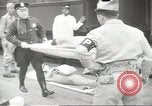
Japanese Nationals and Issei arrive by train and buses at Jersey City, New Jersey for repatriation to Japan in World War II
Opening scene shows police officer removing a sick person, on a litter from a Pennsylvania Railroad train at a station and placing them gently on a railway cart. A uniformed U.S. Army Military policeman helps them. Next, Japanese Nationals and Issei families with many small children are seen leaving a train and walking along a railway platform. A Red Cross woman in white stands behind an ambulance, where a newborn infant lies on a litter. Policeman carry two women on litters and place them in the ambulance. The newborn baby is being cradled in the arms of the Red Cross woman. A Japanese family climbs aboard a bus. Railway workers transport travelers' baggage on a large cart. Police stand near by as a U.S. Army Military policeman boards a bus filled with Japanese to be repatriated to Japan. Two MPs watch as Japanese to be repatriated climb aboard another bus. A group of Japanese men enter a bus, followed by Armed U.S. Army soldiers who also board. An official guides a train to a stopping point on a train station. A large group of men to be repatriated to Japan step from the train under guard by many armed U.S. soldiers.