


 Francais
 Deutsch
 Italiano
Refine Your Search
+"Japan" +1944 stock footage and images
- Showing 1 to 6 of 106 results more
more Hide
Hide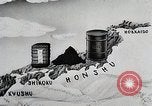
Japanese natural resources related to Second Sino-Japanese war and World War II
Animated map illustrating shortage of indigenous raw materials in Japan. As stockpiles vanish during Second Sino-Japanese war, Japan's domestic sources supply only 10% of the nation's needs for war. Animated sequence shows lack of steel, aluminum, copper, and power generation for the conduct of war. But one of the nation's greatest resources is the population of skilled Japanese workers, who are shown at various high tech jobs, as well as on the farms and in the fishing industry. Japanese workers are seen who work for the Zaibatsu (four ruling families of Japan). Banks of Japanese women typists and women in a factory. Young women painting faces on a "Kewpie doll." A Japanese family at dinner time. Women engaged in fabric spinning. Animated graphic illustrates Japan's war-related resources for World War 2, by showing a Japanese soldier standing astride map of Japan with lines extending to sources of needed raw materials from Japanese possessions in Korea, Manchuria,Formosa, China,Indochina,Malaya, and its network of Pacific Islands. Final scene displays copy of Los Angeles Times newspaper with headline reading: "Jap Supply Lines Blasted." It also features a story that appears to refer to the U.S. 6th Army invasion of Leyte in the Philippines, in October, 1944 (when General MacArthur waded ashore and stated,"I have returned"). (Note: Although produced during World War 2, this film shows prewar scenes of Japan. The animated illustrations and maps and, of course, the newspaper shown at the end, date from World War II.)
Indonesia is promised independence from Japan, at ceremony in Istana Gambir (Gambir Palace). Indonesian crowds celebrate news.
The promise of independence for Indonesia is broadcast throughout the city of Jakarta, following a ceremony at Istana Gambir, or the Gambir Palace (Merdeka Palace, Jawa Timur Jawa, Jawa Timur 65455, Indonesia). Exterior of Gambir Palace in Jakarta Indonesia. Indonesian leader Sukarno, head of the Japanese-created Poesat Tenaga Rakjat (POETERA - Concentration of People's Power) emerges from a car, climbs steps, and enters the Gambir Palace, presently known as Merdeka Palace. He stands together with other Indonesian officials. Imperial Japanese Army Lieutenant General Kumakichi Harada addresses the gathering and delivers news of Japanese Prime Minister Koiso's September 7, 1944 promise of future independence for Indonesia (the so-called Koiso Declaration). Large Japanese flag seen on the wall behind speakers. Sukarno approaches General Harada, bows and then speaks into a microphone. Scenes of jubilation in the streets of Jakarta as citizens hear the news that Japan has promised future independence for Indonesia (date undeclared). A man standing atop a truck announces the news over a megaphone. People stand near the truck, listen and cheer. A caravan of loaded trucks rolls slowly through a Jakarta neighborhood spreading the news about the promised independence. Citizens cheering and smiling. People standing at a railway station and at stopped trains hear the news and cheer. Citizens including men, women, and many children wave to the passing caravan. Sign on side of truck includes words "Bangsa Indonesia diperkenankan merdeka" meaning "Indonesia allowed Independence". Clip is from a Japanese newsreel during World War 2, with Japanese narration.
U.S. 8th Air Force operating B-17s and B-24s in Europe and B-29s against Japan in Pacific during WW2
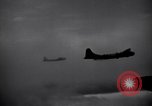
Formation of U.S. 8th Air Force B-17 bombers in flight over Germany during World War 2.Gunners firing 50 caliber machine guns from various positions in a B-17, as attacking German interceptor aircraft race past. One German aircraft is hit and pieces of it fall off. B-17 enters bombing run. View of bombardier and bomb sight image. German aircraft continue attacks and gunners continue defending as the bombardier announces "bombs away." This is a high altitude mission and all crew members are on oxygen. Glimpse of pilot and copilot in cockpit. Pilot alerts gunners to a German FW-190 aircraft attacking them. Waist gunners pause to look at a German fighter smoking, as it falls, and strikes the ground in an explosion. Sequence shifts to formation of B-24 Liberator bomber on a mission with bombs visible dropping from bomb bays. Sequence shifts again, rapidly, to a formation of B-29 Superfortress bombers dropping bombs. Nighttime view of incendiary clusters being dropped on Japan. (Note: One of the B-29s seen is serial number 42-24547, assigned to the 6th Bomb Group, 315th Bomb Wing. This B-29 crashed short of the runway on 31 Dec 1944, at Borinquen Field, Puerto Rico, where the 6th bomb Group underwent combat crew training. And the B-29s shown do not display any tail codes.)
Events of World War 2, and creation of United Nations Organization following the surrender of Germany and Japan
Summary of World War II events and formation of the United Nations Organization. Soviet troops on Eastern Front of Europe fire artillery on German positions in 1944. Russian troops advance. German soldiers come out of buildings and surrender. Allied Forces land in France on D-Day. Allied troops and tanks fight Germans on streets in towns and villages of France. U.S. Army tanks fire at German positions. Various groups of German prisoners of war march along roads and are herded into prison camps operated by American and British forces. In 1945, the Allied leaders meet at Yalta on the Crimean Peninsula to discuss Allied military strategy in the final months of WWII. Leaders included British PM Winston Churchill, U.S. President Franklin D Roosevelt and Soviet Premier Joseph Stalin. The meeting of U.S. and Soviet Russian troops at the Elbe River. German Nazi Swastika symbol blown up in explosion atop Zeppelinfeld Nazi party rally grounds in Nuremberg. Aerial view of Berlin in ruins, as seen from low-flying aircraft flying directly over the Unter den Linden boulevard and the Brandenburg Gate. Wrecked and bombed German buildings seen everywhere. German officials signing surrender instrument at Rheims. U.S. President Harry S Truman, Winston Churchill and Joseph Stalin at Potsdam Conference. U.S. Marines battling on beaches of Pacific Islands. Iconic shot of U.S. Marines raising the American flag on Mount Suribachi at Iwo Jima. Aerial view of bombed and ruined city of Tokyo, Japan. The Japanese surrender to MacArthur aboard the battleship USS Missouri. General MacArthur speaks aboard Missouri. Victory celebrations all across the world, with some scenes from earlier V-E Day (Victory in Europe) day in May 1945, including crowds celebrating in Paris, France, and some scenes on V-J Day (Victory over Japan day) in August 1945. Crowds on streets celebrate. Happy crowds jam streets. Delegates of Nations, among them Andrei Gromyko and Vyascheslav Molotov meet in San Francisco and create a United Nations organization. Truman arrives at signing of UN charter. Various delegates sign charter. U.S. troops disembark troop carrier ships at U.S. ports and are discharged after completing military service in World War 2. Group of U.S. Army soldiers exits a church (the Chapel at Fort Dix, New Jersey), waving their discharge papers in hand.
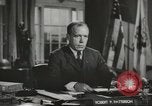
American Undersecretary of War speaks to difficulties facing Allies in confronting Germany and Japan in World War II
Undersecretary of War, Robert Porter Patterson, Sr. speaks about a report from the General staff outlining the needs for combating Germany and Japan in World War 2. He cites Operation Husky, the invasion of Sicily, as an example of what will be needed. He continues to narrate in the background as an animated map appears showing the buildup of supplies and Allied forces in North Africa; Allied air forces flying 60 thousand sorties over Sicily and, the direct amphibious assault using 3,200 vessels. Map also depicts opposing forces of 12 (“unwilling”) Italian Divisions and 3-1/2 German Divisions. View of Allied troops carrying some of their 31 thousand casualties on stretchers from field ambulances. Allied medics attending to the wounded. Some are seen lying on stretchers in a row on the ground near a wall. Interior of a field hospital where surgeons and other medical personnel treat the wounded. Animated map shifts to Europe with Germany at its center, showing , in contrast to Sicily that was only an “outpost,”, the heavily fortified perimeter of Axis controlled areas; the axis industrial might; and the disposition of 300 German Divisions (mostly on the Eastern front) defending the region. Next, the map illustrates Japan’s defended regions in the Pacific Image returns to Undersecretary Patterson i n his office, speaking of the Allied offensives planned for next year (1944), and emphasizing their challenge and difficulty. Scene shifts to General Jonathan Wainwright and his garrison at Corregidor, in the Philippines, surrendering to Japanese forces in 1941. Japanese military camera pans over the Americans being taken prisoner. Other Americans and Filipinos are seen being marched together under guard. Scene shifts to classic views of the Japanese attack on Pearl Harbor, Hawaii, on December 7, 1941. View of Japanese soldiers executing two Chinese civilians in 1937. Dangling bodies of persons hung by Nazis during Operation Barbarossa in Russia, in 1941 A Russian soldier comforts a little girl as he escorts her across a snowy landscape. Time bomb left by German forces retreating from Naples, Italy, in 1943, blows up a Post office building . Views of damage to building and bodies of victims. American Military Police assisting a victim. American soldiers carrying an injured civilian on a litter. Scene shifts to British Foreign Minister, Anthony Eden, Soviet Foreign Minister, Vyacheslav Molotov, and U.S. Secretary of State, Cordell Hull, entering a hall in the Spiridonovka Palace, during the 1943 Moscow Conference in Russia. Close-up of the American, Soviet, and British flags on a table. View of many delegates seated around the table. Close-up of Molotov, Eden, and Hull signing conference document.
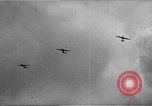
USAAF B-24 bombers drop bombs over target areas in Volcano Island and Yap island in the Pacific Theater during World War II.
U.S. bombings on islands in the Pacific Theater during World War II. Several aircraft in flight. A map showing a flight path from Volcano Island in the Philippines to Iwo Jima in Japan. On 10th August, 1944 : A United States Army air Force B-24 Liberator bomber aircraft in flight. Several B-24s in flight. The aircraft drop bombs over target areas and explosions occur. Smoke rises from the bombed areas. A map showing the flight path to Yap island. On 20th August, 1944 : A B-24 in flight drops bombs over target areas on Yap island. Smoke rises from the resultant explosions.