


 Francais
 Deutsch
 Italiano
Refine Your Search
+"Japan" +1946 stock footage and images
- Showing 1 to 6 of 317 results more
more Hide
Hide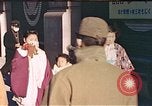
Japanese women dressed in kimonos walk along sidewalks in Tokyo, Japan on New Year Day of 1946.
Citizens and United States soldiers walk along the streets in Tokyo, Japan on New Year Day (Oshōgatsu) of 1946. Japanese women and children dressed in kimonos walk along a sidewalk. Some Japanese men and women are also seen wearing face masks. They are wearing face masks during winter influenza season. A woman wearing a surgical mask and fur coat glances at the camera as she walks by. Japanese women and children walking along the streets.
Effects of the atomic bombing of Hiroshima, Japan, in World War II, and early international efforts to control atomic weapons
Film showing city of Hiroshima, Japan, before and after the August 6, 1945 dropping of the atomic bomb over the city in World War 2. Sequence opens on what the narrator says is August 5, 1945, the day before the event (but the footage is likely from before that date). Camera pans over the city of Hiroshima before the atomic bomb destroyed the city. Japanese air raid lookouts are seen on watch for allied bombers. View of atomic bomb detonation as seen from aircraft high overhead (this is actually a view of the Nagasaki blast, not the Hiroshima blast despite narrator's comments). Next, the complete destruction of the city of Hiroshima is seen from camera at low altitude showing the four and one half square miles of the city flattened and burned. A Japanese hospital still functioning, with red cross flag on it. Hospital workers retrieving wounded victims of the bombing. Ambulatory victims clustered in doorways and halls. Shadow image of a large industrial valve wheel burned onto wall behind it. Similar image of a ladder burned onto a wall. The decorative pattern on a woman's dress burned onto skin of her back. Japanese physicians treating victims of thermal and radiation burns. Views of various victims, including some children, and their respective injuries. Scene shifts forward one year, to August 6, 1946. Children are lined up outside a school building, and then seen inside their classroom. Disfiguration and wounds on children resulting from injuries are still evident on the children at their desks. Sequence shifts again, this time to an early United Nations meeting with delegates grappling with the issue of controlling nuclear power and atomic weapons. Closeup view of American delegates, including James F. Byrnes (Secretary of State)and James B. Conant, President of Harvard University in the assembly. Closeups of representatives from South Asian nations. Closeup of USSR delegation, headed by Foreign Minister, Vyacheslav Molotov. Signs identifying delegates from Colombia, Egypt, Iraq, Bolivia, China. Final sequence shows several U.S. atomic scientists in their respective laboratories, including Enrico Fermi and Vannevar Bush. United States representative to the UN, Warren Austin, speaking about the so-called Baruch Plan, for international control of atomic weapons. (Principal author, Bernard Baruch, is standing behind speaker's left shoulder.) USSR delegation, headed by permanent representative, Andrei Gromyko, who is seen presenting the Soviet plan. View of explosion and mushroom cloud during U.S. Operation Crossroads atomic bomb test in the Pacific.
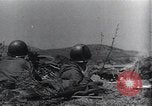
United States Army 187th Airborne Regimental Combat Team returns to Japan from Korea and is welcomed by City of Beppu, Oita
Clip opens with rapid changing scenes: American troops in trench in Korea during the Korean War. American tank on street in Germany. American Ski troops in Alaska. Amphibian assault training in Puerto Rico. Rotating Globe shows: U.S. Army on alert to defend against aggression. Sergeant Stuart introduces episdoe and states that U.S. Army has come to Japan to know their culture and make friends after war and occupation. U.S. Army troops of the 187th Airborne Regimental Combat Team, are seen arriving by railroad train at a train stateion near their base near Beppu,Oita on the island of Kyushu, Japan. U.S. Army soldiers, including white and African American soldiers, exit train cars. They receive a warm welcome from Japanese population. Banner reads:" Welcome Pala Troop comin back from Korea, City of Beppu."[sic] Women holding flowers and families with small children waving American and Japanese flags, welcome them on the train station. A sign over the train station platform reads: "Welcome 187 Para Troop Coming Back From Korea, City of Beppu." The troops stand in formation on the platform while the unit's officers receive the flowers from the women. Japanese men in fraternal uniforms and the general population all join in the welcoming ceremonies. The troops march off the train station under another sign reading: Welcome Home 187 RCT." and march down the main street of Beppu under a swirl of paper confetti. Next scenes are from autumn of 1945, as U.S. soldiers march through streets of Japan during occupation following the end of World War 2. U.S. troops seen marching behind Japanese police to occupy Japan, in 1945, amidst the aftermath of suffering and destruction of the war. The local population standing at road sides and watching with worry and concern. Scenes of postwar destruction in Japan. Rubble of bombed buildings. Scene of simple wooden dwelling shacks and wreckage nearby. A Japanese boy with his baby brother on his back. The baby is crying. Next scene moves again to circa 1950 in streets of a Japanese city, possibly Tokyo, rebuilt and with busy scenes of traffic on streets and commerce. Large outdoor rally with a Communist speaker addressing large crowd of Japanese people who sit and listen. Scenes from a what the narrator describes as a Communist rally in Japan, against America, which turns violent. Protestors running in streets during demonstration, with signboards and police and fire fighters extinguish flames at scene of an overturned, burning car. Flashback again to 1945 or 1946 as U.S. Army soldiers use tractors and heavy equipment to clear and level an area of war rubble and debris during rebuilding efforts after World War 2. Japanese citizens look on, watching the machines at work.
United States B-29 bombers drop incendiary bombs over Kobe, Japan
"Kobe strike" shows United States B-29 bomber aicraft dropping 3200 tons of incendiary bombs over industrial targets in Kobe, Japan during World War 2. Firebombing causes pillars of smoke to rise up. Narrator speaks of strikes on other Japanese cities also and relates statement by General Arnold that beginning July 1945, industrial Japan will be hit by bombs at the rate of 2 million tons per year, or 5480 tons per day, adding that "by the end of 1946, Japan will have ceased to exist as a bombing target."
Views of the United States. Farms, cities, highways, and beaches. Destruction in Japan by atomic bomb. U.S. infantry in combat
Farmers harvesting grain and corn with machinery on American farms with a narrow tractor harvester. Steel mills and heavy industry and cargo railroads in the United States. Industrial views with smokestacks releasing much smoke and smog (also pollution scenes). Scenes of New York City with busy streets filled with cars, buses, and truck traffic, together with pedestrians. Many varied 1940s and 1950s cars on the roads. Elevated and also aerial views of U.S. highway networks busy with 1940s and 1950s cars. Views of Jones Beach, on Long Island, New York. Scenes of destruction in Japan from the atomic bomb, with sweeping views of destroyed city in Hiroshima or Nagasaki circa 1945 or 1946. U.S. Army infantrymen engaged in house-to-house fighting in Europe during World War II, firing rifles and moving between points of cover in a city filled with rubble.
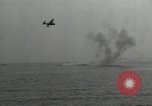
Submarines of the Japanese fleet, being sunk during Operation Road's End, after World War II
Operation Road's End. Japanese submarines being sunk after World War II. A U.S. Navy Martin PBM Mariner flying boat circles over several Imperial Japanese submarines as they are being scuttled and/or sunk by gunfire on April 1, 1946, off the Goto Islands, of Japan. Smoke drifts over the water from charges ignited aboard a sub. One of the submarines explodes raising a surge of water and huge black cloud. Clear view of a U.S. Baltimore class Cruiser with two scout planes aboard. Sailors watch from the U.S. Destroyer, USS Everett F. Larson (DD-830) as a submarine slips below the surface. Another submarine explodes and sinks. Gunfire from the Larson strikes another submarine. Smoke from the Larson's guns drifts in front of the camera. Closeup of the Larson's forward 5-inch guns, turned to starboard, firing.