


 Francais
 Deutsch
 Italiano
Refine Your Search
+"Korea" +1953 stock footage and images
- Showing 31 to 36 of 133 results more
more Hide
Hide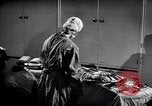
U.S Army Medical Service in Korea. Injured U.S. soldiers evacuated to the United States during the Korean War.
Scenes inside U.S. Army hospital in Japan. Surgeons scrub hand and arms at sinks before surgery. Surgeons prepare for operation on patient. Patients are moved about and treated. Nurse tending bedridden patient. Several soldiers seen leaving to return to duty in Korea. Others are transported to Haneda Air Base, near Tokyo, where the Military Air Transport Command operates long range aircraft in the so-called "Pacific Air Shuttle." A wounded soldier is taken from an ambulance and placed aboard a transport aircraft. Interior of aircraft is shown, with stretchers, medical workers and nurses. Aerial view of Honolulu, Hawaii from aircraft. The aircraft lands at Hawaii where wounded are cared for at Tripler Army Hospital until ready to continue journey to Travis Air Force Base in California. View from cockpit of aircraft landing at Travis Air Force Base. Wounded patients being moved through rear cargo doors of C-97 aircraft. Exterior view of fountains and main entrance at Walter Reed U.S. Army General Hospital in Washington, DC. Captain Zimmerman introduces Lt. Col. S.J. Newsome, who was a surgeon in Korea with the 7th Division. Dr. Newsome emphasizes "speed" as the most important factor in recovery of wounded soldiers. He also mentions the problem of disease affecting soldiers in foreign places like Korea, saying that, "Korea is a disease ridden country" with cases of pnemonia, smallpox, and "orgental diseases we had never seen before." Scenes of Army doctors performing medical examinations on soldier patients. Wounded being placed aboard jeep in Korean War. Soldier firing rifle. Soldiers slogging through mud and water. Soldiers firing artillery in the snow, and evacuating wounded on inflated litter in snow. Combat in jungle. View of civilian people wasing at side of river in India. Civilian dead in streets.

U.S. forces target enemy strong points with artillery and aircraft attacks in Korea.
U.S. troops attack enemy strong points in Korea. Planes drop napalm bombs over Red strong points on hill sides. U.S. Aircraft and artillery target Red bunkers. Infantrymen charge with flame throwers in hand. Flames from the napalm bombs fire spread rapidly. A smoke screen to help the ground troops advance.

UN air and ground forces advance and target Red installations in Korea during the Korean War.
UN air and ground forces advance in Korea. Black smoke from explosion on hills. UN planes in flight over Korean hills. Planes drop combs over enemy North Korean installations. Machine gun fire from an aircraft. An enemy MiG fighter aircraft is hit and downed by a UN plane. The hit plane goes out of control and descends to the ground.
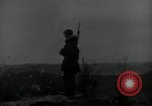
U.S. troops in Korea sing Christmas carols in combat zone
United States Army sentry stands guard and keeps lookout with binoculars, in Korea. While he keeps watch, his comrades gather around a camp fire and sing Christmas carols. (Korean War)
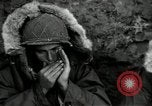
United States soldiers in Korea battle zone try to take some time off for Christmas
While their armed sentries keep a vigilant watch, United States soldiers in Korea, take some time off at Christmastime. A soldier plays harmonica. Another reads a book. African American soldier writes a letter. Other soldiers play cards, and some sing Christmas Carols. They wear warm jackets. Soldiers going to chapel for Christmas Service. They come out and shake hands with the Chaplain.
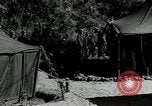
United States soldiers, in Korea, are interviewed and pass Christmas greetings to their families at home.
Christmas Dinner in Korea with "A" Company of the 31st Infantry Regiment, 7th Infantry Division. Members of the Company are in a "Chow line" in their mess tent, as food service soldiers fill their mess trays with Christmas dinner. U.S. Army Cpl Bill Cunningham interviews several of them and gives them opportunity to record Christmas messages to their loved ones at home. He asks them their names, and where they come from and their messages to their family. He interviews Major General Lionel McGarr, the Commanding General of the 7th Infantry Division. Soldiers identified include: PFC Lewis from Massachusetts, Sgt Wiggens from Cambridge Idaho, Cpl Lewis Wells from Indiana, and General McGarr.