


 Francais
 Deutsch
 Italiano
Refine Your Search
+"Linz Austria" +1945 stock footage and images
- Showing 1 to 6 of 9 results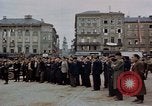
German forces depart Linz, Austria, at the end of World War II
Opening scene shows local citizens as they stand in the main square (Hauptplatz) of Linz, Austria, watching surrendered German troops depart at the end of world War 2. The troops climb over barriers at the base of the Trinity Column (Dreifaltigkeitssäule) and march in loose formation out of the city. A group of American troops watch from atop an M10 tank destroyer. View through a building archway as the German soldiers march past. The long column continues along a road looking down on the Danube River. Another view shows two U.S. soldiers with slinged rifles strolling at the head of the column. The departing German soldiers are all disarmed and carry their personal kit and gear. A group of German officers pass the camera, and one takes particular notice of the filming. A Sherman tank passes going in the opposite direction. A civilian man, carrying a brief case walks past the departing troops. (Note: Today, the Trinity Column looks different than in this film. In 1943 all removable statues and parts were taken from the column and safely stored in central cellars on Kapuzinerstrasse. They were recovered in 1945 and restored to the column, along with other changes, that were completed in December, 1947.)
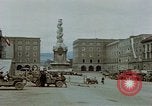
German prisoners of war being assembled in Linz, Austria, near end of World War II in Europe.
German prisoners of war arrive at the town square or Hauptplatz (Hauptpl., 4020 Linz, Austria) in Linz, Austria during last few days of World War II. View of Dreifaltigkeitssäule or the Holy Trinity Column (Dreifaltigkeitssäule, Hauptplatz, 4020 Linz, Austria). Trucks bring more prisoners into the town. The prisoners climb off the trucks and stand in the town square. Trucks loaded with prisoners drive past on a road in the foreground. The prisoners unload from the trucks.
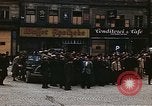
U.S. troops occupy the Town of Linz, Austria, at the end of World War II, in Europe.
End of World War II in Europe. German prisoners of war are held under guard at the base of the Trinity Column in the Town Square of Linz, Austria. American M4 Sherman tanks loaded with U.S. Army soldiers cross the "Niebelungen" Bridge as they enter the town.

Rescued inmates talks about their experiences at concentration camp # 3 in Linz, Austria towards the end of World War II.
Rescued inmates of the concentration camp # 3 talk about their experiences in Linz, Austria towards the end of World War II. The rescued assembled outside a wooden house. Those who were inside the house look outside through a window. The inmates are emaciated. An Italian talks about the adverse living conditions they faced at the concentration camp. He states that they had very little food, they slept 3 or 4 to a bed and there was no way to wash. He said he was also at Mauthausen for a time before being transferred. In total he had been in concentration camps for 8 months and considered himself very lucky to have lived. He said that in Linz there were 50 men in his quarters and each day 3 to 4 men died. He tells how he worked in a forced labor factory in Linz building tanks for the Germans, working 12 hours a day as a welder.
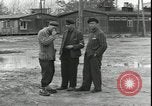
Inmates at concentration camp #3 in Linz, Austria discuss their experiences while held prisoners by the Germans in World War 2
Near the end of World War II, three freed inmates at a German concentration camp in Linz Austria (camp #3) discuss their treatment while at the camp. They speak in English but with varying accents including French. They speak in an open yard of the camp, with barracks in the background. The former inmates talk about lethal injections, cold baths, whippings, hangings, and extermination camps. They also talk about the joy when the camp was liberated by the Americans, which was preceded by the Americans bombing the Nazi forces in the area. They mention that the bombing cut off the water to the camp so the SS forces could no longer subject inmates to the cold baths. They discuss hangings of three prisoners from a scaffold in the yard behind them, and how all the camp inmates were assembled and forced to look at the hung inmates. One of the freed inmates talking is named Alex. They discuss how the jews in the camp had been rounded up and locked in a room with no food. They were in the room two days before being saved by the Americans. They also talk about the camp at Mauthausen where prisoners were subjected to hard labor, torture with heavy rocks, and executed by the SS after 5 days. Also they speak of inmates put in chains and dogs used at Mauthausen.
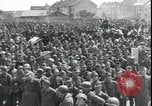
Hungarian Lieutenant General Vitéz Kassai Farkas László talks to a U.S. Army officer in Linz, Austria (WW2)
Hungarian Lieutenant General Vitéz Kassai Farkas László accompanied by his staff, talks to an officer of the U.S. Army in Linz, Austria towards the end of World War II. An American officer orders his sergeant (interpreter) to ask the Hungarian General for his correct name and rank. The sergeant translates the officer's question into Hungarian . He answers with his name, Vitéz Kassai Farkas László, and rank: Lieutenant General. The officer asks him more questions about his men and about the Nazi Germans. The sergeant translates the questions and their responses for both men. The General smokes a cigarette. The sergeant also smokes a cigarette. The officer states that the American Army will not take the General's men prisoner, and will help them to return back to their country. The General stands on the bonnet of a jeep for a thanks giving speech. He thanks the U.S. Army for their humane treatment. His men also join him and cheer the news from their General about the Americans' statement.