


 Francais
 Deutsch
 Italiano

Refine Your Search
+"Luzon Philippines" +1945 stock footage and images
- Showing 49 to 54 of 54 results more
 Hide

American Forces led by General MacArthur land at the Lingayen Gulf and advance to Manila, Philippines during World War II.
The United States campaign against the Japanese in Luzon, Philippines during World War II. An Allied convoy of ships underway in the Pacific Ocean towards the Lingayen Gulf. Naval guns fire at the coast and at Japanese airplanes. U.S. Army Generals Walter Kruger and Douglas MacArthur keep a watch over the convoy of ships. General MacArthur and other officers come ashore at the Lingayen Gulf. Troops unload equipment at a beach. Infantrymen advance inland. The Filipinos greet the soldiers as they advance towards Manila. The soldiers with the Filipinos. People cheer as the American soldiers enter Manila. Animated map of the Philippines depicts the location of the Lingayen Gulf and the advance of American soldiers from the Lingayen Gulf to Manila.
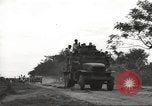
U.S. POWs, rescued from a Japanese prison camp, en route to American lines and an evacuation hospital in Nueva Ecija, Philippines (WW2)
United States prisoners of war, rescued from Cabanatuan Prison Camp by 6th Battalion Rangers, Alamo Scouts, and Filipino guerrillas in Luzon, Philippines, during World War II. The liberated prisoners aboard trucks and Jeeps en route to U.S. lines and the 92nd Evacuation Hospital. Trees and houses along the sides of a road in Guimba, Nueva Ecija. Soldiers and medics seated along with the former prisoners.
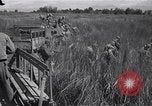
U.S. Army Rangers, Alamo Scouts, and Filipino Guerrillas rescue Allied POWs from Japanese Cabanatuan World War II prison camp
Scenes from the successful World War 2 Mission that rescued more than 500 Allied prisoners of war from the Japanese prison camp near Cabanatuan, Luzon, the Philippines. U.S. soldiers of the 6th Ranger Battalion are seen as they leave their transport trucks, check their weapons and commence their 30 mile trek to the camp. They start down a dusty trail. In view from a hill, above, they are seen fording some streams,. One Ranger looks up and waves his hat at the camera, but all the others keep moving without distraction. The scene shifts to the next day, after the successful rescue of the prisoners. Alamo Scouts, Filipino Guerrillas, and U.S. Rangers mingle with rescued prisoners. Some of the rescued sit in carabao carts provided by local villagers. Former prisoners are interviewed by Rangers, who make notes of their accounts. Several Army ambulances are parked at the site. Some Filipino women and children are seen, around the edge of the gathering. A Ranger helps one former POW to a carabao cart. During all this post-mission activity, beginning at TC: 02:28, the mission commander, Colonel Henry Andrews Mucci, is seen debriefing others around him, and referring to a map and gesturing with a pen, as he does so. He has a growth of beard and mustache, and wears a "booney" hat. View of rescued prisoners resting near a large haystack. A medic seen in midst of others, some of whom sit in carabao carts.

Soldiers in DUKWs slide down ramps of LSTs and wade towards beach during Philippine invasion of Lingayen Gulf (WW2)
United States soldiers advance during Philippine invasion of Lingayen, Luzon during World War II. A soldier sitting at a camp watch with binoculars. A U.S. Army Landing Ship Tank (LST) stationed near a beach with its doors open. Soldiers in DUKWs slide down its ramp into sea water and move towards the beach. A soldier talks to enlisted natives. A tank bulldozer drives out of the LST and pushes sand to make a ramp. DUKWs driven on sandy beaches and other military equipment is offloaded from LSTs. A convoy of DUKWs driven on the sandy beach.
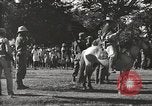
U.S. Rangers, Alamo Scouts, and Filipino guerrillas, on mission to rescue POWs from Japanese prison camp in World War II
Soldiers of U.S. Army 6th Ranger Battalion, Alamo Scouts, and Filipino guerrillas setting out on a mission to rescue American prisoners of war from a prison camp behind Japanese lines, at Kabanatuan (Cabanatuan) in the Philippines, during World War 2. They move out on foot and ford a stream on their way.

A U.S. General decorates the American nurses who served prisoners in Bataan, Philippines.
The American nurses who served prisoners in Bataan, Philippines. The nurses stand in a line. U.S. Generals talk to them. A General gives them cards. The nurses cheer and look at the cards. A General awards the nurses. They all board a plane. (World War II period).