


 Francais
 Deutsch
 Italiano
Refine Your Search
+"Malmedy Belgium" +1944 stock footage and images
- Showing 1 to 6 of 6 results
German view of the beginning of the the Battle of the Bulge in World War II
Beginning of the German counterattack into Belgium, during winter of 1944-45 of World War 2. Opening scenes show German artillery barrages by Grille (Cricket) self-propelled artillery firing 15 cm sIG 33 infantry guns. This is the beginning of German Field Marshal Gerd von Rundstedt's Ardennes Counteroffensive (aka the Battle of the Bulge) in December, 1944. German soldiers riding on Jagdpanzer IV tank destroyer moving forward in Ligneuville, South of Malmedy, Belgium. German infantry walk past a knocked out tank on their way toward the front, where smoke rises ahead. They pass burning American armor and vehicles destroyed by the German Luftwaffe (Air Force). Sounds of artillery fire are heard. Closeup of one soldier carrying an MP44 7.92 x 33 mm (7.92 Kurz) caliber assault rifle. The German infantry move along a ditch parallel to a burning column of U.S. armor and vehicles on the road, where it was wiped out by German aircraft. A United States 3" anti-tank gun abandoned at the roadside. German soldiers retrieve American cigarettes from a knocked out U.S. tank, and share them. At TC:02:00 the German gunner with a belt of ammunition around his neck, is Hans Tragarsky aka Walter Armbrusch, a soldier in the Kampfgruppe Hansen battle group formed during the Battle of the Bulge from SS-Panzergrenadierdivision Regiment 2, an infantry regiment of SS Pz Rgt 2 "Das Reich". (His image is well known but his identity is subject to debate.) German troops relax as they smoke cigarettes. A group of German soldiers sharing cigarettes, atop a Stug III tank destroyer. A German army Type 82 Volkswagen Kübelwagen drives past detritus of combat, near a village church. Glimpse of damage in City of Antwerp from a German rocket.
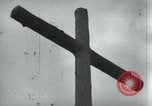
The initial World War II Memorial at Baugnez, Malmedy, Belgium 1945, honoring U.S. POWs executed there by German forces.
The first memorial erected to commemorate U.S.prisoners of war executed by the Nazis during the battle of the bulge (mostly elements of the American 285th Field Artillery Observation Battalion (FAOB), executed by the Kampfgruppe Peiper (part of the 1st SS Panzer Division). This was also known as the Massacre at Baugnez, or the Malmedy Massacre. A wooden cross and a sign reading 'USA - Belgium. To the prisoners of war of overseas who liberated the East districts and were the victims of Nazis cruelty." The wooden cross at the monument to commemorate the massacre of 115 American prisoners at Baugnez on December 17th 1944 during the Battle of Bulge, in World War 2.
German prisoner, Otto Richard Struller, is transferred by jeep from Béverce near Malmedy, Belgium during World War II.
A U.S. Military policeman leans against his jeep in front of a small building in Béverce near Malmedy, Belgium during World War 2. Two German prisoners emerge from the building escorted by an armed American soldier. A military photographer passes to the left, in front of them, as two American military policemen escort another German prisoner (Otto Richard Struller) from the building. They each hold one of his arms. The prisoner is bareheaded. They pause and pose for a photographer (unseen). Closeup of the prisoner with MPs at his sides. Camera zooms in on prisoner, Struller. The MPs direct him to a waiting jeep. They all get in and drive away. Closeup of the jeep passing the camera. It drives away along a muddy road, past an overturned vehicle. (Note: The principal prisoner in this film, is Otto Richard Struller, a ballet dancer, who during the war served as a corporal with Panzerbrigade 150 unit Stielau/Stab solar, where he masqueraded as an American soldier behind the lines. He was executed, as a spy, on January 13, 1945 at the Palace of Justice in Huy, Belgium)
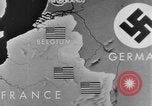
Burial of U.S. POW and Belgian civilians massacred by German troops in Malmedy; Battle of the Bulge scenes, Belgium (WW2)
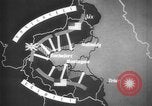
German troops of KG Peiper advance in Malmedy, Belgium during World War II. A map points out Belgium, Germany and France. Camouflaged German StuG III Assault Guns advance. Flamethrowers used. German soldiers fire at American positions and bombard. German soldiers pass by a U.S. Army motor convoy in flames near Malmedy. The United States Army soldier prisoners of war in the town under German guard. Red Cross personnel examine the bound bodies of U.S. POW that were found and, separately, of Belgian civilians massacred by the German troops near Malmedy (the so called Malmedy Massacre). The dead are buried in a common grave. Wrecked houses and buildings. News headline reads, "3rd Army deep in Germany." Fire blazing in supply depots left by the retreating United States forces. U.S. artillery and antiaircraft guns fired point blank at the advancing German tanks. The U.S. tank guns and machine guns fire over the snow covered battlefield. Smoke arises from firing. U.S. Army Air Force aicraft and German Luftwaffe aircraft engage in aerial dogfight combat. Contrails across sky. U.S. soldiers in snow covered forest of trees in Battle of the Bulge. General Eisenhower visits troops at the front. News headlines about Russians smashing German lines and 40 Japanese ships sunk. Views of dead U.S. soldiers on Belgian battlefield.
U.S. C-47s drop supplies to troops at Bastogne. General Taylor congratulates General McAuliffe for his defense of Bastogne
Map shows Allied army drives toward Germany in World War 2, and Battle of the bulge counter attack by Germans. Smoke rising from ruins. An American Army engineer douses a fire. In the ruins of Malmedy, Belgium, a sign reads: "Tower Room Malamedy, Protestant Church." Map shows Bastogne. Some of 400 C-47 transport aircraft resupply flights are seen in the air after weather clears. They airdrop food and ammunition to U.S Army troops who had been holding their position and preventing Germans from overtaking in the snow at Bastogne. U.S. gliders, that brought medical assistance, are seen on the snow-covered ground. Aerial view snow covered town. View of food bundles and supplies. Elements of General Patton's 3rd Army arriving to break through German lines and reach the embattled 101st Airborne at Bastogne. Dead and captured German soldier prisoners of war (POW). Destroyed tanks and equipment. Later (January, 1945) Commander of the 101st Airborne Division, Major General Maxwell Davenport Taylor congratulates Brigadier General Anthony McAuliffe for his defense of Bastogne. American troops in Bastogne find time to rest up and smile for the camera after enduring difficult battle.

Battle of Malmedy during World War II
Trucks carrying U.S. troops of the 30th Infantry Division arrive in snow-covered woods, where they begin preparing 50 caliber machine gun ammunition and setting up defenses. A 90mm gun manned by the 143rd Antiaircraft gun Battalion in position to command a road. U.S. jeep moves along a muddy road past other positions where such guns are set up. Scene shifts to the town of Malmedy, where U.S. Army engineers mine bridges with 800 pound TNT charges. View of American soldiers standing on a bridge next to the explosives. Some civilian women run past several U.S. soldiers. A German Army corporal is seen who was wearing an American uniform, insignia, identification and dogtags, when captured. He is driven away in a jeep by U.S. Military Police.