


 Francais
 Deutsch
 Italiano
Refine Your Search
+"Manila Philippines" +1944 stock footage and images
- Showing 7 to 12 of 12 results
United States planes attack on airfields and ships in Manila, Philippines during World War II.
A strafing attack on airfields and ships by U.S. planes in Manila, Philippines during World War II. A strafing attack on a Japanese Destroyer (DD) underway at a high speed . Strafing of a Japanese Twin Engine Bomber parked near an airstrip. Strafing of parked Japanese planes. Grasslands seen.

The Philippines gains independence from the United States on July 4, 1946; also scenes from 1941 Japanese invasion WW2
The Philippines are established as an independent nation. Crowds of Filipinos gathered at Rizal Park (Luneta Park) in Manila on the July 4, 1946. View of Independence Grandstand (a temporary structure built in front of the Rizal Monument) with American flag and Philippine flags on tall flag poles.. View looking down on General Douglas MacArthur at a podium, speaking into microphones. Camera pans over various segments of the audience. A map shows the Philippine Islands in context of its neighbors in the Pacific Ocean. Camera pans closeup across faces of many Filipinos gathered at the independence event. View of the Jones Bridge over the Pasig River in downtown Manila. Heacock’s Department Store on the Escolta. The Legislative Building. (later the National Museum of the Philippines). Ocean going ships in a harbor. Cargo being offloaded from a ship onto smaller boat. An industrial complex with eight tall smoke stacks emitting smoke. Steel and petroleum plants. Filipino workers in an assembly plant. The Legislative building with people coming and going. Air raid sirens sounding and people running in streets of Manila at onset of Japanese invasion of the Philippines in December, 1941, at start of World War 2, in the Pacific. People running across the Jones Bridge, seeking shelter. Others boarding a bus. Smoke rising from Japanese bombing. Glimpse of Japanese tanks entering Manila during attack and invasion. Japanese infantry climbing a hill. Bodies of persons killed during the Japanese invasion. Glimpse of Japanese troops occupying Corregidor. U.S. General Wainwright negotiating the surrender of Corregidor with Japanese General Homma. View of an American warship firing during the U.S. campaign to defeat the Japanese on islands in the Pacific. An American landing ship carrying U.S. troops who storm ashore. General Douglas MacArthur striding ashore with a retinue of officers, at Leyte, Philippines, on October 20, 1944. as he keeps his promise to return to the Philippines. Views, back again, to MacArthur speaking at the Independence Day ceremony in Manila on July 4, 1946. Also seen at the ceremony are: U.S. Senator Millard Tydings, (co-sponsor of the 1934 Tydings–McDuffie Act, which provided independence to the Philippines after a 10-year transition under a limited autonomy), and Paul V. McNutt, U.S. High Commissioner of the Philippines, who read President Truman's proclamation of Philippine Independence to the assembly. Camera pans over the gathering which includes many U.S. Service personnel in uniform. The oath of office is administered to the elected President of the Philippines, Manuel Roxas. At the conclusion, the American flag is lowered by Paul McNutt, as President Roxas raises that of the Republic of the Philippines. A celebratory parade in Manila includes a float with signs reading: "Let's Produce and Rebuild," among other things. Other floats represent "Mountain Province," and "The City of Manila," "The University of the Philippines," and "The Division of City Schools." One float, sponsored by the Chamber of Commerce, contains a huge replica machine gear, and models of an aircraft and a ship. It's message is about turning the gear that helps make the nation great. American and Filipino soldiers march, carrying their respective national flags. A white-helmeted military band plays for the marchers. Final scene shows large loose formation of military aircraft in flight very high above the Independence Grandstand, at Rizal Park.
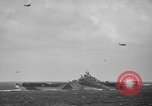
U.S. Navy aircraft from the USS Wasp engage Japanese aircraft and strafe ground installations in World War II
Aerial view of the U.S. Navy Aircraft carrier, USS Wasp (CV-18) painted in camouflage Measure 33, Design 10a paint, underway in Manila Bay, during World War 2. Close view of an F6F Hellcat of Navy Squadron VF-14 taking off from the Wasp, followed by a TBF/TBM Avenger of VT-14. Formation of TBFs passing overhead and then over coast of Japanese-held territory. A Japanese airplane with smoke streaming behind. A Japanese airplane being attacked from behind and hit by gunfire (probably from an F6F). View from U.S. Navy aircraft strafing Japanese ground targets.
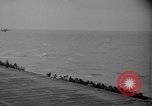
A FM2 Wildcat aircraft hits another plane and tumbles into ocean while attempting to land on the deck of a Light Aircraft Carrier (CVL) in Manila Bay during World War II
USS Ticonderoga (CV-14) painted in camouflage measure 33 design 10a, underway in Manila Bay, Philippines, during World War 2. United States Navy TBF Avenger torpedo bombers circle above the USS Ticonderoga. An SB2C Helldiver lands on the deck of USS Enterprise (CV-6). An FM-2 Wildcat attempts to land on a CVL, overshoots, and hits an FM-2 parked on the forward flight deck. It shears off a wing of the parked plane, and tumbles into the ocean.
A U.S. Navy F6F Hellcat makes gear-up landing on the deck of USS Essex underway in Manila Bay, Philippines, during World War 2.
USS Essex (CV-9) underway in Manila Bay, Philippines during World War 2. F6F Hellcat of VF-9 flies past the Essex at low altitude for a gear check. Its landing gear is malfunctioning and can't be extended. The pilot is cleared to make a gear-up landing on the carrier. Next he is seen making a well-controlled touchdown near the beginning of the flight deck. Then the aircraft slides along the deck almost halfway, veering slightly to the right as it comes to a halt. It appears relatively undamaged except for a bent prop (and surely some underside damage). Deck crewmen rush to assist the pilot and bring fire extinguishers to bear on areas around the hot engine. An F4F, taking off during the emergency, veers off the side of the flight deck, but manages to continue safely. Meanwhile, deck crews continue to assist the pilot and safely secure the accident site.The pilot, apparently unhurt, is escorted as he walks away from the airplane.
U.S. Navy TBF Avenger gunner from USS Essex is buried at sea with his aircraft during World War II
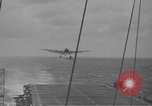
A Grumman TBF avenger torpedo bomber of VT-15 Torpedo Air Group, approaches and lands on the deck of the USS Essex (CV-9) during the Battle of Manila Bay, in World War 2. Upon landing, Lt. Robert Cosgrove (Pilot) and Sailor Digby Denzek (Radioman) can be seen in their respective forward and middle crew positions. But the rear gunner position, occupied by Aviation Machinist Mate 2nd Class, Loyce Edward Deen (Gunner), has been completely destroyed by Japanese enemy 40mm shell fire, and AMM2C Loyce Deen is dead. As the aircraft is parked among others, with wings folded up, U.S. Navy sailors of the USS Essex take fingerprints and cut dog tags from the body of AMM2C Deen in the gunner position. Captain Carlos W. Wieber, Commanding Officer of the Essex, and her crew, participate in funeral services on the deck. A chaplain conducts the services from beside the aircraft, where Loyce Deen's remains in the gunner's position have been shrouded. Closeup of Rear Admiral Frederick C. Sherman during the service of burial at sea. A bugler plays taps. Beside the bugler is David L. McDonald, who was XO of the USS Essex (and later Chief of Naval Operations in the 1960s). Deen's remains are then buried at sea in the TBF avenger in which he died. The aircraft floats off the fantail for a short time before sinking from view. Two TBF Avengers are seen flying overhead, in tribute. Crew members then disband and return to their duties.