


 Francais
 Deutsch
 Italiano

Refine Your Search
+"Manila Philippines" +1945 stock footage and images
- Showing 73 to 78 of 112 results more
 Hide
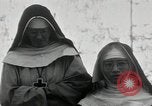
Roman Catholic nun Sister Helena expresses her relief after the Liberation of Manila from Japanese forces (WW2)
Sister Helena, a Chinese nun of the Roman Catholic Order of St Anne from Hankow, China (Shashi, Hubei, China) expresses her relief at the World War II coming to an end in Manila, Philippines. Standing beside her is interpreter Sister Ursula Mary. She speaks about her gratitude to the American forces and their experience living under a concentration camp in Manila in her mother tongue.

Civilian internee prisoners at a Civilian internment camp in University of Santo Tomas, Manila
Men women and children at a Civilian internment camp during occupation by Japan. Picnic party on camp grounds at University of Santo Tomas, Manila, Philippines. People indulge themselves in various activities like talking and reading books. Children play on the ground. A nun conducts school for small children.

Civilian internees work in a vegetable garden at a Civilian internment camp in University of Santo Tomas, Manila
Civilian internees from Allied countries including Americans, work in a vegetable garden at a Civilian internment camp operated by occupying Japan, at the University of Santo Tomas, Manila, Philippines, during World War 2. Sign says “Vegetable garden”. Various vegetables growing in a garden. A female internee planting seeds on soil. A woman picking from vines. Two men sitting in front of crops. A man and a woman walking together. Men and women use shovels to dig up soil. A man waters trays of seedlings. Several internees buy vegetables in market. Vegetables such as turnips, radishes, potatoes and other root crops on sale. Internees selling vegetables inside camp market. Children looking at vegetables for sale. Women picking leaves. A man distributes packages.

Civilian internees play games and use playground at a Japanese internment camp at the University of Santo Tomas, Manila.
Civilian internees including Americans play volleyball and basketball at a Japanese internment camp at the University of Santo Tomas, Manila, Philippines during World War 2. Several women internees sit on chairs while they watch other internees play. Children play in groups. A group of boys playing American football. Children playing on slides and swings and playground equipment.

Japanese delegation meets with members of General MacArthur's staff to plan formal Japanese Surrender ending World War II
Japanese officials arrive to coordinate arrangements for a formal Japanese surrender, at a Conference in Manila, Philippine Islands. Headed by Lt. Gen. Torashiro Kawabe, Vice-Chief of the Army General Staff, the sixteen-member Japanese delegation descends steps from U.S. Army Air Forces C-54 transport Aircraft, tail number 44-9045, at Nichols Field, near Manila. General Kawabe salutes American Colonel Mashbir, coordinator of the Allied translator and interrogator Section. Major General Charles Willoughby, Director of Intelligence, leads them to waiting cars. Meeting in the City Hall in Manila, the Japanese officers surrender their personal swords and present documents delegating them powers Plenipotentiary by the Japanese Government. They file into a conference room, where they and American counterparts take their places across a long, black table. U.S. Army Lieutenant General Richard Kerens Sutherland, General MacArthur's Chief of Staff, presides over the discussions, accompanied by Major General S. J. Chamberlin, General MacArthur's Operations Officer. They are supported by Allied translators and interpreters. The conference is concluded successfully and sets the stage for the final formal surrender of Japan. (Note: Plans for this critical conference were developed by Colonel David Larr, Chief of Planning on General Chamberlin's staff.) The clip concludes with views of many U.S. warships and of cargoes being loaded in readiness for the occupation of Japan.
U.S. 8th and 5th Cavalry Regiment troops entering outskirts of Manila. Officers refer to map on the street
United States 8th Cavalry and 5th Cavalry Regiment troops enter Manila, Philippine Islands during World War II. 8th Cavalry Regiment troops file past dead Japanese lying in a street. Major General Verne D. Mudge, commander, U.S. 1st Cavalry Division, and Regimental officers study a map at a street intersection.