


 Francais
 Deutsch
 Italiano
Refine Your Search
+"Mariana Islands" +1944 stock footage and images
- Showing 1 to 6 of 370 results more
more Hide
Hide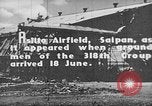
Aslito Airfield as it appeared when ground men of the 318th Fighter Squadron arrived on 18th June, 1944, Saipan Island.
The Pacific Campaign of World War II on the Island of Saipan, Mariana Islands. Aslito Airfield as it appeared when ground crews of the 318th Group arrived on 18th June, 1944. A U.S. Marine as he walks around inspecting the dead bodies of Japanese soldiers. Japanese mess kit showing spilled rice. Several dead Japanese soldiers lying around in the area. Destroyed Japanese aircraft with "NTP-1" written on tail. Demolished hangars and buildings. Fuel drop tanks lying around in the area. Surrounding installations showing the buildings that have been bombed or completely demolished. 804th Aviation Engineers at work clearing the area for camp site using heavy duty equipment such as bulldozers, graders, cranes, and half tracks. Damaged Japanese hangar.
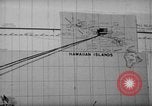
U.S. convoy of freighters, aircraft carriers, and LSTs, reaching Saipan Island, Mariana Islands in World War II
The Pacific Campaign on the Island of Saipan, Mariana Islands during World War 2. Map titled 'Mariana Islands' showing the location of U.S. carrier convoy. Map showing the location of LSTs (Landing Ship, Tank). Map with heading '804th Aviation Engineers in Saipan'. Map and sea route marked from Hawaii past Johnson Island showing location of transport convoy, June 17, 1944. Convoy at sea showing men aboard the ships looking down at the water. Convoy showing the various types of vessels in the convoy, mostly freighters. Continuation of maps with sea markings of the route of the convoy showing the location of Kwajalein Islands and location of Eniwetok. Carriers underway showing planes aboard the carriers. Personnel on look out, aircraft spotters and others. Huge geyser of water erupting near a freighter. Convoy off the coast of Saipan showing a huge geyser of water going up. LSTs and freighters at anchor off the coast of Saipan. Personnel aboard LST as they move in towards the shore. Gun flashes can be seen ashore. Unloading operation showing the LST pulling into shore, the door falls down into the water and a half track pulls out and moves into the shore loaded with men and equipment. Trucks, jeeps and all types of equipment moving across the water in toward shore. Men walking ashore.
B-29 , tail number 42-224802 on Guam, Mariana Islands during World War II.
Camera pans across North airfield on Guam, Mariana Islands, in World War 2. Next a large group of Airmen are seen standing around a shiny B-29 bomber parked on the ramp. It has "K333" stenciled on left side of its forward fuselage. Its tail number is 42-224802. (This B-29 is named "Purple Shaft," but that is not stenciled on its left side.) The airmen walk around and examine it. Next, The aircraft commander, Lieutenant Warren Richard Aylsworth is seen speaking with a Captain, as they stand next to the plane. Others join in the conversation. (Note: The plane is scheduled to fly to Tinian this night, the 20th, but will land at Saipan, instead, because runway lights were not yet operational on Tinian. The "Purple Shaft" will be the first B-29 to arrive at Tinian, the following day, December 21, 1944.)
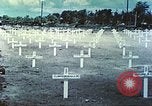
A U.S. Marine walks past 2nd Marine Division Cemetery in Saipan, Mariana Islands.
A U.S. Marine cemetery in Saipan, Mariana Islands during World War II. Crosses over graves. A marine armed with a carbine walks past a sign: '2nd Marine Division Cemetery'. Names of the marines who died on 15th June, 1944 engraved on the crosses.
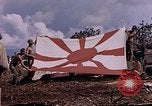
Aftermath of Japanese Banzai charge on Saipan, Mariana Islands during WWII
Americans display (holding it upside down) a huge Japanese rising sun Vice Admiral rank flag , captured after a desperate "banzai" attack by Japanese forces on Saipan, during World War 2. A photograpner takes a picture. Ammunition left on the ground from the battle. Two knocked-out Japanese Type 95 Ha-Go tanks. Destroyed defensive positions and buildings. Americans examine remains of buildings and defensive positions. Several local civilians walk into the center of the scene of death and destruction. Dead Japanese soldiers are seen everywhere, throughout the sequence. (Note: Aftermath of the "Tanapag Plain banzai attack" on July 6th and 7th, 1944. Americans engaged included units of the 105th Infantry; 165th Infantry; 23rd Marines; 24th Marines; 25th Marines; 20th Marines; and 10th Marines.)
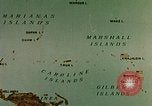
U.S. Naval Task Force 58, including USS Yorktown attacked by a Japanese Kawanishi H8K flying boat in the Pacific.
USS Yorktown CV-10 in the Pacific Theater during World War II. Early 1944: Animated map shows the Caroline Islands, Mariana Islands, Gilbert Islands and the Marshall Islands in the Pacific. The U.S. Naval fleet advances from Truk Islands towards an advanced naval base in the Marshall Islands, taken from the Japanese. U.S. ships underway around the fleet anchorage. U.S. Navy Aircraft Carriers, battleships, cruisers, fleet auxiliaries and support ships. Crew and aircraft on the flight deck of the 'Fighting Lady' CV-10. The crew members relax and enjoy themselves in the water. They dive and jump off a makeshift platforms and diving boards into the ocean, and then swim and play around large floating rafts. Sailors sort letters in the ship's post office. Some write letters back home. The crew assembled on the ship deck. Commander of the ship Rear Admiral Joseph James 'Jacko' Clark briefs the crew about their mission, designation to Task Force 58, and advance towards Tokyo. The USS Yorktown and other carriers of the Task Force underway. Sign boards for various Ready Rooms on the ship. Air Group Commanders and pilots ready on call. Rear seat gunners and radio men on call in another Ready Room nearby. They talk, relax, drink Coca-Cola and have ice cream. Flags on board. Commander of the TF 58 Admiral Marc Andrew 'Pete' Mitscher and Skipper Clark on the flight deck. A poster for the ship board movie 'Home in Indiana'. Sailors watch the movie. Planes in flight through clouds, the Task Force underway seeking the Imperial Japanese Naval fleet. New cruisers, Coast Guard cutters and Navy Transports in the Task Force. The patrol spots a Imperial Japanese Navy search plane, a Kawanishi H8K flying boat called 'Emily' by the Allies. The plane fires at the Task Force ships before being hit and sinking in the water. U.S. officers and sailors in a discussion. An animated map depicts the objective to move towards and free the Mariana Islands.