


 Francais
 Deutsch
 Italiano

Refine Your Search
+"Marianas Islands" +1945 stock footage and images
- Showing 67 to 72 of 125 results more
 Hide
U.S. Navy Commander Ashworth, crew member on B-29 that dropped atomic bomb on Nagasaki, interviewed at Tinian, Marianas Islands
Setting: North Field, Tinian,in Mariana Islands. Public Affairs Officer Major John F. Moynahan interviews Commander Frederick L. Ashworth of the U.S. Navy, who was the weaponeer on the B-29 called Bockscar (sometimes "Bock's Car") that dropped the atomic bomb on Nagasaki, Japan during World War II. He expressed initial concerns about not being able to bomb their primary target and having, instead, to proceed to their secondary target, Nagasaki.
Captain Kermit Beahan, bombardier of B-29 that dropped atomic bomb on Nagasaki, interviewed at Tinian, Marianas Islands
Setting: Airbase at North Field, Tinian Island in Marianas Islands. Public Affairs Officer, Major John F. Moynahan (not seen) identifies Captain Kermit K. Beahan, bombardier of the B-29, "The Great Artiste." (Note: Captain Beahan was the regular pilot of the B-29, "The Great Artiste", which was scheduled to carry the bomb. But it needed to be re-instrumented for the mission. So, instead, its crew simply switched airplanes with the crew of the B-29 "BocksCar" which was already properly configured. Thus, "BocksCar" was the airplane from which bombardier Beahan actually dropped the bomb.) When asked about his experience, Captain Beahan recalls being greatly relieved when clouds parted and the target, Nagasaki, could be clearly seen. He felt that dropping the bomb on Nagasaki, was the biggest thrill of his lifetime. (World War II period).
Captain Theodore J Van Kirk, navigator of B-29,'Enola Gay' interviewed at Tinian Island base, Marianas Islands in WW II
Atomic bombing mission in Japan by the United States Army Air Force, during World War II. U.S. military base in North Field, Tinian Island in Mariana Islands, South Pacific. Captain Theodore J. Van Kirk, the navigator of 'Enola Gay' (B-29 which dropped atomic bomb on Hiroshima) is asked about his experience, by Public Affairs Officer, Major John F. Moynahan (seen only from the back at very end of clip). Captain Van Kirk stands in front of Enola Gay and states his belief that the new bomb they carried would be a great help in shortening the war.
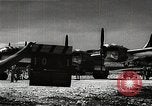
'Enola Gay,' the B-29 that dropped atomic bomb on Hiroshima,parked at North Field base,Tinian, Marianas Islands.
U.S. military base in North Field, Tinian Island in Marianas Islands, South Pacific. 'Enola Gay' the B-29 bomber that dropped the world's first atomic bomb on Hiroshima, Japan, parked on the ramp. The fuselage of Enola Gay. Name Enola Gay painted on its nose. (World War II period).
Bulldozers, power shovels and trucks at work during the reconstruction of Saipan airfield in the Mariana Islands.
Reconstruction of Saipan airfield in the Mariana Islands by American soldiers. Damaged hangars on Saipan airfield due to bombings by Japan. Men beside bulldozers parked in an area. A bulldozer clearing the airstrip. Men set detonation charges on the ground. The bulldozers at work in the background. The charges going off resulting in explosions. Power shovels, bucket elevators and trucks used to reconstruct the airstrip. Equipment at work on the airstrip. Narrow gauge flatcars are loaded with supplies by a crane. The flatcars moving on a path. The supplies are unloaded. A man beside a flatcar. Men beside equipment clearing the airstrip. Two U.S. soldiers sitting on a track and one of them writes 'B & O Express' on the back of a rail cart. The men shake hands. A man beside a rail cart of drums on a track. Men stand on materials in rail carts and the rail carts move. Several tents in view. (World War II period).
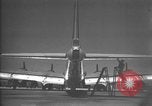
Members of U.S. Army Air Force 73rd Bombardment Wing paint the undersides of B-29s in Saipan, Northern Marianas Islands.
Members of U.S. Army Air Force 73rd Bombardment Wing paint the undersides of B-29 Superfortresses black for night –flying camouflage in Saipan, Northern Mariana Islands during World War II. Men stand on ladders and paint the underside of a Boeing B-29 Superfortress. Side view of the B-29. B-29s are lined up and are painted.