


 Francais
 Deutsch
 Italiano
Refine Your Search
+"Marianas Islands" +1945 stock footage and images
- Showing 97 to 102 of 125 results more
more Hide
Hide
Colonel Paul Tibbets, Pilot of the Enola Gay, describes his mission dropping the atomic bomb on Hiroshima Japan.
Crew members of the B-29 Enola Gay are interviewed about their atomic bombing mission over Hiroshima Japan by the United States Army Air Force, during World War II. In this interview at North Field, Tinian Island in Marianas Islands, Public Relations Officer, Major John F. Moynahan (not seen) interviews Colonel Paul W. Tibbets, Jr., Pilot of the Enola Gay Among things Colonel Tibbets mentions, he recounts that he took a steep turn to avoid radiation from the explosion. When he saw the explosion he was surprised about its intensity. The cloud from explosion covered the whole city of Hiroshima.
Major Thomas Ferebee, the bombardier aboard Enola Gay shares his experience of the Hiroshima atomic bombing mission
Setting: North Field, Tinian Island, Marianas Islands. Major Thomas Ferebee, the bombardier aboard Enola Gay (B-29 that bombed Hiroshima) is asked about his experiences, by Public Relations Officer John F. Moynahan (not seen). He recalls - His navigator aligned him correctly with the target. Hiroshima was clearly visible to him and so he was able to deliver the bomb. (World War II period).
Interview of Major Charles Sweeney, pilot of the B-29 that dropped the atomic bomb on Nagasaki.
Setting: North Field, Tinian Island in Marianas Islands. Major Charles Sweeney, pilot of the B-29 that dropped the atomic bomb on Nagasaki, is interviewed by Public Affairs Officer, Major John F. Moynahan, who identifies Sweeney as the "pilot of 'The Great Artiste', the second B-29 to drop an atomic bomb on the Empire." (Note: Major Sweeney was the regular pilot of the B-29, "The Great Artiste", which was scheduled to carry the bomb. But it needed to be re-instrumented for the mission. So, instead, he and his crew simply switched airplanes with Captain Frederick C. Bock and crew, whose B-29 "BocksCar" was already properly configured. Thus, "BocksCar" was the airplane from which Sweeney and crew actually dropped the bomb.) In the brief interview, Major Sweeney describes their difficulties in three tries at the primary target and their decision to proceed to their secondary target, Nagasaki. With less remaining fuel than planned, they were forced to recover at Okinawa. (World War II period).
Japanese fighter planes attack grounded U.S. Army Air Force B-29 Superfortress planes in Saipan during World War II.
Japanese air raid over Saipan during World War II. U.S. Army Air Force B-29 Superfortress bombers parked at an airfield in Saipan, Mariana Islands. Crewmen work on a B-29. Pilots being briefed by USAAF Brigadier General Emmett O'Donnel. B-29s take off from an airbase. B-29s fly through flak. Bombing of Tokyo by B-29s. Wreckage of B-29s after Japanese air raid on Saipan. Firefighters in action. Black smoke rises from the burning B-29s. A Japanese plane goes into a kamikaze suicide dive over Saipan.
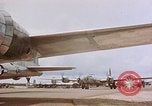
U.S. B-29s maneuvering and parking at North Field, Guam, Marianas Islands
United States Army Air Force Boeing B-29 Superfortress aircraft, and activities of airmen on North Field, Guam, immediately after World War II. Parked B-29 aircraft warm up. Aircraft of the 314th Bomb Wing, 29th Bomb Group (Tail Code "O"), 330th BG (Tail Code "K) and several of the 19th Bomb Group (Tail Code "M") are seen. B-29s taxi and maneuver on the ground as they are moved to different parking places.
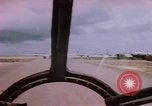
A U.S. Army Air Forces B-29 Superfortress bomber takes off from Isley Field, Saipan in the, Marianas Islands during World War II.
View from nose canopy of a U.S. Army Air Forces B-29 bomber, as it taxis behind another at Isley Field, Saipan, during World War 2. Next, the B-29 is on the active runway, accelerating for takeoff.