


 Francais
 Deutsch
 Italiano
Refine Your Search
+"Marshall Islands" +1944 stock footage and images
- Showing 61 to 66 of 83 results more
more Hide
Hide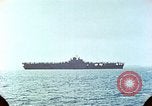
U.S. Task Force being resupplied, Marshall Islands, during World War II.
Sequence taken from the heavy cruiser USS Indianapolis, CA-35 at Majuro Atoll, Mashall Islands, during World War 2. Time 00:05 to 00:11 starboard view of an Essex class aircraft carrier with the battleship USS Iowa, BB-61 on the horizon. Time 00:12 to 00:14 starboard view of an Independence class light aircraft carrier. Time 00:31 to 00:50 stern view of the battleship USS New Jersey, BB-62, in all blue measure 21 camouflage. Time 00:51 to 00:55 port side view of the battleship USS Tennessee, BB-43, in measure 32/1d camouflage, with a Cleveland class light cruiser in the background off the stern. Time 00:56 to 00:57 Left to right, Essex class aircraft carrier; battleship USS Colorado, BB-45, in measure 32/16d camouflage; battleship USS Pennsylvania, BB-38, tied up next to a cargo ship; Essex class aircraft carrier. Time 00:58 to 01:04 another port side view of the battleship USS Tennessee, BB-43, in measure 32/1d camoflage. Time 01:06 to 01:11 port side view of the light cruiser USS Santa Fe, CL-60. Time 01:15 to 01:17 stern view of the light cruiser USS Mobile, CL-63. Time 01:18 to 01:51 now tied up next to the cargo ship already replenishing ammunition of the battleship USS Pennsylvania, tied up on the other side.
The Rise of Japanese militarism in the 20th Century
Film opens showing reenactment of Japanese attack ostensibly against Formosa, in 1894. Japanese troops and artillery are shown. The event is depicted in a critical political cartoon. Next, Japanese Admiral Heihachiro Togo is seen in 1904, standing with other naval officers. Then, Japanese warships are shown, firing barrages of naval gunfire at the Russian fleet in Port Arthur, Manchuria. Huge black clouds arise from burning ships. Scenes of Japanese people celebrating their naval victory. Date shifts to 1910. Cartoon depicts Japanese annexation of Korea. Cartoon illustrates Japanese actions in World War I when, siding with the Allies, Japan acquired the German-held Shandong (Shantung) Peninsula of China, as well as German-held Marianas, Carolines, and Marshalls islands in the Pacific. Japanese representatives are seen participating in Post World War 1 international activities. They signed the so-called Five-Power,Four-Power, and Nine-Power treaties, and participated in the League of Nations. Glimpse of two Japanese officers, followed by cartoon depiction of the Mariana, Caroline, and Marshall Islands, that Japan insisted on keeping. Cartoon shows them being fortified. A Japanese military marching band parades down a city street while being cheered by spectators on the sidewalks. Next, Japanese military General, Baron Tanaka Giichi, is seen in uniform with other officers. Cartoon illustrates the so-called Tanaka Memorial document that Baron Tanaka allegedly presented to the Emperor, in 1927, outlining a strategy to conquer the world. Cartoon then illustrates plan of conquest by acquiring Chinese manpower; Manchurian iron and coal; Siberian timber, coal, wheat, and metals; Tin,oil and rubber from Malaysia and the East Indies. The United States is shown as the last conquest. Views of ordinary farm and factory activities in the U.S. Cars parked in the Ford Motor Company factory lot. Japanese officials and legislators meeting in the Diet (Parliament). Japanese theater patrons and a Japanese woman singing with an American-style band, are shown as examples of activities the Japanese Government sought to discourage. A Japanese female ensemble in traditional dress, playing traditional instruments, is shown as more desirable. Western dancing and western hollywood movies are shown and narrator states they were forbidden by the Japanese government. Japanese movie scene depicts ancient martial arts. A musical production on stage displays German Nazi swastika flag , Japanese rising sun, and symbol of Kingdom of Italy, celebrating the axis alliance. Japanese men are shown playing the ancient game of Chu Shogi, instead of playing Western card games. People are shown in a library, where Western books are replaced by more militaristic tomes, such as: "If we fight" by Admiral Shinsaku Hirata, March 15, 1930 (shown on film slate). Slate goes on to quote about attack on Hawaii as the first battle in war of the Pacific. Film cites another approved Japanese publication: "Arguments Against American Policies" by Kawashima Seichiro, Christmas Day, 1924. It discusses distruction of the American fleet and subsequent landing on the U.S. West Coast.

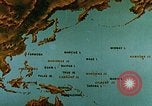
A map locates various islands of the Pacific and the invasion of these islands by U.S. forces.
A training film titled 'The Kwajalein Operations' on the operations of U.S. forces on Kwajalein Atoll in the Marshall Islands during World War II. A map locates islands in the Pacific Ocean. Animation depicts the area invaded by U.S. forces. The Gilbert Islands, the Solomon Islands, Midway Island, Tarawa and other islands located on the map. U.S. lines of communication on various islands. Kwajalein Atoll on the map. The atoll is selected as a base for U.S. forces. It is selected because of various benefits which would prove useful during the invasion of the Marshall Islands. Bases and installations on Kwajalein Atoll.
Bombing by the U.S. troops, Landing Craft Vehicles lowered and Landing Craft Personnel circle in Eniwetok Atoll.
Battle of Eniwetok during World War II. United States Ship Battleship USS Nevada (BB-36) at Eniwetok Atoll (sometimes spelled Enewetak or Eniewetok) in the Marshall Islands. Stern view of hospital ship USS Solace (AH-5) in the pacific. Bombardment by the United States forces. Water splashes due to bombardment. Officer of United States looks at the artillery bombing by telescope. Troops on deck. Landing Craft Vehicles (LCV) are lowered from ship. Troops on LCV. Landing Craft Personnel (LCP) circle in the water.
U.S. and Japanese Naval aircraft in aerial combat over the island of Kwajalein in the Pacific Theater during World War II.
The USS Yorktown (CV-10) in the Pacific Theater during World War II. Map of Marcus Island and surrounding islands in Japan. Animation depicts the U.S. fleet's aim to recapture the Philippines and land on the main land of Asia to help their ally China. USS Yorktown underway. A map depicts its advance towards its target of Kwajalein Island in the Marshall Islands. Imperial Japanese Navy Air Service Mitsubishi A6M Zero fighters in flight. U.S. planes in dogfights with Japanese aircraft over Kwajalein Island. Aerial gun camera footage shows United States aircraft attacking Japanese aircraft. Japanese airplane is hit and explodes. Another Japanese airplane falling from sky to crash in water. Heavy bombardment and strafing on land of enemy targets, wrecked aircraft. Black smoke rises from explosions on the burning island. Heavy shelling by surface ships. Assault crafts filled with U.S. Marines and Army soldiers hit the beaches on Kwajalein. U.S. airplanes in flight over the island.
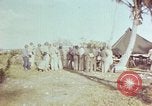
Admiral Chester Nimitz and his party visit American soldiers after Kwajalein Island is wrested from the Japanese in World War II.
U.S. Navy Admiral Chester William Nimitz visits fKwajalein Island, Marshall Islands, in World War 2. . Admiral Nimitz and his party casually visit various places on the island, Remnants of Japanese barracks and fortifications are seen. Tents and palm trees in the background. The party in jeeps. They inspect debris and remnants of Japanese flags.