


 Francais
 Deutsch
 Italiano
Refine Your Search
+"Maryland United States USA" +1942 stock footage and images
- Showing 1 to 6 of 11 results
U.S. soldiers decontaminate combat vehicles and tanks during training; also flashback WW1 mustard gas aftermath scenes
World War 2 training film teaching U.S. soldiers about decontamination of combat vehicles, at Aberdeen Proving Grounds in Maryland. Soldiers during a decontamination procedure with real mustard gas. The soldiers in armored vehicles. A group of soldiers prepares for the decontamination. An aircraft flying at low height. A stationary U.S. Army Pershing tank. Two soldiers in a jeep. Soldiers wearing gas masks decontaminate a vehicle. Flashback scenes to August 1918 in World War I in France, with many mustard gas attack victims being cared for at a field hospital (which narrator says is Field Hospital number 326). Medic washing eyes and face of a World War 1 gas attack victim. Next view is a soldier in 1942 with mustard gas burns on his hand, being treated by a medic. Next scene returns to World War 1 in 1918, showing mustard gas burns on arms, hands, legs, and feet of U.S. Army soldiers.
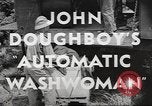
U.S. soldiers wash and dry clothes in a mobile laundry in Maryland, United States.
U.S. soldiers demonstrate a mobile laundry developed by Quartermaster Corps for the troops in field. A mobile laundry truck passes through a forest in Maryland, United States. It is parked near a pond. Two soldiers put a landing gear on the ground so that a container may rest on it. Two soldiers set the corner stand jack. The trailer is uncoupled and the prime mover is camouflaged under a tree. Four soldiers set up the laundry machine. The soldiers connect a pipe from the machine to the pond. Two soldiers setting up a water pump. The soldiers unloading laundry from a truck. A soldier puts on the washing machine. A soldiers loads the machine with clothes. A soldier takes out the clothes from the centrifugal drier. Two soldiers take out dry clean cloths. Some soldiers pack the clean cloths. A truck filled with the clean clothes leaves. (World War II period).
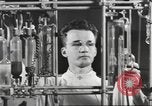
U.S. soldiers decontaminate various combat vehicles during a training in Maryland.
U.S. soldiers train for gas attack and chemical warfare decontamination at Aberdeen Proving Grounds in Maryland during World War II. A scientist working in a chemical laboratory with many vials before him. Two soldiers spreading a protective ointment in their hands. A soldier decontaminating a tank. A soldier wearing a mask spraying a protective liquid on a gun. A soldier spreading the protective ointment on his helmet. Many soldiers in front of U.S. Sherman tanks decontaminating cloth covers. Soldiers sitting on a tank cover it with a decontaminated cloth. Two soldiers issue impregnated clothing to a soldier. A World War 2 soldier covers himself with a protective cellophane cover. A soldier decontaminating a half track using Decon filled with DAMC. Soldiers filling a truck with chloride of lime containers.
U.S. soldiers demonstrate vehicle decontamination at Aberdeen Proving Grounds in Maryland in WWII.
U.S. soldiers demonstrate gas attack and chemical warfare decontamination techniques at Aberdeen Proving Grounds in Maryland during World War 2. An aircraft generates a heavy smoke screen. Another aircraft sprays the smoked area with a chemical. Soldiers on a half track put on cellophane cover and, once covered, they put on gas masks. They then practice attacking the aircraft while wearing the protective equipment. The cellophane and the combat vehicles are heavily contaminated by the chemical. The soldiers remove the cellophane cover and throw them out. Soldiers take on decontamination procedures.
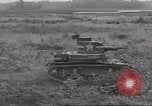
U.S. soldiers demonstrate decontamination of a combat tank at Aberdeen Proving Grounds in Maryland.
U.S. Army soldiers demonstrate decontamination of chemical agents such as mustard gas from a combat tank at Aberdeen Proving Grounds in Maryland, during World War 2. A tank moving on a training ground. Two soldiers decontaminate the vehicle using a spray (second echelon decontamination using Decon 3 devices, which are 3 gallon sprayers). One soldier stands on the tank and decontaminates it. Under carriages heavily encrusted with mud. Two soldiers spreading lime on the ground. A tanker passes through the lime mud slurry to coat the track and wheels. Two soldiers spraying a tank with high pressure water to remove mud from the under carriages. Now they spray the tanks with lime. A water tanker arrives. An aircraft passes over at a low height. A heavy smoke screen in the background. Soldiers wearing cellophane protective covers. Narrator states that the training procedures shown were conducted with real mustard gas.
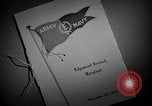
U.S. Army Colonel Black and Major General Reckord during the Army-Navy 'E' Award ceremony in Edgewood Arsenal, Maryland (WW2)
The Army-Navy 'E' Award ceremony at the Edgewood Chemical Warfare Arsenal in Maryland, United States during World War II. A car led by motorcycle escorts driven on a path lined by soldiers holding guns. An officer standing on the side of the path saluting. A motorcade follows the car. The officers on the side of the path saluting. Civilian workers of a war plant walking on the path between the soldiers. View of the Post Recreation Hall and soldiers lining the path to the hall. A car arrives and high ranking army and navy officers emerge from the car. Several civilians and officers gathered in the area in front of the hall. Officials and dignitaries going up the steps onto a stage inside the hall during the Army-Navy 'E' Award ceremony at which companies would be conferred awards for excellence in production of war equipment. Several views of the crowd seated. The army and navy officers, officials and dignitaries seated on the stage. Master of Ceremonies Colonel H. M. Black Chief of the Arsenal Operations Department, Edgewood Arsenal, stands in front of a microphone and announces the award by Undersecretary of War Robert P. Patterson. Colonel Black reads out from a note from the Under Secretary. The note says that the army and navy is conferring upon the workers of the Edgewood Arsenal War Plant the Army-Navy 'E' Award for their contribution in the production of war equipment. Major General Milton A. Reckord Commanding General Third Service Command standing behind a podium and speaking into microphones. The Major General praises the workers of the war plant who won the award. The army and navy personnel, officials and dignitaries seated behind the Major General.