


 Francais
 Deutsch
 Italiano
Refine Your Search
+"Mexico" +1946 stock footage and images
- Showing 25 to 30 of 38 results more
more Hide
Hide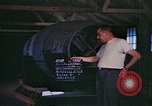
A drawing shows various parts and complete coverage of a German V-2 rocket at the White Sands Proving Ground, New Mexico.
Control section of a German V-2 rocket at the White Sands Proving Ground, New Mexico. View of the control section. A drawing shows various parts and complete coverage of the V-2. A chart of fuel of the V-2 (Ethyl alcohol, liquid oxygen, nitrogen, peroxide, calcium, permanganate, steam and exhaust).
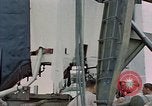
A German V-2 rocket is held in firing position by movable parts of a trailer at the White Sands Proving Ground, New Mexico.
A German V-2 rocket at the White Sands Proving Ground, New Mexico. Men stand at the base of the V-2 rocket. The rocket is held in firing position by movable parts of a trailer used to carry the V-2 to the launching site. Men work on final preparations of the V-2. Equipment is lowered.
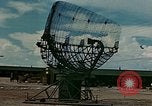
Radar equipment in operation at the White Sands Proving Ground Radar Tracking Station in New Mexico.
A radar tracking station at a German V-2 rocket test site at the White Sands Proving Ground, New Mexico. The large radar tracking station shows radar equipment in operation.
A German V-2 rocket is hauled out of a hangar building at the White Sands Proving Ground, New Mexico.
A German V-2 rocket at the White Sands Proving Ground, New Mexico. The V-2 is hauled out of a hangar building.
Technicians prepare German V2-Rocket for launch at White Sands Proving Ground in New Mexico.
Scenes of personnel and technicians working on German V2-Rockets. Army personnel walking about. Rocket on the launch pad (launch tower). Men fuse rocket. Final checks are made before launching.

Devastation from atomic bomb dropped on Hiroshima Japan in World War II
U.S. War Department film showing devastation from atomic bomb dropped on Hiroshima, Japan, during World War 2. Opening scene is darkness of predawn in Alamogordo, New Mexico, on 16, July, 1945, at 5:29:45 AM. Suddenly, a huge explosion lights up the sky. A fireball and mushroom shaped cloud form. Closer view of the explosion from another camera. Following the initial explosion, the ensuing sound is a continuous roar. Another view is shown, from a third camera location. It highlights the boiling fire and smoke of the explosion. These scenes document the first successful test of a nuclear weapon, code named "Trinity". Change of scene shows glimpse of the Manhattan Project B Reactor site at Hanford, Washington, as viewed from a car driving past. Closeup of the facility, from right up against a boundary fence. Glimpses of other Manhattan Project facilities in New Mexico, Oak Ridge, Tennessee, and another view of the Hanford, Washington facility. Next, a rough topographical map of Japan is shown. Closeup of elevated railroad train traveling in Hiroshima, Japan. Imperial Japanese Army motorized vehicles are shown on parade, including fully tracked open personnel carriers with soldiers aboard and Type 94 Tankettes being driven by individual soldiers. Japanese infantry marching in full field gear including shouldered rifles with fixed bayonets. Closeup of a Japanese Army officer. Glimpse of Japanese support troops, such as quartermaster elements, in black uniforms. Japanese technicians in white lab coats at a wartime facility. Japanese Navy Warships being launched from Hiroshima ship yards. A lone B-29 bomber seen in flight over clouds. Its tail number, 42-63735 is clearly seen. It displays a large "05" on it upper tail. (This is not the "Enola Gay" whose tail number was 44-86292.) Closeup of one of the aircraft's engines with propeller turning. Glimpse upward from interior of the aircraft. Scene shifts to aerial photograph of Hiroshima with overlay depicting the bomb strike zone. Animated map showing explosion and precise point ot detonation above the junction of the Motoyasu and Ota Rivers. A view at the ground of destruction from the atomic explosion. An American soldier stands in the midst of the destruction. Slabs of heavy concrete are destroyed. View looking East from ground zero, past a burned tree trunk in the foreground, where the shells of several stronger buildings still stand amidst a sea of rubble. To the South, hardly anything is left standing. Looking West, everything is essentially leveled.