


 Francais
 Deutsch
 Italiano
Refine Your Search
+"Michigan United States USA" +1926 stock footage and images
- Showing 1 to 6 of 15 results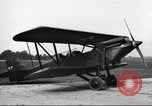
The 1926 Ford "National Air Tour for the Edsel B. Ford Reliability Trophy," at Ford Field, Dearborn, Michigan.
Subject is the 1926 Ford "National Air Tour for the Edsel B. Ford Reliability Trophy," which started at Ford Field, Dearborn, Michigan, on August 7, 1926. Film opens showing a parked biplane with tandem open cockpits. It has an unusual exhaust gathering container atop its engine and an exhaust pipe extending straight down below the fuselage. Camera shows the same aircraft from the rear, with hangar and terminal building in background. Another parked biplane displays the number "19." It is equipped with small interconnected wing flaps on its upper and lower wings. Next is seen a Woodson Model 2-A Biplane with number 14 on its fuselage and another biplane marked Number 11. Closeup of Henry Ford leaning out of a car, talking with a cinematographer, holding a camera, and reporters. A large group of persons involved in the events pose for a photograph. The camera pans across them as they pose in front of a hangar. Scene shifts to spectators crowding around a Ford-Stout 2-AT aircraft as it begins its takeoff roll. Camera follows the airplane as it continues and becomes airborne.
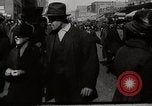
American men walk on busy street near Ford Factory.
American men walk on busy market street. Trams or Trolleys or Streetcars pass by in market street. Cars and trucks on busy market street. Tall Tower in background. Likely at Ford Factory. Approximately 1926.
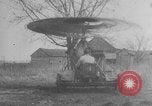
Man attempts to fly the Pitt "Sky Car."
Early attempts at flight during history of aviation. The Pitt Sky Car ornithopter device is seen: A car equipped with an umbrella-like rotor intended for vertical takeoff. 'Sky car' written on a cloth sign on the chassis of the aircraft. A man in aviator's clothing seated at the controls of the machine. The powerful motions of the pulsating rotor cause the machine to rise several inches. But it simply drops to the ground again. This happens with each oscillation of the rotor. (The motor-rotor devise was invented by John W. Pitts, of Detroit, Michigan, and patented in 1926. However, as seen in these images, it was a failure.)
USAAS Curtiss Pursuit P-1 and Boeing Pursuit PW-9 taxi, take off and in flight at Selfridge Field in Michigan, United States.
United States Army Air Service (USAAS) modern airplanes for military purposes at Selfridge Field in Michigan, United States. A Curtiss Pursuit P-1 Hawk capable of flying at 170 miles per hour is stationary. The P-1 taxis and takes off during testing for maneuverability by Lieutenant James Doolittle. The P-1 in flight. USAAS Boeing Pursuit PW-9 which is capable of flying at a speed of 168 miles per hour is stationary. The PW-9 aircraft taxis, takes off and banks. PW-9 buzzing the field. Aerial maneuvers of the PW-9 aircraft.
USAAS airplanes commanded by Major Carl Andrew Spaatz take off from Selfridge Field in Michigan, United States.
United States Army Air Service (USAAS) 1st Pursuit Group at Selfridge Field in Michigan, United States. Commanding Officer of the 1st Pursuit Group Major Carl Andrew Spaatz gives a signal for preparations for take off. Crew get into airplanes. Views of fighter aircraft across a airfield at Selfridge Field. Three aircraft take off followed by other aircraft. Formations of aircraft flying overhead.
A USAAS P-1 aircraft being fueled by a hand pump and aircraft with skis taxi and take off in Michigan, United States.
United States Army Air Service (USAAS) 1st Pursuit Group in the northern part of Michigan, United States. A fifty gallon drum of fuel is hauled on a sled towards an airplane. The airplane is fueled by a hand pump. USAAS Curtiss P-1 Hawk aircraft with skis for landing on snow. The engines of the P-1 start. A second plane in the background. A long line of P-1 aircraft with ski-type landing gear. A P-1 aircraft taxis and takes off. Other airplanes taking off in the background.