


 Francais
 Deutsch
 Italiano
Refine Your Search
+"Moscow Russia Soviet Union" +1941 stock footage and images
- Showing 13 to 18 of 18 results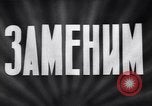
Russian boys and women replace workers in a machine shop who have left to serve in the military during World War II.
Opening slate states (in Russian) "Replacement of those who left for the front." Russian boys work in a machine shop during World War 2. One operates a large drill press. A woman tends a lathe. Closeup of a young man using drill press to drill holes in a steel plate. Closeup of a women measuring a piece of metal in a lathe. Another woman turning items on a lathe with cooling lubricant spraying over the cutting point. She removes the finished product and places it on a table with others. A woman using a gauge to check dimensions of a turned piece of metal, possibly for war armament production . A young man consults with a woman at a lathe. Another woman also working at a lathe. A man and two women examining finished products on a table.
Soviet farmers hasten to harvest wheat in advance of invading German forces in World War II
Film shows wheat waving in breeze at a huge farm in the Soviet Union during World War 2. View from above of harvesting combines operating in parallel. Closeup of tractor pulling a combine. Closeup of grain flowing into a bin. View through harvesting wheel of the operations. Closeups of farmers atop their machines. View from above of combines at work with grain discharging into a large tractor-pulled wagon. More views of the operation and of grain filling the wagon. Closeup of two farmers examining the wheat grain. Officials sealing large sacks of wheat. View of many sacks piled in front of a building. A tractor pulls numerous flat bed wagons filled with sacks of wheat.
Soviet civilians, and military members receive awards. Officers and soldiers speak encouragingly to others soldiers assembled during World War II
Opening scene shows Soviet people seated aroung a long table. As names are called, individuals step forward and receive small boxes containing medals in recognition of their contributions to the nation during World War 2. Narrator announces their names as they come forward. Uniformed members of the military as well as civilians, receive the awards. Change of scene shows a seated group of army soldiers in uniform, as they listen to an officer speaking enthusiastically to them from a small group in front of them. They stand and applaud. A woman soldier in uniform addresses them. Camera focuses on several women soldiers in the large group. Another soldier also addresses the group. He raises a fist in emphasis as he speaks. The soldier audience stands and applauds.
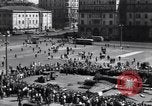
Soviet military displays downed German Junkers Ju 88 aircraft and bombs, to the public in Teatralnaya Square, Moscow, during World War II
Opening scene shows Soviet people walking around an open air display containing a German Junkers Ju 88 bomber and various pieces of wreckage. It also includes displays of German bombs of various types (presumably inert). Closeup of the aircraft cockpit cabin and remains of engines. A huge hole in the plane fuselage. Wired panels and wire bundles inside the aircraft. Closeup view downward, of people pressing forward to observe the displays. Soldiers guarding the wreckage. Camera pans across the aircraft, showing the swastika on its tail. View from close to the wreckage shows the people behind barriers. Trams pass in the background, on front of the Bolshoi Theater, with the quadriga atop it (statue of Apollo riding chariot pulled by 4 horses) covered by canvas during repairs from earlier German bombing. Closeup inside the display barriers shows the German bombs. A soldier picks up an incendiary bomb and walks to people in the crowd shaking the device and speaking about it. People gathered at one corner of the display where smaller pieces of the plane are piled up. Another closeup of the airplane tail with swastika on it. View of the Ju 88 from its tail to the front.
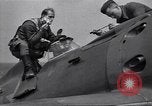
Russian pilots are decorated on the front in Moscow.
Russian pilot shaving his face. Russian pilots lined up at fields are decorated. Shows Russian aircrafts flying.
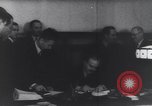
Signing of the German-Soviet Border and Commercial Agreement, by German Friedrich Werner von Schulenberg and Soviet Vyacheslav Molotov.
German diplomat Friedrich Werner von Schulenberg, of Nazi Germany, and Vyacheslav Molotov, of the Soviet Union meet together in Moscow, Russia, to sign the German-Soviet Border and Commercial Agreement. View of the two men and other representatives from each country at the signing ceremony. Narrator indicates that the agreement document covers expanded trade and commerce between the countries, establishes the northern border, and covers repatriation of Germans from republics including Lithuania and Estonia. View of the German and Soviet leaders each signing the document. Wax seals are added and a close-up of the signature page of the agreement is shown. (The Agreement also included the third set of secret protocols of the Hitler-Stalin Act or German-Soviet Treaty of Nonaggression. It followed the German-Soviet Frontier Treaty, which was the second secret protocol. Despite the pact, Germany attacked the Soviet Union 6 months later.) (World War II period).