


 Francais
 Deutsch
 Italiano
Refine Your Search
+"Nagasaki Japan" +1946 stock footage and images
- Showing 73 to 76 of 76 results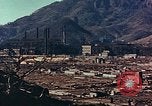
Children walk through the ruins of the University Hospital and the collapsed square column after the atomic blast in Nagasaki.
Physical damage caused by the atomic bombings in Nagasaki, Japan at the end of World War II. Damaged Mitsubishi Small Arms plant in the background. Foundations of the buildings that has collapsed in the foreground. The collapsed square brick column. An intact round concrete structure. The entrance of shrine. A set of stone lanterns on the steps leading up to the shrine. The lantern on the left falls west while the lantern on the right remains standing. The stone railing on the north side of the step which is protected by a blast from a stone wall. The south railing is blasted. The shrine and steps leading to shrine , the railings, stone lanterns and arc at head of stairway. Five children walk through the ruins of the University Hospital. A concrete wall support bent. A bridge with railing fallen and one standing. A view of the fallen side and the hospital in the background. The round concrete structure shows little effect of blast, while on of the square brick collapsed.
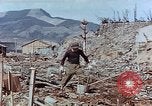
A Japanese uses a long handled ladle to pour fertilizers and seaweeds is laid onto concrete slabs to dry in Nagasaki.
A Japanese drying seaweeds after the atomic bombings in Nagasaki, Japan during the end of World War II . A Japanese stands on the ruins and debris. He uses a long handled ladle to pour some fertilizer into the ground. The seaweeds is laid onto concrete slabs to dry.

An aerial coverage of a harbor area and a river parallel to the Mitsubishi Small Arms Plant in Nagasaki after World War II.
An aerial coverage of Nagasaki, Japan to show the atomic bomb damage which occurred during World War II. Aerial views of a harbor area and a river parallel to the Mitsubishi Small Arms Plant and a new air strip. Ships anchored and a bridge over a river. Views of buildings and plants.
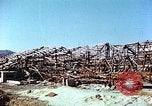
Structural collapse of the Mitsubishi-Urakami Ordnance Plant after the atomic bombings of World War 2
The Mitsubishi-Urakami Ordnance Plant shows the effects of atomic blasts of World War II on its light steel frame structure in Nagasaki. While the structurally stronger east wall and the center section of the building withstood the blast comparatively well, the entire section has been displaced. The wall of the building was afforded some protection by the boiler house. Structural collapse of the light steel frame building.