


 Francais
 Deutsch
 Italiano
Refine Your Search
+"Netherlands" +1944 stock footage and images
- Showing 1 to 6 of 68 results more
more Hide
Hide
Ground and air crew of Allied aircraft work to bomb German held territory in France and Netherlands in Spring of 1944 during World War 2.
Allies bomb Nazi targets in France and Netherlands during World War II. An animated map shows France and Germany. Allied squadrons move towards the bombers. Martin B-26 Marauder aircraft taxi and take off from a British airfield in England, United Kingdom. Interior cockpit view of a B-26 A pilot in the cockpit as he puts on a steel combat helmet and wears a steel jacket. A formation of bombers drops bombs on a Nazi German controlled airfield in Holland. Ground crew watches as a bomber comes in for landing. An aircraft sends off flares shortly before landing, indicating to ground crews that there are wounded soldiers on board. The bomber lands on its belly. Ground crew moves towards the bomber. A row of bombers. Crew members work on the bomber. Multiple shots of more bomber aircraft as they take off (some shots from the side, and some with the aircraft approaching the camera position). View of bombs attached to the bomber with bomb bay open. Bombs away view as bomb clusters are released through open aircraft bomb bay doors. Bombs dropped on Nazi installations in France. Aerial view of explosions on the ground.
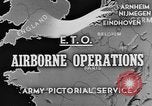
The 82nd Airborne Division and 101st Airborne Division prepare for a mission in the Netherlands (WWII)
Allied airborne operation in Netherlands during World War II during Operation Market Garden. Map showing the cities of Arnheim, Nijmegen, and Eindhoven in the Netherlands. The 82nd Airborne Division and 101st Airborne Division prepare for a mission in the Netherlands in World War 2. Troops listening. Paratroops board C-47s and fly to their objectives. Glider troops prepare to take off. They board the U.S. Army gliders (Waco CG-4). Waco CG-4 gliders take off and seen in flight. Aerial views of aircraft and ground below. View of gliders landing at Eindhoven. Troops assemble for their initial objectives. Troops hold rifles and pass away on Jeep. Allied troops enter the town of 't Zand on September 18, 1944 as Dutch citizens greet them.
U.S. troops set up a field kitchen and mess in Eygelshoven, the Netherlands, during World War 2
View from hill, above, of U.S. Army troops, from the 3rd Battalion, 115th Regiment, 29th Division, who have set up a field kitchen and mess along the side of a road (Nieuwenhagerweg) in Eygelshoven, the Netherlands, during World War II. Closeup of the troops in a chow line, receiving food in their personal mess kits. Closeup of one soldier's mess kit with his ration. Closeups of smiling soldiers and views of some eating their meals. [Note: In the first 10 seconds, two churches can be seen in opposite corners of the background.The oldest, on the right, sheltered US soldiers. The other, on the left, was hit by German shelling around December 20, 1944. U.S. soldiers of the 562nd Anti-Aircraft Artillery Battalion, Automatic Weapons (Mobile), Battery D, patched the hole in the church roof.]
Jewish exit railroad cars at concentration camps; Hans Albin Rauter trial for Nazi war crimes.
Dutch war court in the Hague, Netherlands in 1948. Hanns Albin Rauter, Nazi police leader on trial for his crimes in German occupied Netherlands during World War II. Dignitaries and people in courtroom stand up as the judges arrive and take their seats. Session of trial begins. Views of prosecution desk and tribunal seen in turns. Hans Albin Rauter is being questioned by judges. 1942, 1943, or 1944 flashback scenes of Jewish, Dutch civilians being rounded up and deported on railroad trains to forced labor camps and concentration camps, while in background audio the prosecutor reads the charges. The round up footage first shows Jewish families with women and children being directed onto trains at a train station. A subsequent shot shows Jews exiting cramped railroad train cars and being lined up under Nazi guard at concentration camp. Documents about crimes committed by the accused are shown. Another man enters the courtroom, takes the oath and is questioned by the tribunal. The man is a supervisor of slave labor prisoners working for the Germans, and at the time of the trial was detained at a Rotterdam Penitentiary.
The first U.S. C-47 aircraft (and its crew) to drop Pathfinder Paratroopers on D-day eve in World War II.
U.S. Army Air Forces C-47aircraft , number 42-93098, of the 9th Troop Carrier Command Pathfinder Group, and its crew. This is the first aircraft and crew to drop American paratroopers (pathfinders) over France during the Allied invasion, in World War 2. The aircraft taxis on a British airfield. Crew of the aircraft are seen in front of it, including pilot, Lieutenant Colonel Joel Crouch, Copilot, Captain Vito Pedone, Navigator, Captain William Culp, Radio Operator, Harold Coonrod, along with two crew chiefs. Crew members shake hands and board the aircraft. Colonel Crouch waves from the cockpit of the C-47 (but has not started engines). Major J.L. Sweetman boards another aircraft. Colonel Crouche's C-47 taxis to where the Pathfinders will load up. View of Control Tower at RAF North Witham, with ambulance parked outside it. Three hours before takeoff.Colonel Crouch, is seen on a path near the airfield, with a Pathfinder Captain and Lieutenant, who will be aboard his aircraft and be the first to jump into France. They kid around. The Pathfinder officers note that Colonel Crouch wears paratroop wings. Later, two Pathfinders, of the 101st Airborne Division , with camouflaged faces and American flag insignia on their right shoulders, step from woods and pose momentarily. Pathfinder Paratroopers line up to board C-47 aircraft as Lt. Col. Crouch rides a scooter at the airfield. Aircrews and Pathfinders pose for photographs before taking off. The lead aircraft, number 42-93098, with Lieutenant Colonel Crouch at the controls, takes off from RAF Station North Witham at 9:54 PM, on June 5, 1944. to begin the invasion of France. (Note: This C-47 was shot down on September 18, 1944, during Operation Market Garden, and crash landed on Haamstede Airbase, Netherlands. Although shot at by German troops on the ground, pilot, Maj Joseph A. Beck, and Navigator Lt. Vincent J. Paterno, survived as prisoners of war. Copilot Capt Fred O. Lorimer and another crew member were fatally shot.)
Red Devil paratroopers of British 1st Airborne Division, drop into Holland to outflank the German Siegfried Line in World War II
At start, the film shows a formation of American C-47 transport aircraft with paratroopers starting to jump from them during World War 2. Viewed moments later from the ground, the sky is filled with trooper' open chutes, descending. An animated map shows Netherlands, Belgium, Luxembourg, and Germany. It shows location of the Allied paratroopers drop in Holland, intended to spearhead a drive around the Main River into Germany. The map then shows German forces encircling the paratroopers and the Second British Army heading North to the rescue. Next, a huge number of American Soldiers are seen assembled out of doors in England. Closeup of General Dwight D. Eisenhower speaking in a microphone to the assembly. Closeups of soldiers including some who are American Army Air Corps pilots, and other aircrew members, mostly Lieutenants. Senior Paratrooper officers stand at attention in front of formation of troopers with American flag beside them.(Narrator says these were the men who made up the "lost division," heroes who fought alone for seven terrible days.) General Eisenhower makes his way between close ranks of the paratroopers. He is followed by Brigadier General and a Colonel. Lieutenant General Lewis H Bereton also makes his way through the ranks. Scene shifts to a base in England where many British Airspeed AS.51 Horsa gliders are seen with paratroopers heading across the airfield to board. American C-47 aircraft are seen in the background. All aircraft are painted with D-Day stripes. Several British and American paratroop officers review a map together. At a tent camp, A military policeman and two U.S. paratroopers checking their weapons and ammunition. Some troopers sharpen their knives. A trooper is issued Dutch and German money. A British and and American trooper in camouflaged helmets, pose before a glider with a huge British roundel on its side. British paratroopers boarding a Horsa glider, named "Gertie." A Horsa glider moving as it is towed by a British Whitley twin-engine bomber. View from side of runway as the bomber takes off with its towed glider behind. (Narrator comments: "Destination, Holland.") Formations of tow planes and gliders in flight. View of pilot in cockpit of a Whitley bomber. Formations of fighter aircraft in flight overhead. View from inside an aircraft as paratroopers exit through a side door. Sky filled with paratroopers in chutes descending. (Note: This Allied thrust into Holland to launch a drive around the German Siegfried Line was known as the Allied joint American-British "Operation Market Garden," which took place 17 to 25 September 1944, the 7 days referred to by the film Narrator. )