


 Francais
 Deutsch
 Italiano
Refine Your Search
+"Nevada United States USA" +1955 stock footage and images
- Showing 31 to 36 of 61 results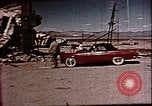
Civil Defense observers inspect test homes blown by an explosion at a test site in Nevada, United States.
Operation Cue nuclear test at Nevada test site in Nevada, United States. A man in a construction hat walks amidst rubble caused due to a nuclear test explosion. Civil Defense personnel at the blast site to inspect. Ruins of a two story building. An undamaged test house reinforced by concrete blocks. A partially damaged two story frame house. A protective basement room is inspected. Ruins of a house destroyed in the nuclear blast.
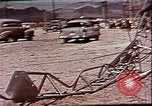
Partially damaged power lines and transformers after nuclear blast at a test site in Nevada, United States.
Evaluation of Operation Cue nuclear test at Nevada test site in Nevada, United States. A collapsed radio tower at the site after the blast. Slightly twisted radio tower. An undamaged 18000 gallon supply tank. In a radio house transmitter equipment is replaced on a table. Partially damaged power lines and transformers. Several power poles are undamaged. Radio substations are undamaged. Food in cases is taken away for laboratory tests.
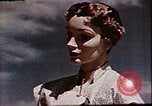
Mannequins are inspected and observers of a blast line up for food at the test site in Nevada, United States.
Operation Cue nuclear test evaluation at Nevada test site in Nevada, United States. Mannequins and their dresses are inspected after nuclear test explosion. Civil Defense observers at the blast site. A butcher cuts meat. Observers of the blast line up for food at the test site. A woman inspects ruins and debris of houses. Civil Defense personnel work at the site. A damaged mannequin is carried out. Views of explosions.
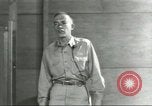
Instructor at Camp Desert Rock, in Nevada, briefs U.S soldiers about atomic explosions
A U.S. Army Captain, instructor at Camp Desert Rock, in Nevada, briefs U.S soldiers about atomic maneuvers. He notes that the first indication of an atomic explosion is the brilliant light created. After that, a fireball will be visible. Animated images accompany his descriptions of changes in the fireball and formation of the characteristic mushroom cloud. Troops being briefed are seated in a large outdoor area at the camp. Using chalk and blackboard, the Captain explains that danger comes from blast, heat, and radiation. Animated images illustrate the effects of atomic blast, as the Captain narrates.

U.S. Army Captain lectures troops about protection against blast from atomic explosion
Animated images accompany views of a U.S. Army Captain briefing soldiers about effects of atomic explosions, at Camp Desert Rock, in Nevada. He emphasises importance of getting down, below ground level, if possible, to avoid blast and flying objects. Troops are seen seated in a large outdoor area for the briefing. Soldiers are told to get down, to protect against blast, as soon as they perceive the flash of an atomic explosion.
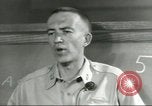
A U.S. Army Captain lectures troops at Camp Desert Rock, about protection against heat from an atomic explosion
An Army Captain stands at a blackboard in Camp Desert Rock, Nevada, as he lectures U.S. Army troops about protection against heat from an atomic explosion. The troops are seated in a large outdoor assembly area. Closeups of the soldiers in the audience. He notes that burns from the heat can occur in a half second from the time of the flash. He notes that burning can occur within 3 miles of the explosion, but ordinary clothing can protect as close as 1 mile away. And, the shade of a foxhole will protect from the heat. The Captain also mentions the blinding flash of an atomic explosion. The troops all look up momentarily at the sun, as he compares it to the flash of an atomic explosion.