


 Francais
 Deutsch
 Italiano
Refine Your Search
+"New Guinea" +1943 stock footage and images
- Showing 19 to 24 of 101 results more
more Hide
Hide
General MacArthur arrives and inspects Allied forces at the war front in New Guinea during World War II.
A USAAF B-17 bomber taxis in after landing at Vivigani Airfield on Goodenough Island in New Guinea. General MacArthur steps from the aircraft and is greeted by the American Air Base Commander. Closeup of General MacArthur. Next, a jeep carrying him and several others is seen from the rear as it drives over roads literally hacked from the jungles. Views of friendly native tribesmen, engaged by the Allies, carrying supplies toward the front. as Australian troops march along side them. View of rough water tumbling in a river and native bearers crossing it on a suspension bridge. View from above of long line of New Guinea native bearers moving along a path. Back at Vivigani Airfield , MacArthur greets some of the American fliers who have been attacking Japanese shipping from there. His B-17E, tail number 41-12633, ("Sally") is parked in the background. General MacArthur salutes and heads to his B-17 (that will take him to 7-Mile Drome near Port Moresby). View of a USAAF B24 Liberator bomber taxiing on the airfield. Another B-24 (named "Connebb's Speciab" is being loaded with bombs. Crew of a B-24 getting briefed as they stand under the wing of their aircraft. A pilot sticking his head out of the cockpit window. A B-24 airborne after takeoff. View from B-24 of a Japanese ship in sea below. Gunners inside the B-24 strafing the ship as the B-24 flies low over it. Bombs dropping during the Aircraft' second pass over the Japanese ship. View of the bombs exploding at port and starboard of the ship. View of clouds and then interior of the B-24 as crew members converse on their way back to their base.
United States 5th Air Force bombers and fighters destroy Japanese targets on New Guinea in World War II.
U.S. Army Air Forces operations in New Guinea Island during World War 2. Animated map highlights New Guinea and shows limit of Japanese defenses. U.S. troops board U.S. Army Air Forces C-47 Skytrain transport plane. Formation of C-47s in sky. C-47 lands. Troops getting off the C-47 and running for cover. Australian troops getting equipment moving armament. Wounded soldier being placed aboard C-47. U.S. Army Air Forces C-56 Loadstar buzzing airfield. American troops making a runway. U.S. Army Air Forces P-38 Lightening fighter aircraft takes off. Shutter of a B-25 Mitchell bomber aircraft. Bombs exploding on Japanese targets. B-25s bomb Japanese ships. B-25s strafing Japanese planes on ground. Parafrog bombs being dropped by B-25s. Shells exploding. U.S. Army Air Forces B-24 Liberator bombers in flight. View at Wewak Island. B-17 Flying Fortress bombers and P-38s in flight.
New Guinea natives carry supplies for the Allies and the Allies bombard a Japanese held island in the South Pacific.
War between the Allied Forces and the Axis troops in the South Pacific during World War II. New Guinea Papuan natives carry arms, ammunition and supplies for the Allies in a boat. An overnight camp of the Papuan people. The natives carry the supplies across mountains and makeshift bridges. The Australians inspect a Japanese submarine in Sydney Harbor, Australia. They remove the firing mechanism of the torpedo and the instrument which helps a torpedo to find its way once fired from a submarine. U.S. and Australian naval forces move towards a Japanese held island and bombard it. The sailors load and fire artillery. Smoke rises in distance as the shells hit the targets. U.S. Marines survey the damage. Dead Japanese soldiers. A lone U.S. Marine with captured Japanese prisoners.
The United States bomber aircraft bomb New Guinea and New Britain in Pacific Theater.
United States B-25 Mitchell bomber bomb Japanese Bases in New Guinea and New Britain in Pacific Theater. Preparations for the attack at night. B-25 bombers stand in a row. Pilots enter the planes. Planes take off. Aircraft in flight. Pilots seated in the cockpit. Smoke rises up due to explosions. Aerial view of the land. Splashes in water due to explosions. Planes return back after the mission is over. (World War II period).
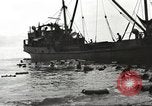
Natives unload gasoline drums from a U.S. supply ship at Horiko Beach, New Guinea during World War II.
Unloading of gasoline drums from a U.S. supply ship at Horiko Beach, New Guinea during World War II. Natives unload drums from the supply ship into water. They push the floating drums towards the shore, roll them on the beach and load them onto trucks. American soldiers stand around.
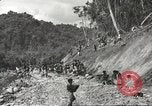
Construction of a road from Oro Bay to Dobodura, New Guinea by natives under supervision of U.S. soldiers during World War II.
Construction of a road from Oro Bay to Dobodura, New Guinea under supervision of engineer battalion of the U.S. Army during World War II. Natives dig a drainage ditch at a side of a road under the supervision of U.S. 116th Engineer Battalion, 41st Division soldiers. Various views of natives working in mud. The soldiers drill holes with pneumatic drills. A bulldozer levels the road.