


 Francais
 Deutsch
 Italiano

Refine Your Search
+"New Guinea" +1944 stock footage and images
- Showing 19 to 24 of 130 results more
 Hide
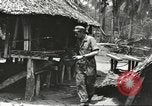
U.S. soldiers put huts on fire and cross a stream during the invasion of New Guinea of World War II.
United States soldiers during the invasion of New Guinea during World War II. Two United States soldiers throw gasoline on native huts. The huts on fire as smoke rises. Men atop an improvised observation tower. A man at a multiple 50 caliber machine gun. A long column of soldiers wades through waist deep water as they cross a stream.

An airstrip being constructed in New Guinea as a Brigadier General looks on during World War II.
An airstrip under construction in New Guinea during World War II. A road scraper works at the airstrip. A Brigadier General of U.S. Army looks on. U.S. Army Lieutenant General Walter Kruger talks to several officers at the airstrip.

An airstrip being constructed and a C-47 aircraft lands in New Guinea during World War II.
An airstrip under construction in New Guinea during World War II. A sign reads ' T2 our motto. Get the lead out of your ass and get it up to the troops'. The airstrip being leveled. Men and equipment at work at the airstrip. A U.S. Army Air Force C-47 Skytrain aircraft lands at the airstrip and taxis. C-47s lined up on the airstrip.

Troops cross a wooden bridge built by engineers across a stream in New Guinea during World War 2
United States troops cross a stream in New Guinea during World War II. United States soldiers get into a rubber raft and pull themselves across a stream. Engineers put logs of wood in the stream as they construct a wooden bridge. The engineers carry wooden logs towards the stream. The soldiers cross the wooden bridge.
U.S. Army Air Forces operations at Nadzab Airfield Complex, New Guinea, during World War II
The U.S. Army Air Forces Nadzab Airfield Complex, New Guinea, during World War 2. USAAF P-38 aircraft on the flightline. A P-38 on takeoff roll passes the camera. Camera pans across the runway to a line of parked B-25 bombers. A B-24 Liberator bomber of the 90th Bomb Group (Skull and Cross Bombs on its tail) takes off, followed by two P-38s,and another B-24. Closing segment shows several Japanese prisoners of war.

Highlights of the Allied New Guinea campaign and other Pacific battles against the Japanese in World War II
The Allied campaign across New Guinea and onward to the Philippines during World War 2. U.S. warships firing their guns at night. Flashes illuminate the blackness. Bombs dropping from an aircraft bomb bay. Bombs exploding on stretch of jungle near water. A U.S. Army Air Forces B-26 bomber in flight View rearward from very low flying USAAF bomber as it bombs it drops explode behind. U.S. troops making amphibious assault on New Guinea. Map showing path of Allied attacks from Australia, across New Guinea from Port Moresby to Buna and on to the Admiralty Islands, cutting off Japanese-held Rabaul, New Britain. Map shows Allied forces moving towards Japanese strongholds at Wewak and along the North shore of New Guinea and bypassing Wewak to strike at Hollandia. General Douglas MacArthur is seen aboard a U.S. warship conferring with American and Philippine officers. Annimated map shows Allied assaults on Japanese positions along the coast from Hollandia, to Warde, Biak, and beyond, stepping along towards the Philippines. Views of numerous fallen Japanese soldiers numbering more than 150 thousand dead. Crosses in battlefield cemetery at graves of some of the more than 13 thousand Allied military who lost their lives during the campaign. A soldier paying respects at one of the gravesites. Admiral Chester Nimitz with members of his staff at his headquarters in Hawaii. U.S. Navy F4F aircraft launching from an American aircraft carrier. American aircraft bombing Japanese positions on an atoll. U.S. warships bombarding Japanese positions with their heavy guns. Admiral Nimitz standing with Admiral William Halsey. More Navy gunfire and amphibious assault scenes. Map showing places where Allied forces had to battle the Japanese, including, Tarawa in the Gilbert Islands, Kwajalein, in the Marshals, Saipan, and Guam in the Marianas, and Palau to complete the "bridging" of the Pacific to the doorstep of the Philippines.