


 Francais
 Deutsch
 Italiano
Refine Your Search
+"New Guinea" +1944 stock footage and images
- Showing 37 to 42 of 129 results more
more Hide
Hide
Indian soldiers, freed from Japanese prison camp, are ferried out of Senai airfield, New Guinea, by L-4 airplanes, during World War II
Pilot sits in cockpit of a Piper L-4 airplane of the U.S. Army Air Corps 25th Liaison Squadron, parked on a grass field at Senai, New Guinea, during World War 2. An Indian Punjab soldier, recently freed from a Japanese prison camp, sits in the back seat of the airplane. Several soldiers watch as the airplane takes off. A local tribesman sits near an Australian officer and an American pilot, who have a map spread out in front of them. A local native approaches followed by another liberated Indian soldier, walking with help of a stick. The American pilot walks out to greet the Indian who shakes his hand and bows. Another Indian also walks out to greet him, salutes, and shakes his hand. Three Indian soldiers pose for the camera, with the U.S. pilot standing nearby. The one with the walking stick salutes. Then two of them shake hands. Several Australian soldiers pose for the camera. Closeup of a Piper L-4 airplane with "Guinea Short Lines," and image of kangaroo, painted on its fuselage.

Highlights of the Allied New Guinea campaign and other Pacific battles against the Japanese in World War II
The Allied campaign across New Guinea and onward to the Philippines during World War 2. U.S. warships firing their guns at night. Flashes illuminate the blackness. Bombs dropping from an aircraft bomb bay. Bombs exploding on stretch of jungle near water. A U.S. Army Air Forces B-26 bomber in flight View rearward from very low flying USAAF bomber as it bombs it drops explode behind. U.S. troops making amphibious assault on New Guinea. Map showing path of Allied attacks from Australia, across New Guinea from Port Moresby to Buna and on to the Admiralty Islands, cutting off Japanese-held Rabaul, New Britain. Map shows Allied forces moving towards Japanese strongholds at Wewak and along the North shore of New Guinea and bypassing Wewak to strike at Hollandia. General Douglas MacArthur is seen aboard a U.S. warship conferring with American and Philippine officers. Annimated map shows Allied assaults on Japanese positions along the coast from Hollandia, to Warde, Biak, and beyond, stepping along towards the Philippines. Views of numerous fallen Japanese soldiers numbering more than 150 thousand dead. Crosses in battlefield cemetery at graves of some of the more than 13 thousand Allied military who lost their lives during the campaign. A soldier paying respects at one of the gravesites. Admiral Chester Nimitz with members of his staff at his headquarters in Hawaii. U.S. Navy F4F aircraft launching from an American aircraft carrier. American aircraft bombing Japanese positions on an atoll. U.S. warships bombarding Japanese positions with their heavy guns. Admiral Nimitz standing with Admiral William Halsey. More Navy gunfire and amphibious assault scenes. Map showing places where Allied forces had to battle the Japanese, including, Tarawa in the Gilbert Islands, Kwajalein, in the Marshals, Saipan, and Guam in the Marianas, and Palau to complete the "bridging" of the Pacific to the doorstep of the Philippines.
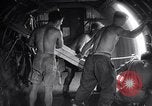
Soldiers drop supplies from C-47 Skytrains over Salamaua in Papua New Guinea.
March 1943: Soldiers in Douglas C-47 Skytrains prepare to drop supplies for American and Australian troops over Salamaua in Papua New Guinea. Aerial view of drop point in Salamaua with parachutes from previous drops visible on the ground. Supplies with and without parachutes descend to the ground. Planes fly low over the drop area. Parachutes with medical, food and ammunition supplies. C-47s fly low over the drop area. Planes fly over the peninsula. (World War II period).
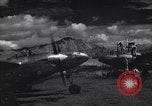
P-38 aircraft and ground crews of U.S. 49th Fighter Group in New Guinea, during World War II.
P-38 Lightning aircraft of the 9th Fighter Squadron, 49th Fighter Group, at Schwimmer Field near Port Moresby, New Guinea, during World War 2. Crew chiefs attend to P-38 aircraft, some with engines running. Ground crewmen manually maneuver nose wheel using towbar. Crew chief cleans the aircraft of American Ace, Captain Richard I. Bong. His P-38, named "Marge," displays large picture of woman and 27 Japanese victory flags ( Bong having just broken Eddie Rickenbacker's World War I record of 26 victories). Staff in control tower use light signals. Aerial view from airplane flying among cumulus clouds.
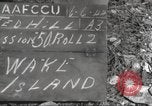
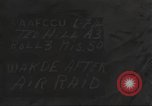
Views of destruction from Japanese air raid on Wakde Island, New Guinea, as U.S. forces occupy it during World War II.
Scenes of destruction from Japanese air raid on Wakde Island, New Guinea during World War II. (Opening slate incorrectly reads Wake Island.) U.S. troops bivouacked in tents near shore. Large supply Ship and several others visible in background.
U.S. Aircraft destroyed on the ground by Japanese air raid in Wakde, New Guinea, during World War II.
Aftermath of Japanese air raid on Wakde Island, New Guinea during World War 2. Numerous destroyed U.S warplanes litter the field. Some are still burning. Most are unrecognizable, but the wrecks appear to include B-25s, B-24s, and P-38s.