


 Francais
 Deutsch
 Italiano
Refine Your Search
+"New Zealand" +1945 stock footage and images
- Showing 1 to 6 of 7 results more
more Hide
Hide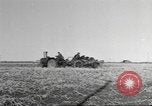
Food and rations supplied by New Zealand to U.S. Army Quartermaster South Pacific operations during World War II.
Cooperation between New Zealand and the U.S. Army Quartermaster Corps during World War II. A tractor on a farm in New Zealand. A tractor plows the field. The Pukekohe Golf Club, near Wellington, converted from golf to farm to grow crops for the war effort. New Zealand farmers works in the field. Farmers load a truck with sacks of potatoes. Close up view of potatoes on a sorting belt and farmers sort potatoes and bag them. Women workers sort cabbage and package the cabbage for shipment. Men and women farmers picking fruits and vegetables in farm fields. A factory shows apples being moved on a belt driven machine, and peeled and cored by a machine, cut into very small pieces and dehydrated in order to conserve shipping space. Canning operations are shown as the dehydrated fruits and vegetables are packed in moisture proof tins in packing houses. Meat and vegetable are mixed in proportions to prepare Quartermaster combat rations. Combat ration cans being filled and sealed at a factory plant. A machine re-generating chocolate bars from old chocolate by melting them down and reprocessing them. Soldiers unloading cartoons from the truck. Rations from New Zealand are loading on to ships by cranes with nets at large shipyards, with ships bound for the Solomon Islands. A dairy warehouse of the New Zealand Co-op Dairy Company (later Tatua) is seen at an airport near Auckland (Possibly Tatuanui or Pauanui). Milk is loaded into a specifically converted B-24 aircraft at the airport. Soldiers loading the aircraft with milk containers. The B-24 aircraft takes off. The aircraft arrives at the Tontouta Air Base in New Caledonia. A nurse serves milk to a wounded soldier patient in a hospital. Sign over the patient's bed says "Pappy Shooter, 27th Division; Saipan; Oahu, Hawaii". The patient drinks milk. Bread being made in Quartermaster bakery. A group of Army bakers working together to form loaves of bread dough on a large work surface. Workers making bread. A worker opens an oven revealing many loaves of baked bread. Ice slabs being formed at an ice plant, and soldiers picking up ice blocks for use in preserving meats and other foods, and in making ice cream. A soldier making ice cream using an ice cream churn in the field. View of a larger Quartermaster ice cream plant that was setup at a large base.
South African and New Zealand troops occupy Florence in Italy.
Mop up operation by British Allied forces in Florence, Italy, during World War 2. South African and New Zealand troops advance on tanks. Soldier looks through binoculars. Views of city of Florence including Florence Cathedral (Duomo). View of Ponte Vecchio bridge in the city, the only one spared by the German forces who destroyed all other bridges over the Arno River at Florence. Soldier fires from the hidden area. Explosions in the city. Soldiers patrol on streets of Florence. Civilians on streets, including some partisan civilian soldiers aiding in the elimination of German sniper positions.
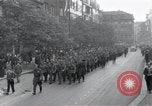
Czech soldiers march and sing; group of United States and New Zealand liberated prisoners in Prague, Czechoslovakia.
Czech soldiers in Prague, Czechoslovakia near end of World War 2 in Europe. The soldiers sing as they march in the streets. Civilians stand beside a street and watch them. The soldiers carry rifles on their back. A group of liberated United States military and New Zealand military prisoners stand on a bridge.
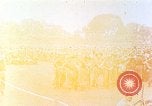
American, Australian, New Zealand and Chinese troops participate in victory parade in Rangoon, Burma.
Allied troops participate in a victory parade in Rangoon, Burma towards the end of World War II. The troops of the United States, British forces of Australia, New Zealand and China are gathered on a grassy field. They stand in formation and parade on the field. An artillery gun is fired in honor. Dignitaries review the parade.

Signing of the surrender note aboard the USS Missouri after the surrender of Japan to the Allied Forces in World War II.
Signing of the instruments of surrender formalizing the capitulation of Japan to the Allied Forces in World War II. The Battleship USS Missouri in the Tokyo Bay. The U.S. Destroyer, Buchanan, pulls alongside bringing representatives of the Allied Powers to participate. U.S. General of the Army, Douglas MacArthur, Supreme Commander of Allied Forces boards the USS Missouri and is welcomed by Fleet Admiral Nimitz and Admiral Halsey. They proceed to the ship's Veranda deck for the signing ceremony. Japanese delegation led by Foreign Minister Mamoru Shigemitsu, accompanied by General Yoshijiro Umezo arrives in a boat. Speech by MacArthur as Japanese delegation looks on. Japanese representatives sign the surrender instruments. General MacArthur then signs using several pens that he presents to U.S. General Wainwright and British General Percival and others. Admiral Chester Nimitz signs for all U.S. forces, followed by Admiral Halsey. Allied representatives then sign for China, the United Kingdom, Soviet Union, Australia, Canada, France, Netherlands, and New Zealand. MacArthur gives closing comments. Allied aircraft fly overhead after the ceremony.
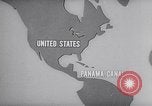
Mutual aids to one another by Allied nations under the lend lease program, fighting against Axis powers during World War II.
Charles Winninger narrates facts about the lend-lease and mutuals aids by Allied nations fighting against the Axis powers during World War II. Animated map shows Japanese threaten eastern coast of United States. British aid under the lend lease flies to U.S. German attack on Suez canal countered by British and U.S. Armies. Map shows timely aids allowed munition factories at work and new recruits joining the military. Australia and New Zealand aid the fighting Allied nations. U.S. warships to Russia in return to graves of German. Aid to China in return to the death of Japanese. Animation shows dropping of atom bomb and unconditional surrender of Axis nations.