


 Francais
 Deutsch
 Italiano
Refine Your Search
+"Normandy France" +1943 stock footage and images
- Showing 1 to 6 of 6 results more
more Hide
Hide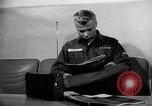
The story of AFN ( American Forces Network) Radio. Founding announced in 1942. First broadcast in 1943; growth in 1944.
U.S. Army soldier reads newspaper while listening to radio. Soldiers doing their respective chores, listen to AFN (American Forces Network) Radio. General Marshall and General Eisenhower announce the creation of AFN, in 1942. July 4, 1943, the first broadcast of AFN. General Eisenhower mingling with paratroopers of the 101st Airborne Division, on the eve of D-day. U.S. B-26 aircraft in flight. United States soldiers aboard landing craft and wading ashore at Normandy, France, on D-day, June 6, 1944. Soldiers tuning radios in the field. United States Sherman tanks and infantry move along country road in France. Audio includes portions from AFN broadcasts, including an announcer saying "You are listening to AFN Paris. This is the American Forces Network, on the road to Berlin." Road sign points to St. Lo. Group of U.S. soldiers gathered around a jeep with a radio, listening to AFN, in Germany. (World War II period).
Allied troops aboard ships and gliders head for Normandy, France for the D-day invasion during World War II.
Allied invasion of Normandy, France during World War II. U.S. General Joseph McNarney, Deputy Chief of Staff at a desk as he outlines the importance of June 6, 1944 the day Allied forces attacked the Germans in Normandy. He speaks about the decision to knock down the Nazis first and then the Japanese during the World War. He says that the invasion of Normandy was planned in November 1943. He also states how General Dwight D. Eisenhower, Supreme Commander of the Allied forces in Europe, planned and executed the invasion. He also speaks about how the U.S. Army Air Forces and the Royal Air Forces aircraft bombarded the coasts of Normandy prior to the D Day invasion. Past events show American soldiers getting onto landing crafts in England as they leave for the invasion. The soldiers aboard the ships in the English Channel. The soldiers read the Bible and comics, sleep and cook aboard the ships. On June 5th , 1944 the ships head towards Normandy for the invasion. In England gliders carrying paratroopers take off from an airfield to bombard the German positions in Normandy. British soldiers receive ration and work on motorbikes. TNT (trinitrotoluene) charges being prepared by soldiers tasked with demolition duties. British soldiers check their guns and other weapons prior to the invasion. Jeep and artillery being loaded onto aircraft.
Preparations for allied invasion of Normandy France during World War II.
'Normandy: Air borne invasion of fortress Europe ' Allied invasion of Normandy. Lieutenant General William S Knudsen introduces the film to be presented, expressing thanks to makers of the glider aircraft used in the invasion, who are the intended audience of the film. Field Order no1, 9th Troop commander Carrier. A man puts a Top Secret seal on the order. The Captain of United States 82nd Air Borne Division briefs men about the terrain with the help of a mosaic. A map of Europe shows principle cities of the continent. Map and narrator describe German Atlantic Wall coastal defenses on European continent. A giant concrete coastal gun emplacement. A large German railroad coastal gun moved out of a concrete shelter. Various concrete structures, sandbag structures of coastal guns. A concrete base gun turret revolves. Huge coastal guns protrude from concrete gun emplacements. Huge steel and concrete tank barriers stretched across. Large concrete and steel structures built along the coast to prevent assault craft from landing. Combined Chiefs of staff of the United Nations at a meeting. George Marshall and Henry Arnold at the head of the table during the meeting. A map shows invasion area near Le Harve. Troop Carrier units departing for Allied invasion on Sicily, Africa on 10 July, 1943. The United States C-47 aircraft take off towing gliders from an airfield in Africa. Troops transported from British 1st Air Borne division and United States 82nd Air Borne division. Dust rises as aircraft take off from a desert field. Demolished gliders on field and beside water. Multiple views of demolished gliders. C-47 in flight and paratroopers jump from the plane in New Guinea. Instructor trains paratroopers in United States. Discussion and demonstration of improvements in glider equipment and usage after Sicily Invasion and prior to D-Day Normandy invasion. Two men attach link nose chain to glider. Parachute extended and held open by men. Pilot of a glider talks to the pilot of the plane towing the glider over intercom.
Joseph Stalin, Franklin Roosevelt and Winston Churchill at Tehran conference; also Yugoslavian and French resistance fighters.
General Secretary of the Communist Party Joseph Stalin, President Franklin D Roosevelt of the U.S. and Prime Minister Winston Churchill of the UK seated on porch of Soviet Embassy building in Tehran, Iran, 28 November 1943, during World War 2. Scene shifts to group of Yugoslav Partisans and closeup of their leader, Marshal Tito, at their mountain headquarters. Yugoslavian Marshal Tito smoking a pipe while standing on the porch of his headquarters with American Office of Strategic Services (OSS) Officer, Army Major Linn M. Farish, U.S. Liaison to the Partisans, and British Brigadier General Fitzroy Maclean, Winston Churchill's special envoy to the Yugoslavia leader. Next scene shows French resistance fighters with their flag on a mountaineer's pick. It reads,""Vaincre ou Mourir"" and displays a cross of Lorraine. Closeups of French resistance fighters at attention and also relaxed, smiling, and singing. Scenes of various such groups joining in the June 6, 1944 Allied invasion at Normandy, France. Aerial glimpse of D-day task force crossing the English Channel. Animated map shows Germany being attacked by Russian forces from the East, by the other allies from Britain in the West and from Italy, in the South. Allied forces moving across a pontoon bridge and engaging German forces in France. A U.S. M3 Gun Motor Carriage firing its 75mm gun. American troops firing machine guns, carrying wounded on stretchers and using flame throwers. Troops, including ambulatory wounded moving under enemy fire. Paratroopers of the 101st Airborne Division in France. One carries a wounded buddy. American troops firing a variety of artillery from under camouflage netting. French underground forces engaged in Paris. Closeup of one wearing a French Adrian helmet firing a rifle. Another throws a grenade out an apartment window. An American tank moving under the base of the Eiffel Tower as French Resistance fighters run across the area. French citizens celebrating the liberation of Paris. View from an American jeep as French people cheer. Closeups of French people. A bombed out bridge. A battlefield cemetery. Destruction and death in the wake of combat. Fallen French civilians lying on pavement. A U.S. tank slowly driving through a masonry wall. Soviet forces advancing through destroyed buildings. Chinese troops marching along the Great Wall. British troops on parade in tropics. Asian ally troops marching. Huge formation of marching U.S. soldiers. United Nations flags in the breeze.
Preparations in England for the D-Day invasion of Normandy in World War II
World War 2 invasion of Normandy, France. President Franklin D. Roosevelt, Marshal Joseph Stalin, and Prime Minister Churchill, meeting at Tehran, Iran, in December 1943. U.S. Generals George Marshall and Hap Arnold, at conference table. Closeup of General Dwight D. Eisenhower. Map showing defense areas of the German 7th, 15th and 19th Armies in Europe. Map showing ports at Brest, Cherbourg, Le Havre, Dieppe, and Calais. Cherbourg is highlighted. U.S. Army trucks, tanks, and artillery, stockpiled in England. Railroad train carrying M3 Stuart tanks. U.S soldiers leaving troop ships and marching to their camps in Britain. Allied troops practicing amphibious assaults on Southern coast of England. Formation of B-26 bombers. View from Allied aircraft flying low over German-occupied area. B-17 aircraft dropping bombs over Germany. Bombs away view seen as bombs drop toward enemy targets. German fighter planes attacking B-17 bombers beginning in February 1944. Gunner in turret of B-17 firing at them. Dogfight views with German fighter aircraft. A B-17 exploding in the air. German fighter downed by B-17 gunner. Gun camera footage of German Bf 109 attacked from rear by gunfire. Just as it is hit it releases its drop tank. American soldiers in trucks, DUKWs, M4 tanks, and M8 armored Cars. Troops receive gas masks, waist life belts, field rations, and French money. May 30, 1944, American soldiers board tanks, trucks and other vehicles bound for embarkation points in England. Seen are Stuart M3 light tanks, jeeps, and M7 Priest tanks. M7 tanks are seen, equipped with intake and exhaust ducts. (At TC:11:39, U.S. M7 Priest tanks, equipped for deep wading, are seen passing the base of the Jubilee clock on the beachfront at Weymouth, on their way toward Castle Town in Portland for embarkation.) Transport ships are loaded at the embarkation ports. Trucks being backed onto LCT-453. U.S. Army infantry marching and boarding transport ships. Troops marching into LST 376 at Plymouth, England. Higgins Boats, from the USS Samuel Chase (APA-26) bringing troops to board her. Troops on deck of Attack transport, USS Joseph T. Dickman (APA-13). Barrage balloons overhead. Soldiers shooting craps on a troop ship deck. Coastguardsmen playing with a puppy dog. Gun crews on U.S. Navy warship being briefed. Soldiers field-strip and check their weapons.
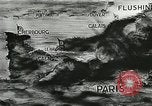
Allies decide that Normandy, France, is the best location for an invasion in World War II. Workers mobilize to build weapons of War in the U.S. and Britain.
Map shows coast of Europe with discussion of various places for a possible Allied invasion of France during World War 2. Normandy was chosen. German coastal defenses on English Channel and Atlantic shore (Atlantic Wall). German officers inspect defenses. Map highlights Cherbourgh, Le Havre, and Caen in Normandy. American workers building war machinery in defense plants and shipyards. Huge numbers of workers are seen in the yard of a U.S. defense plant. View inside a U.S. factory where numerous M3 Lee tanks are being manufactured on production lines during 1941-42. A welder at work. A woman using a saw and many other workers in a busy machine shop. B-17 bombers being built in a Boeing factory. Liberty ships under construction at a shipyard. A lookout watching the skies above a city, for enemy aircraft. A man and woman working together on a plumbing job. British women in Army uniforms working with typewriters. An American woman driving a forklift and loading a piece of ordnance on a railroad freight car. A rail yard filled with stream locomotives and freight trains. A line of trucks carrying war time cargoes. An army truck being loaded into the hold of a cargo ship. Ships underway in a harbor.