


 Francais
 Deutsch
 Italiano
Refine Your Search
+"Normandy France" +1944 stock footage and images
- Showing 439 to 444 of 579 results more
more Hide
Hide
United States Army soldiers land on beachhead during Allied invasion of Normandy in World War II
Allied invasion of Europe during World War 2. Opening scene shows sailors preparing to launch a landing craft. Skies are dark above and some barrage balloons are aloft. A Landing Craft Tank (LCT), filled with soldiers, slowly approaches a secure beachhead where U.S. Army trucks are driving along the beach. Next, the LCT has beached and lowered its front ramp. It is still some way from the beach. Soldiers ride jeeps down the ramp and through the water toward the shore. Some soldiers are seen dug in on the beach. Others march informally along the beach. Jeeps and trucks drive along the beach. Dark black smoke rises in the background An M4 Sherman of the 70th Tank Battalion, fitted with a bulldozer blade, moves past a fallen (dead) soldier partially covered with a tarp, lying on the sand. Small clusters of soldiers are setting up positions in the sand. Medics carry two stretchers towards a landing craft as they wade through the surf. Soldiers wade ashore from a stranded LCT.
U.S. troops setting up defensive positions and bringing supplies ashore, during the Normandy invasion of World War II
Several U.S. soldiers set up defenses inland from a Normandy invasion beachhead during World War 2. One, in a sand-bagged position, loads cartridges into a bandolier. Closeup of two others in a sand-bagged communications center containing radios; light and other signalling equipment. The soldier loading rounds into a bandolier is seen again. A group of soldiers appear relaxed as they converse. View of the beach, where landing craft are beached and caterpillar tractors move about. A Rhino Ferry (barge) containing many trucks, sits in the water, close to shore. Two soldiers in a DUKW amphibious vehicle move along the beach.
U.S. forces being resupplied on a beachhead during the invasion of Normandy in World War II
Logistic support during Normandy invasion of World War 2. Soldier of U.S. 101st Airborne Division walks toward Normandy beachhead where large supplies of military equipment are seen onshore. Several landing craft are beached and tractors equipped with "A" frames move across the sand. U.S. Soldiers occupy a sand-bagged bunker. Radio antennas are set up. Scene changes to closeup of Army 6x6 camvas-covered trucks making their way from a Rhino Ferry (barge) across shallow surf to the beachhead. A barrage balloon is aloft in background.
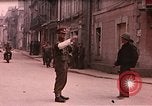
A soldier directs traffic at an intersection in Normandy while being harassed by a G.I. for a light during World War II.
A moment of comedy during the Invasion of Normandy. A soldier directs traffic at an intersection while a G.I. bothers him to light his cigarette. The lighter doesn't work, and the G.I. throws it on the ground. A truck drives past them. The soldier approaches a woman for a light instead. Sign on a building reads, 'Penchurch S'
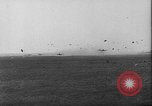
German Air Force fighter bombers support infantry in Battle of Normandy during World War II
German Air Force (Luftwaffe) operations in support of the German 990th Regiment (990th Volksgrenadier Regiment of the 277th Infantry Division) during battle of Normandy, following Allied invasion in World War 2. German Focke-Wulf FW-190s take off from a field in France and proceed on tactical mission interdicting Allied lines of communication in Normandy. View of FW-190 dropping bombs, and of others strafing roads, and ground targets where Allied military movements are underway.

Allied bombers raid Nazi German targets, before ground forces reach coast of Normandy in France during D-Day Invasion (WW2)
Allied forces raid the coast of Normandy in France on the D-Day invasion, during World War II. Some of the first views of warships bring back dead and injured Allied soldiers from the Normandy battle to British ports. Infantrymen march on roads during preparations for D-Day invasion. Boats, landing vehicles and battleships sail towards the coast of Normandy from England. Allied bombers bombing the coast of Normandy prior to the ground forces landing there. Aircraft seen in the skies include the Boeing B-17 Flying Fortress, Consolidated B-24 Liberator, and Martin B-26 Marauder bombers seen from above. Aerial views of bombers releasing bombs and smoke markers on targets for other bombers to follow. Many views of bombs impacting on German controlled targets in France and smoke rising from targets. A bridge over water is bombed. Smoke arises from bombing of rail lines and supply routes.