


 Francais
 Deutsch
 Italiano
Refine Your Search
+"North Africa" +1954 stock footage and images
- Showing 1 to 6 of 8 results more
more Hide
Hide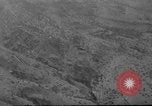
French troops on patrol on patrol in North Africa. Leaders carry submachine guns. Hilly terrain, sparse vegetation,palm tree
Aerial view of hilly terrain with sparse vegetation. French troops on patrol, coming single file down a sloping path along a wire fence. Radioman with backback radio and antenna, stands by as officer uses the handset. Troops ,armed with rifles, patrol along river. View of palm trees growing on shoreline. A patrol moving along rugged stony path. Patrol leaders carrying French MAT-49 submachine guns.
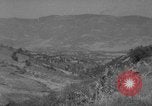
French troops establish fortified position atop a mountain in North Africa
Rugged terrain and mountain ranges. Trucks loaded with French soldiers drive through a hilly area. Trees in the background. Cattle and civilians walk on roads. Trucks drive on a curving road. The soldiers jump from the trucks and climb up a hill. A soldier looks down at ground. A truck drives through a village. Local civilians sit under a tree. Soldiers dig the ground with shovels. They pass stones in a brigade and construct a fortification. Loaves of bread loaded into the back of a truck. A boy serves bread to the soldiers. The soldiers cleanup and rest and relax under a tree near tents.
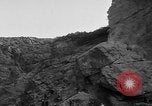
French military engineers survey and use explosives to carve out roads and build fortifications in mountains of North Africa
French military engineers using a transit, on a tripod, take surveying measurements. Two French Legionnaires use a pneumatic drill to make holes in rock for dynamite sticks. Large group of local tribesmen work on project. Legionnaire places dynamite into prepared hole in rock. Dynamite is detonated producing cloud of smoke and causing large amounts of rock to collapse. Local workers scramble over the dynamited area.
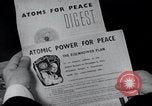
Voice of America broadcasts President's speech and USIS "Atoms for Peace" exhibits are presented worldwide
President Eisenhower of the United States addresses United Nations on December 8, 1953 about atomic bomb and atomic weapon dilemma in the nuclear age (part of Atoms for Peace initiative). Operators in radio transmission control rooms note down readings. View of time clocks of various places in the world including Honolulu, New York, London, Moscow, Calcutta, Bangkok and Tokyo displayed. The Voice of America broadcasts program in different languages by announcers. Scene of a family sitting in a living room as they listen to the president's speech on a console radio. People work at typing, printing, and translating the speech. USIA motion pictures service prepare newsreel of president's speech. A man views air mail of USIA films. Exterior views of several different United States embassy buildings worldwide. A guard standing outside the building. A Public Affairs Officer at the U.S. embassy in Japan, in Tokyo, meets with U.S. Ambassador to Japan Robert Murphy. USIA members seated around table for meeting, and, in Washington DC, creating publications about the Atoms for Peace program. People seated in a USIA library in Brazil read books and various USIA materials. Architects design 30 foot high Atoms for Peace exhibits. An exhibit being setup in a foreign country (possibly in North Africa). Exterior and interior views of the West Berlin, Germany Atoms for Peace exhibit. Prime Minister Jawahar Lal Nehru in India is seen arriving in a jeep to view the Atoms for Peace exhibit in India. Prime Minister Nehru inside the exhibit hall watching a presentation. In Japan, a woman operates remote-controlled robotic hands to hold radioactive materials, at a demonstration for Japanese citizens. In a city in Italy, a view of a mobile van unit carrying an Atoms for Peace exhibit. Scenes from a film "A is for Atom" that was translated into 30 languages and shown all over the world. Wide view of the Kremlin in Moscow, Russia, Soviet Union. A Russian radio commentator speaking at a microphone. Propaganda dramatization showing the Russian announcer attacking American plans for Atoms for Peace.

Prince Charles and Princess Anne board the Royal Yacht Britannia in England.
Prince Charles and Princess Anne arrive at a shipyard, accompanied by the Queen Mother and Princess Margaret in England. They get off the car and soldiers welcome them. Royal Yacht Britannia at the shipyard. The royals board the ship. Crew standing on the ship to welcome them. Queen bids good bye to the children. The ship begins its long journey to North Africa where the King and Queen are on tour.
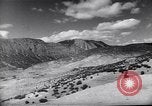
Moroccan Goums (Gourmiers Marocains--native Moroccan tribesmen soldiers under French command)
Mountains are seen in Morocco. French officers inspect a small contingent of Goums in formation.. These were known as "Gourmiers Marocains," a name Americanized to "Goums" by U.S. soldiers during WWII. The patterns on their flowing coats indicate their tribal affiliations.