


 Francais
 Deutsch
 Italiano
Refine Your Search
+"Northern Mariana Islands" +1944 stock footage and images
- Showing 1 to 6 of 229 results
Soldiers on a U.S. war ship destroy Japanese aircraft flying off the coast of the Northern Mariana Islands.
A U.S. Task Force destroys Japanese aircraft in the Northern Mariana Islands during World War II. The Japanese aircraft in flight. A U.S. war ship in the Pacific Ocean. U.S. soldiers at a gun barrel. Explosions in the air. A Japanese aircraft catches fire and plunges in the sea.
U.S. amphibious assaults on Saipan and Luzon during World War II
June 14, 1944. Naval guns of U.S. battleships and other warships bombard the island of Saipan, in the Marianas, in World War 2. U.S. aircraft fly low over the shore attacking Japanese military positions. A U.S. tank and marines moving on the beachhead. October 19, 1944, landing craft, manned by U.S Coast Guardsmen, from the Coast Guard operated Attack Transport USS Calloway (APA-35) are seen among others maneuvering in the water as they begin the assault on Luzon, the Philippines. U.S. troops wading ashore on Luzon.
U.S. convoy of freighters, aircraft carriers, and LSTs, reaching Saipan Island, Mariana Islands in World War II
The Pacific Campaign on the Island of Saipan, Mariana Islands during World War 2. Map titled 'Mariana Islands' showing the location of U.S. carrier convoy. Map showing the location of LSTs (Landing Ship, Tank). Map with heading '804th Aviation Engineers in Saipan'. Map and sea route marked from Hawaii past Johnson Island showing location of transport convoy, June 17, 1944. Convoy at sea showing men aboard the ships looking down at the water. Convoy showing the various types of vessels in the convoy, mostly freighters. Continuation of maps with sea markings of the route of the convoy showing the location of Kwajalein Islands and location of Eniwetok. Carriers underway showing planes aboard the carriers. Personnel on look out, aircraft spotters and others. Huge geyser of water erupting near a freighter. Convoy off the coast of Saipan showing a huge geyser of water going up. LSTs and freighters at anchor off the coast of Saipan. Personnel aboard LST as they move in towards the shore. Gun flashes can be seen ashore. Unloading operation showing the LST pulling into shore, the door falls down into the water and a half track pulls out and moves into the shore loaded with men and equipment. Trucks, jeeps and all types of equipment moving across the water in toward shore. Men walking ashore.
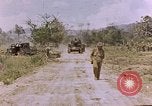
Aftermath of Japanese last desperate "banzai" attack against American forces on Saipan in World War II
Opening scene shows an M8A1 75mm Howitzer motor carriage (variant of M8, using M5A1 Stuart tank chassis). It moves slowly toward the camera along a dirt road on Saipan during World War 2. Closeup shows short gun barrel and driver in turret above, speaking on radio. Bodies of many Japanese soldiers are seen, recently killed in final attacks culminating in their organized suicide assault (AKA "the Tanapag Plain banzai attack") on July 6th and 7th, 1944. A marine throws a hand grenade at a clump of foliage. (Note: Principal American defenders included units of the 105th Infantry, that bore the brunt of the assault, together with 165th Infantry; 23rd Marines; 24th Marines; 25th Marines; 20th Marine,Engineers; and 10th Marines, plus supporting artillery units.
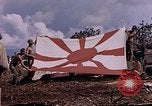
Aftermath of Japanese Banzai charge on Saipan, Mariana Islands during WWII
Americans display (holding it upside down) a huge Japanese rising sun Vice Admiral rank flag , captured after a desperate "banzai" attack by Japanese forces on Saipan, during World War 2. A photograpner takes a picture. Ammunition left on the ground from the battle. Two knocked-out Japanese Type 95 Ha-Go tanks. Destroyed defensive positions and buildings. Americans examine remains of buildings and defensive positions. Several local civilians walk into the center of the scene of death and destruction. Dead Japanese soldiers are seen everywhere, throughout the sequence. (Note: Aftermath of the "Tanapag Plain banzai attack" on July 6th and 7th, 1944. Americans engaged included units of the 105th Infantry; 165th Infantry; 23rd Marines; 24th Marines; 25th Marines; 20th Marines; and 10th Marines.)
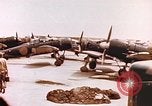
Aircraft of 19th Fighter Squadron and 6th Night Fighter Squadron land at Saipan, after its capture during World War ii
U.S. Army Air Forces begin operations on Saipan after its capture from the Japanese during World War 2. Japanese Zero fighter planes parked in a jumble on Saipan, after its capture by American forces in 1944. American soldiers are seen walking about and U.S. Army engineers are repairing the field for use. The first American P-47 to arrive, after Saipan is secured, lands on the airfield. Its pilot, Major Henry E. McAfee, Commander of the 19th Fighter Squadron, 318th Fighter Group, poses by his P-47 named "Jeanie." At another area of Saipan, U.S. Marines administer medical aid, including blood plasma, to a wounded comrade. A P-61 of the 6th Night Fighter Squadron lands on the field. Aerial views of Saipan, showing destroyed structures and buildings.