


 Francais
 Deutsch
 Italiano
Refine Your Search
+"Nuremberg Germany" +1946 stock footage and images
- Showing 55 to 60 of 68 results
Judge Musmanno questions defendants and they respond during the Nuremberg Trials in Germany.
The Nuremberg Trials for World War II war crimes, at Nuremberg in Germany. Judge Musmanno questions the defendants at the court. The defendants called one after the other answer the questions of the judge and prosecutors at the court. The defendants continue pleading 'not guilty' at the court. The judge recesses the court.
Rudolf Hess seated in the dock during the Nuremberg Trials in Germany.
Nuremberg Trials. All present are standing as Panel of judges enters the chamber and takes their seats. Flags of several nations behind them. Rudolf Hess Deputy to Adolf Hitler, is tried at the Nuremberg Trials in Germany. The judges of the Nuremberg Trials sit. United States flag in the background. Attorneys and translators don headsets with microphones. The defendant Rudolf Hess is seated in the dock alone. Judge ask about reference to a medical report. Hess speaks to his attorney about it. Rudolf Hess is asked about his "forgetfulness" and memory about the period before his flight to England. His ability to properly participate in his trial and defense is put in question. Prosecution asserts that he should be tried regardless of his claims of amnesia.
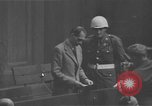
Rudolf Hess defends himself during the Nuremberg Trials in Germany.
Deputy to Adolf Hitler, Rudolf Hess is tried at the Nuremberg Trials in Germany. The defendant, Rudolf Hess, is seated alone in the dock. Rudolf Hess stands and speaks, making an extended personal statement. Military Police officers stand near him.
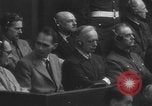
International Military Tribunal announces verdicts in trial of Nazi leaders in Nuremberg
Judgments being announced regarding Nazi leaders tried for war crimes during Nuremberg trials in Germany. Justice Francis Biddle declares Joachim Von Ribbentrop guilty of all charges against him. Hermann Goering, Rudolf Hess and Ribbentrop and other Nazi leaders in prisoner's dock. Justice Geoffrey Lawrence speaks about defendant Ernst Kaltenbunner.
Hans Frank describes the atrocities inflicted on prisoners by the Nazis; Hoess testifies; footage of atrocity evidence.
During Nuremberg trial Hans Frank describes the Nazi policies of exterminating Poles and others. Atrocities inflicted on prisoners in Ourador Sur Glane, France in Bande, Belgium in Catacombe, Italy and in Czechoslovakia. Nazi German soldiers engaged in destruction following massacre of many residents in town of Lidice, Czechoslovakia in 1942 (retaliating for the assassination of SS officer Reinhard Heydrich.) Dead bodies in Nazi concentration camps, including Auschwitz, in 1945. Bones visible in crematory ovens. Victims inside crowded barracks including women prisoners who have been liberated. Large piles of items taken from victims before their deaths, including luggage, hair locks, toothbrushes, shaving cream brushes, shoes, clothing. Bones of victims piled at a concentration camp. Rudolf Franz Ferdinand Höss (sometimes spelled Höß or Hoess or Hess) describes concentration camps at Auschwitz in Poland during testimony. Victims in hospitals are shown, as words of Hess describe medical experiments include lowering the body temperature, injecting the body with poisons and infectious diseases and subjecting victims to high altitude pressure chambers. View of mutilated corpses. Sign that reads, "Arbeit Macht Frei" over the Auschwitz concentration camp gated entrance. Corpses of victims in the concentration camps.
During Nuremberg trial Nazi leaders questioned by prosecution
During Nuremberg trial attorneys of Nazi leaders defend them. Nazi leaders Kaltenbrunner and others testify. Prosecution asks questions. Rosenberg, Kietel, Reader, Joachim von Ribbentrop, Goring. Walther Funk and Schirach make final statements.