


 Francais
 Deutsch
 Italiano
Refine Your Search
+"Nuremberg Germany" +1947 stock footage and images
- Showing 7 to 12 of 12 results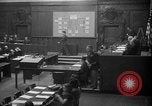
Defendants rise as their names are called and they plead to the indictment during war crimes trials in Nuremberg, Germany.
Indictment of Flick during war crimes trials (Flick case) in Nuremberg, Germany. Defendants rise as their names are called. Defendants include Freidrich Flick, Otto Steinbrinck, Odilo Burkart, Konard Kaletsch, Bernhard Weiss and Hermann Terberger. Defendants Flick, Steinbrinck, Burkart and Weiss plead to the indictment. Judges enter into courtroom and take their seats. American General Lucius D Clay seated in prosecution section of the courtroom. Defendants in dock.
M A. Musmanno calls three defendants for trial and B. Ferencz makes his opening speech at The Einsatzgruppen Case in Nuremberg.
The Einsatzgruppen Case in Nuremberg, Germany war crimes trials after World War 2. Judge Michael A. Musmanno announces that three defendants are to be arraigned separately because they were ill when the remainder of the prisoners were arraigned. The prosecutor, Ben Ferencz, makes his opening speech in which he says that the court is not looking for vengeance but rather a plea of humanity to law.
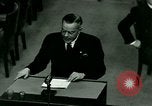
General Telford Taylor in courtroom and prosecution reads, the crimes done by the Einsatzgruppen, during a trial in Nuremberg.
The Einsatzgruppen Case in Nuremberg, Germany. General Telford Taylor in a courtroom. A member of the prosecution reads in part the description of the mass murders committed by the Einsatzgruppen. He also describes how the displaced persons, or DPs, were put into a van and gassed to death. One Einsatzgruppen detachment while making a report states that 121, 817 Jews were killed and that at one place they arrested all Jews over 16 and with an exception of the doctors and the elders all of them were executed. The leader of Einsatzgruppen reports that 15,000 Jews were executed in Schrewindt.
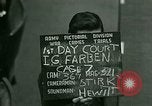
Judge Michale A Musmanno starts with the proceedings and defendants present at IG Farben Trial in Nuremberg at Germany.
IG Farben trial in Nuremberg,Germany. Tribunal with Judge Michale A Musmanno announces that the court will now proceed with the arraignment of the defendants. The defendants in the dock. One of the defendant is asked to stand and is questioned whether he is guilty or not. He answers the questions and sits.
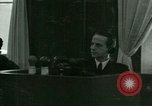
James E. Heath questions Otto Ohlendorf and Michael A Mussmanno makes a statement in the Einsatzgruppen Case, Nuremberg.
The Einsatzgruppen Case in Nuremberg, Germany, following World War 2. The chief defendant in trial in the case, Otto Ohlendorf, tells his story on the witness stand, relating that the records indicate where his Nazi German death squad group put to death more than 90,00 persons. Mr. James E Heath, prosecution lawyer questions Otto Ohlendorf about the 90,000 killings by Einsatzgruppen. Judge Michael A. Mussmanno makes a statement related to the above talks.
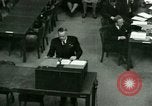
Otto Ohlendorf, the Einsatzgruppen leader, talks about the corpses and killing of Jews during War Crimes Trials in Nuremberg.
The Einsatzgruppen Case in Nuremberg, Germany. The member of prosecution reads the indictment. Prisoner Otto Ohlendorf gives reports that the group of corpses were first buried in the snow and then later buried by the Army. Einsatzgruppen Case reports the extermination of Jews by the death squad after the capture of Kiev. Report goes on to say that not only the Jews were considered politically dangerous but others such as Russians, Georgians, Poles etc. were also considered to have Bolshevistic tendencies. Otto Ohlendorf, the commander of the Einsatzgruppen death squad unit destroyed over 90,000 Jews. One Einsatzgruppen killed 700 people.