


 Francais
 Deutsch
 Italiano
Refine Your Search
+"Oak Ridge Tennessee" +1946 stock footage and images
- Showing 7 to 12 of 12 results
Woman workers operate a switchboard and work at files in Oak Ridge, Tennessee.
A telephone switchboard operations room in Oak Ridge, Tennessee, established during Manhattan Project effort to build the atomic bomb. Women operate a switchboard. Two information workers in the foreground. Two women work at files. Female workers operate the switchboard and put plugs in a board.
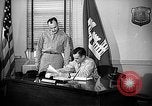
Colonel Kirkpatrick in a meeting with the staff members of Clinton Engineer Works in Oak Ridge, Tennessee.
Colonel Kirkpatrick, the Commanding Officer in Oak Ridge, Tennessee. Colonel Kirkpatrick works at a desk in his office. U.S. and Oak Ridge flags in the background. A meeting of Clinton Engineer Works. Facilities and Service staff in the meeting. A man takes notes. A map on a wall in the background. The Colonel addresses the meeting. F. F. Kromer is included in the meeting. Draws a diagram titled 'Alamogordo' that shows a tower (likely atomic bomb test tower), a photo location, headquarters location at 17,000 yards from the tower, and Control area at 10,000 yards from the tower.

World War 2 battle scenes; wrecked buildings and masses of displaced persons in Europe after World War II.
'Problems of Peace in Europe' produced in 1948, depicts reconstruction problems in aftermath of World War II and includes footage from during the war and soon after the war. Scene of desperate and hungry civilian people (possibly in Germany but could be elsewhere in Europe) scrambling over each other and trying to find food on the ground among garbage or wreckage, circa 1945 or 1946. European peoples massing to reestablish political order and seek relief in post-war Europe. Montage of images of people from all walks of life. Reminders of war showing aircrews in bombers and bombs falling. Batteries of rockets being fired. A formation of U.S. B-17s and a B-26 aircraft with D-day stripes, in flight. Allied bombing of cities with devastating effect (likely 1944-1945). Aerial view of the Statue of Liberty in New York Harbor. Aerial view of a major U.S. industrial complex, with many smoke stacks and industrial pollution. Mass of workers leaving at end of shift at a U.S. manufacturing plant or factory. Views of two different streamlined locomotives pulling passenger trains at high speed, approaching camera position. Freight trains speeding on railroads. Farmers harvesting and baling hay by machine and cultivating fields with tractor. Multiple wide views of the K-25 building of the Oak Ridge Gaseous Diffusion Plant, in Oak Ridge Tennessee, the world's largest building in 1944 when it was built, and an instrumental part of the Manhattan Project effort to develop the atomic bomb in World War 2. Huge sprawling industrial sites in America. Map of Europe. Street scene in Germany with destroyed buildings and rubble cleaned from street, but still piled up in places. Desperate, hungry, and poverty stricken German citizens rummaging through garbage piles for anything to eat or anything of value. Two very young German boys standing together on a street, with one boy smoking a cigarette. Children scrambling over trash and rubbish heaps.
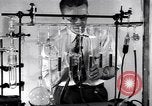
Procedures and testing of radioactive materials at the National Laboratory in Oak Ridge, Tennessee
Various processes at the Oak Ridge National Laboratory (ORNL) for creation of plutonium from uranium, for atomic bomb, nuclear weapons and nuclear power. Chemist scaling glass tube containing some gases with a blow torch. The thick-walled equipment to prevent any radiation are shown. Women in uniform checking the effects of heat and radiation on a uranium piece with an Geiger Counter. Clothing of worker uniforms is scanned for radiation levels.

Devastation from atomic bomb dropped on Hiroshima Japan in World War II
U.S. War Department film showing devastation from atomic bomb dropped on Hiroshima, Japan, during World War 2. Opening scene is darkness of predawn in Alamogordo, New Mexico, on 16, July, 1945, at 5:29:45 AM. Suddenly, a huge explosion lights up the sky. A fireball and mushroom shaped cloud form. Closer view of the explosion from another camera. Following the initial explosion, the ensuing sound is a continuous roar. Another view is shown, from a third camera location. It highlights the boiling fire and smoke of the explosion. These scenes document the first successful test of a nuclear weapon, code named "Trinity". Change of scene shows glimpse of the Manhattan Project B Reactor site at Hanford, Washington, as viewed from a car driving past. Closeup of the facility, from right up against a boundary fence. Glimpses of other Manhattan Project facilities in New Mexico, Oak Ridge, Tennessee, and another view of the Hanford, Washington facility. Next, a rough topographical map of Japan is shown. Closeup of elevated railroad train traveling in Hiroshima, Japan. Imperial Japanese Army motorized vehicles are shown on parade, including fully tracked open personnel carriers with soldiers aboard and Type 94 Tankettes being driven by individual soldiers. Japanese infantry marching in full field gear including shouldered rifles with fixed bayonets. Closeup of a Japanese Army officer. Glimpse of Japanese support troops, such as quartermaster elements, in black uniforms. Japanese technicians in white lab coats at a wartime facility. Japanese Navy Warships being launched from Hiroshima ship yards. A lone B-29 bomber seen in flight over clouds. Its tail number, 42-63735 is clearly seen. It displays a large "05" on it upper tail. (This is not the "Enola Gay" whose tail number was 44-86292.) Closeup of one of the aircraft's engines with propeller turning. Glimpse upward from interior of the aircraft. Scene shifts to aerial photograph of Hiroshima with overlay depicting the bomb strike zone. Animated map showing explosion and precise point ot detonation above the junction of the Motoyasu and Ota Rivers. A view at the ground of destruction from the atomic explosion. An American soldier stands in the midst of the destruction. Slabs of heavy concrete are destroyed. View looking East from ground zero, past a burned tree trunk in the foreground, where the shells of several stronger buildings still stand amidst a sea of rubble. To the South, hardly anything is left standing. Looking West, everything is essentially leveled.
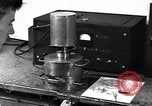
Technicians and equipment at the Oak Ridge National Laboratory, Tennessee.
Technicians and equipment at the National Laboratory in Oak Ridge, engaged in creation of plutonium from uranium, for atomic bomb, nuclear weapons and nuclear power. Technicians work with a portable electrometer measuring small amount of radiation. Scientist observes meter readings at a control panel.