


 Francais
 Deutsch
 Italiano
Refine Your Search
+"Oakland California USA" +1935 stock footage and images
- Showing 1 to 5 of 5 results
U.S. aviatrix Amelia Earhart arriving in Oakland California after solo flight from Honolulu, Hawaii
Scenes of Amelia Earhart taxiing her Lockheed Vega 5B airplane to the ramp, at Oakland Airport, on January 12, 1935, having left Wheeler Field, Honolulu the day before. This completed her solo flight from Honolulu, Hawaii (the first person to successfully accomplish such a transpacific flight). Crowds her airplane as she taxis in, and parks near a hangar of the U.S. Naval Air Station. Amelia stands in the cockpit of her airplane, holding a bouquet of flowers, as crowds mill about on the ramp beneath. Change of scene shows Amelia standing on a steel platform, of the airport tower, with her husband, George Putnam. Closeups of Amelia.

Amelia Earhart successfully spans a 2400-mile course over the Pacific.
Amelia Earhart's plane lands on an airfield in Oakland,California. She emerges out of the cockpit and welcomed by press, media and public. Earhart gives an interview to the journalists and explains about her flight from Honolulu to the mainland. It took her 18 hours to span a 2400-mile course over the Pacific.
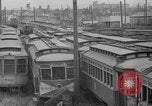
Seventy-two trolley cars piled in a huge bonfire following their condemnation as obsolete, Oakland.
Obsolete trolley cars piled in a huge bonfire in Oakland, California. Seventy-two trolley cars parked in an open area in Oakland. Men marking on trolley cars. Men set trolleys on fire. Burning trolleys.
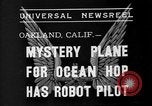
Mystery Plane taxis and takes off during a test by the U.S. Army in Oakland, California.
A man stands on the wing of a U.S. Army customized DC-2 or DC3 aircraft outfitted with additional sensors in the lower part of the nose and a circular antennae of some kind mounted over the cabin. Newsreel notes state that the "mystery plane" is "directed by robot pilot" during a test by the U.S. Army in Oakland, California. (Likely early testing in automated flight control, blind flying, and instrument flying.) A man works on the engine. View of three men in civilian business suits, present for the flight test. (Possibly inventors or scientists who created the technology.) The aircraft taxis and takes off.

Former U.S. President Hoover speaks out against Franklin Roosevelt's New Deal and new taxation
Former U.S. President Herbert Clark Hoover addresses people in Oakland, California during the Great Depression. He speaks out in favor of a balanced budget and against the new spending and taxation proposals of the New Deal under President Franklin D. Roosevelt. He says, "The cost of the New Deal threatens to exceed that of the Great War...We have seen the creation of a most gigantic spending bureaucracy. That is not only a reduction of your standard of living, but of your freedom and your hopes. Here is where common sense cries out to be hear. The folly and waste must be cut out of this expenditure, and the federal government budget balanced, or we shall see one of three horsemen ravage this land: Taxation, or repudiation, or inflation...these issues transcend any group or individual. They represent the fate of the nation."