


 Francais
 Deutsch
 Italiano
Refine Your Search
+"Ohio USA" +1922 stock footage and images
- Showing 1 to 6 of 6 results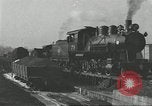
A Detroit, Toledo and Ironton Railroad train operating along its main line in Ohio
Steam locomotive, number 79, of the Detroit, Toledo, and Ironton Railway on a slightly elevated track, next to a coal car.in a train yard. Worker is examining and possibly oiling parts of engine drive. Scene shifts to interior of locomotive maintenance shop where men work on a train car parked next to a locomotive. Scene shifts, again, to view from rear of moving train as it traverses route along the valley floor, from vicinity of Spargursville (AKA Spargurs) to Bainbridge, including bridges over Sulphur Creek , Alexander Hollow Rd, and both bridges over Paint Creek between the two towns. The train passes a tender connected to some sort steam driven machine (probably a pile driver as they are working on trestles). Also shown are box cars converted into bunk houses used by the work crew, which appear to be parked at Storms, only 6.9 miles from Summit, where the work is likely being undertaken. . The film ends at the Bainbridge train station. (Note: regarding the reference to work going on at Summit. Although not seen in this sequence, the track there was so steep that trains had to be broken down and moved up a few cars, at a time, to the top, where the train was then reassembled before proceeding.)
De Bothezat helicopter being tested during its development at the engineering division of McCook field in Dayton,Ohio
General Mason M. Patrick,Chief of Air Service inspects De Bothezat helicopter during its development at engineering division of McCook field in Dayton, Ohio. Brigadier General William "Billy" Mitchell also takes a look at the helicopter. Russian immigrant George De Bothezat, the inventor of the helicopter, speaks to the officers. Two lift tests are shown with one lifting 1000 pounds and the other lifting 3500 pounds at 160 horsepower.
De Bothezat "flying octopus" helicopter being tested at the engineering division of McCook field in Dayton,Ohio
Secretary of Commerce Herbert Hoover (not pictured) inspects De Bothezat helicopter at engineering division of McCook field in Dayton,Ohio. Dr. George De Bothezat sits in the pilot seat and lifts off in the helicopter sometimes called the Jerome-de Bothezat Flying Octopus, with four rotors, built for the U.S. Army Air Service. It hovers a few inches above the ground. Men stand on all sides of it to help stabilize it. Assistant to George de Bothezat, Mr. Eremeff pilots the helicopter in another test.
United States Army Air Service Officers inspecting the helicopter of inventor George de Bothezat
At McCook Field in Dayton, Ohio, U.S. Army Air Service engineers inspecting Plane-Radial screw (helicopter lift mechanism) of George De Bothezat, a Russian immigrant working under contract with the Army. General Mason M. Patrick, Chief of the Air Service, inspects the radial screw. 1000 pounds of weight is lifted by lifting-rotor utilizing 35 horsepower. View of revolving rotor blade and officers in background. Brigadier General William Mitchell ( "Billy Mitchell" ) also inspects the work and discusses with George de Bothezat. Test flight for then Secretary of Commerce Herbert Hoover of the Jerome-de Bothezat Flying Octopus, equipped with four 6-bladed rotors. George de Bothezat in the pilot seat as the large helicopter lifts. It is held from going up very high and stabilized by men all around it. Another test with de Bothezat's assistant Mr. Eremeff in the pilot seat.
Testing of De Bothezat helicopter in open fields.
Ground testing of the de Bothezat quadrotor helicopter at McCook Field, hangar in background. Helicopter contraption demonstrating lift and movement on airfield. Men hanging on to side of helicopter assisting with its early flight.
Flight testing of De Bothezat helicopter.
Flight made by inventor, Professor George De Bothezat. De Bothezat sitting at the controls of the helicopter. Helicopter rising short distant and descending. Many views of helicopter rising and descending. Men watching.