


 Francais
 Deutsch
 Italiano
Refine Your Search
+"Okinawa" +1945 stock footage and images
- Showing 19 to 24 of 656 results more
more Hide
Hide
American aircraft carrier under Kamikaze attack, off the Japanese coast in World War 2
World War II in the Pacific. American aircraft carriers underway off the coast of Okinawa on May 14, 1945. Japanese Kamikaze (suicide dive bomber) flies through heavy antiaircraft gun fire. One of the Kamikaze gets hit and crashes just ahead of the carrier. Several other kamikaze planes are shot down. Damage control party aboard the USS Enterprise carrier deck fights fires from a Kamikaze strike.
Destroyer, USS Sigsbee, being taken in tow by the Cruiser, USS Miami, after being hit by a Japanese Kamikase in World War II
Aftermath of Japanese Kamikaze attack that struck aft of number 5 gun on the destroyer, USS Sigsbee (DD-502), April 14th, 1945, while she was on radar picket duty off Okinawa, during World War 2. The USS Sigsbee is seen with its stern partly under water. The USS Dashiell (DD-659) is in the background. View of the Sigsbee, from the U.S. Cruiser, USS Miami(CL-89) as she prepares to take the destroyer under tow. Some Sigsbee crew members seen on her upper deck and several occupy her gun position forward of the damaged area. Camera pans over Sigsbee's main deck, where many of her crew are seen, and then focuses on her bow, as crews from both ships secure tow lines.
Japanese delegates reach Ie Shima, Ryukyu Islands and then advance towards Manila, Philippine Islands in the South East Asia.
Japanese surrender in Southeast Asia during World War II. Airplanes in formation flight. Two Japanese Mitsubishi G4M-1 'Betty' twin-engine bombers painted white with green crosses on their wings, fuselage and tail land at Ie Shima Ryukyu Islands near Okinawa carrying Japanese delegates. The planes land at Nichols Field at 1813 hours. The planes are dubbed 'Bataan number 1' and 'Bataan number 2.' Lt. Gen. Torasirou Kawabe, the vice chief of the Japanese Army's General Staff and his surrender party disembark from the airplanes. Members of the surrender party include Rear Admiral Ichiro Yokoyama Representative, Imperial Japanese Navy Staff., Colonel Yashima Terai General Staff, Colonel Orato Yamoto General Staff, Mr. Morio Yakawa Secretary, Japanese foreign office. Kawabe leads the surrender party. Army C-54 transport airplanes parked. Japanese surrender delegates board the airplanes which take off for Manila, Philippines. United States Army General Douglas MacArthur speaks to his troops from a balcony at the war damaged Manila City Hall (Padre Burgos Ave, Ermita, Manila, 1000 Metro Manila) on 20 August 1945. He notes that he is hopeful that they will all be able to return home soon.
Aircraft Carrier, USS Hancock, struck by a Japanese Kamikaze in World War II
A series of views filmed from the USS Essex (CV-9) of the USS Hancock (CV-19) after she was struck by a Japanese Kamikaze aircraft on April 7, 1945, off the coast of Okinawa, during World War 2. Opening scene shows the Hancock almost completely enveloped by smoke. Camera pans across the ship. Subsequent scenes show smoke abating somewhat. View from flight deck of the Essex, of the Hancock steaming away, from the Essex. Brief view of four Japanese aircraft in flight, low overhead, and seven more at high altitude. Sailors line edge of the Essex flight deck looking at black objects in the water. Scene shifts to earlier sight of the Hancock burning., as viewed from a position on the island of the Essex, occupied by an officer and some sailors, wearing headsets. It shows heavy black smoke rising from the Hancock. The Battleship, USS North Carolina (BB-55) appears briefly in the background, upwind of the Hancock. Another view shows the Essex flight deck where sailors watch as the Hancock maneuvers. More scenes fairly closeup of smoke enveloping the Hancock.
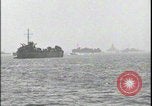
United States Navy Invasion fleet under Admiral Richmond K. Turner sailing near Okinawa coast, green beach, during Battle of Okinawa in WW2
Whole invasion fleet of the United States Navy in Operation Iceberg, or more famously known as the Battle of Okinawa, during World War 2. Invasion fleet includes amphibious ships such as patrol craft coastals, submarine chasers, battleships, LST (or Tank Landing ships), LCI (Landing Craft Infantry), Landing Ship Medium (LSM), and landing craft such as the LCVP (landing craft vehicle personnel boat or also known as the Higgins boat). A Tank Landing ship sails towards Okinawa, showing military equipment and with sectional pontoons attached to its side. Landed amphibious LVT tanks and Higgins boats on the Green Beach in Okinawa’s coast. Invasion fleet in Green Beach in Okinawa during Battle of Okinawa. Okinawa Island in smoke from Battle of Okinawa off green beach.
Japanese gun turrets and shore defense on Okinawa beach as seen from unsteady boat, USS Solace sails near coast of Okinawa, green beach, during Battle of Okinawa in WW2
Various views of the Japanese shore defense gun turrets, wreckage of pillbox nests and Japanese shore defense, and the coast of Okinawa Island in the Battle of Okinawa during World War 2, all seen from a moving boat. United States Hospital Ship, USS Solace (AH-5), sails close to coast of Okinawa Island as part of the invasion fleet for the Okinawa Gunto. As the USS Solace sails near the coast of Okinawa, an APA ship can be seen sailing from a distance.