


 Francais
 Deutsch
 Italiano
Refine Your Search
+"Pacific Ocean" +1945 stock footage and images
- Showing 349 to 354 of 442 results more
more Hide
Hide
Wounded soldiers treated aboard hospital ship USS Bountiful (AH-9) during a Pacific campaign of World War 2
Portrays the suffering of wounded U.S. soldiers in action during a Pacific campaign in World War II, Pacific Ocean Theater. A naval air transport flying boat in action for transporting severe cases to hospital which is far away. Wounded soldier carried on stretcher. Wounded soldiers loaded aboard army transport aircraft parked on airfield. Wounded soldier lying on stretchers and beds aboard hospital ship USS Bountiful (AH-9) at anchor off the coast. Nurse and doctor examine wounded men. A wounded soldier gets head massage. Operation theatre aboard hospital ship shows soldiers with severe wounds on arms and legs being operated by surgeons. Patient on wheel chair pushed on deck of USS Bountiful. Wounded soldiers on deck of ship relax and smoke. Blood stained faces of soldiers.

General Simon Bolivar Buckner, Admiral Mitscher and Admiral Richmond K Turner plan an invasion of Okinawa.
Invasion of Okinawa. U.S. Army and Navy headquarters in Guam, Pacific Ocean. Army and Navy officers walk along path in exteriors of building. Officer arrives to his flagship at fleet's starting point. U.S. convoy underway at sea. General Simon Bolivar Buckner, Admiral Mitscher and Admiral Richmond K Turner in conference examine map. Map shows Kerama Islands near Okinawa. U.S. convoy underway and naval bombardment. Landing crafts advance toward island in Kerama group. Amphibious landings on islands in the Kerama group by 77th Division and the 305th Regimental Combat Team. Troops advance and fight enemy. Dead Japanese soldiers. U.S. soldiers question Japanese prisoners and natives. (World War II period).
United States APA ships sailing towards the Kerama Islands, Japan (WW2)
United States attack transport ships (APA) sailing toward the beach at Kerama Islands (Japan) during World War 2. A group of APA ships sailing on choppy waters in the Pacific Ocean. View of an APA ship.
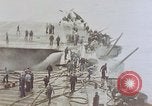
Crew of USS Enterprise suppressing fire after being struck by a Japanese kamikaze in World War II
U.S. Navy warships under attack by Japanese aircraft during World War 2. Fire fighting detail working on the deck of USS Enterprise (CV-6). They play hoses into elevator shaft where forward elevator was blown out of its well by Japanese kamikaze on 14 May 1945. Another ship in the far background, as battle with Japanese aircraft continues. Bomb splash in water near distant ship.
Destroyer, USS Sigsbee, being taken in tow by the Cruiser, USS Miami, after being hit by a Japanese Kamikase in World War II
Aftermath of Japanese Kamikaze attack that struck aft of number 5 gun on the destroyer, USS Sigsbee (DD-502), April 14th, 1945, while she was on radar picket duty off Okinawa, during World War 2. The USS Sigsbee is seen with its stern partly under water. The USS Dashiell (DD-659) is in the background. View of the Sigsbee, from the U.S. Cruiser, USS Miami(CL-89) as she prepares to take the destroyer under tow. Some Sigsbee crew members seen on her upper deck and several occupy her gun position forward of the damaged area. Camera pans over Sigsbee's main deck, where many of her crew are seen, and then focuses on her bow, as crews from both ships secure tow lines.
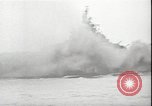
Aircraft Carrier, USS Hancock, struck by a Japanese Kamikaze in World War II
A series of views filmed from the USS Essex (CV-9) of the USS Hancock (CV-19) after she was struck by a Japanese Kamikaze aircraft on April 7, 1945, off the coast of Okinawa, during World War 2. Opening scene shows the Hancock almost completely enveloped by smoke. Camera pans across the ship. Subsequent scenes show smoke abating somewhat. View from flight deck of the Essex, of the Hancock steaming away, from the Essex. Brief view of four Japanese aircraft in flight, low overhead, and seven more at high altitude. Sailors line edge of the Essex flight deck looking at black objects in the water. Scene shifts to earlier sight of the Hancock burning., as viewed from a position on the island of the Essex, occupied by an officer and some sailors, wearing headsets. It shows heavy black smoke rising from the Hancock. The Battleship, USS North Carolina (BB-55) appears briefly in the background, upwind of the Hancock. Another view shows the Essex flight deck where sailors watch as the Hancock maneuvers. More scenes fairly closeup of smoke enveloping the Hancock.