


 Francais
 Deutsch
 Italiano
Refine Your Search
+"Pacific Ocean" +1951 stock footage and images
- Showing 1 to 6 of 15 results
United States aircraft carrier USS Independence (CVL-22) damaged in Operation Crossroad "Test Able," risk in daily lives and discussion of radioactivity.
'Radioactive contamination' about the hazards posed by the sinking of a United States aircraft carrier and the methods to control radioactivity. United States Navy F6F-3 Hellcat aircraft taking off from United States aircraft carrier USS Independence (CVL-22) in the Pacific Ocean during World War II. F6F-3 Hellcat firing rockets in air. Landing signal operator LSO using flags while guiding plane for landing on USS Independence. Kamikaze attacks at Tarawa. Anti aircraft guns on carrier cut down kamikaze planes as they attack. USS Independence flying USA flag at Tokyo Bay. Scene of surrender of Japanese at Tokyo Bay aboard the USS Missouri. Aerial view of atomic bomb blast at Bikini in 1946. The wrecked carrier Independence being towed away after it was used as a target for an atomic bomb test in 1946 as part of Operation Crossroads. Men at a construction site talk about contamination caused in sea water due to sinking of Independence containing radioactive waste. They comment, "she's all full of that radioactive poison" and with respect to eating fish in water near the ship, "would you eat fish again?" Two women dressed in furs, in a car, also discuss radioactivity. One woman says, "from what I've heard it's very dangerous. " View of 1940s car backing into oncoming traffic and almost causing an accident. An aerial view of atomic explosion at Bikini. Damaged USS Independence ship after TEST ABLE. Signs on board warn of radioactivity with words, "Keep Clear, Danger! Very Radio-Active" and "Radioactivity. Do not remain more than 2 hours." Men in small boat near USS Independence examine damage to the ship. Parts of the USS Independence being tested for radioactive contamination at the Naval Radiological Defense Laboratory NRDL, Hunter's Point Naval Shipyard in San Francisco, California. The USS Independence being sunk in 1951. View of Bikini atomic bomb blast within a bay surrounded by ships. Simulation shows the effect a similar blast would have on a coastal city as a radioactive cloud covers the city. Officers holding handkerchiefs to their mouths as they enter an office building from outside. Firemen climb ladders while putting out a large fire. A house wife working in a kitchen and responding to a pot boiling over on the stove burns her hand. A man slips on a bar of soap in the shower while singing. An officer honking at an oncoming car as he is run off the road. Woman driver dressed in furs exclaims to her friend about the bad driving of men. Officer just run off the road by woman driver exclaims, "Women !" with frustration. Aerial view of test nuclear explosion at Bikini Atoll.
United States nuclear testing: Test "Dog" of Greenhouse series. This is a Mk 6 strategic bomb at Enewitak Atoll.
Cloud filled sky is golden as test bomb burst begins for test "dog" in the Greenhouse series of atomic tests in 1951, on the Enewitak Atoll in Pacific Ocean.Test of Mk 6 strategic bomb. Emitted light obscures vision for several seconds. Shock wave, fireball, and plume follow.
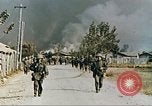
Activities of U.S. marines and USS Missouri battleship (BB-63) in Korea during the Korean War.
1st Marine Division in Korea during the Korean War. U.S. marines walk on the streets of a village. A marine eats while walking. Marines carry a wounded comrade on a stretcher. Graves of U.S. marines in a cemetery. A marine places a wreath on a grave. A candle is lit. A Korean boy stands and smiles. Three nuns stand. Children play in snow and slide on sleds over frozen ice. USS Missouri BB-63 battleship underway in the Pacific Ocean. U.S. Marines aboard US Missouri salute. Marines and tanks advance through a field during Korean War.
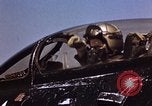
U.S. Navy locates a missing pilot using photographs and rescues him from behind enemy lines during Korean War.
Glimpse of a U.S. Navy pilot in the cockpit of an airplane, during the Korean War. He is pointing down at something. Next, a parachute is seen drifting rapidly in the wind as it descends. Pilot in aircraft hears about a pilot bailing out behind enemy lines. He is instructed to photograph the area. Next, a Navy 9F9 Panther aircraft is seen in the air. It has tail code "PP" indicating it is from the aircraft Carrier USS Essex (CV 9) with Carrier Air Wing Five (CVW-5) and Composite Squadron 61 (VC-61) from June 1951 to March 1952. . Glimpse of Navy ships in formation. View of Landing Signal Officer bringing in several 9F9 Panther aircraft to land on deck of the USS Essex. These aircraft carry tail code "M" of Squadron VF-23 with Air Task Group 2, aboard the Essex from June 1952 to February 1953. Next, several Navy A-4 Skyraider aircraft come in to land. They display "S" tail codes of Squadron VF-54. They are followed by another 9F9. Scene shifts to photo interpreters and pilots studying the photographs for clues to where their parachuting pilot might be located. They discover a parachute in the photos, and circle it. Ship loudspeaker is seen as helicopter crews are alerted for rescue mission. A Sikorsky HO3S-1 helicopter takes off from the flight deck. Other pilots wait anxiously as the Helicopter returns to land on the Essex flight deck. The missing pilot is aboard and they help him from the helicopter, place him on a litter and cover him with blankets. His friend takes his picture.
Pilot briefing in ready room of USS Sicily.
Marine pilot reads a document in ready room. Loud speaker on bulkhead. Captain at desk signs papers. A pilot instructing other pilots, walks to the blackboard. Pilots seated and listening. Pilots get ready and leave the ready room.
Aircraft F4F brought on flight desk of USS Sicily.
Aircraft F4F pushed onto elevator on hangar deck. Elevator goes up to flight deck. Bridge of USS Sicily and F4Fs on flight deck.