


 Francais
 Deutsch
 Italiano
Refine Your Search
+"Pacific Theater" +1944 stock footage and images
- Showing 103 to 108 of 210 results more
more Hide
Hide
Crippled planes attempt landings and crew pay homage to casualties aboard USS Yorktown during the Battle of the Philippines.
U.S. Navy filming aboard 'The Fighting Lady', pseudonym for the USS Yorktown (CV-10) in the Pacific Theater during World War II. U.S. aircraft return after an assault on the Imperial Japanese Naval fleet. Damaged and crippled planes make landing attempts on the flight deck. A dive bomber attempts a landing on one wheel, lands and falls over one side of the carrier into the water. Another plane lands and crashes. A U.S. Navy crew member helps the U.S. Navy pilot out of the burning plane. Crew members carry him away on a stretcher. Another crippled plane lands on the flight deck. Sailors put up the scores on a wall of the carrier including Japanese aircraft, ships and cruisers destroyed by the USS Yorktown crew. A pilot puts up his score on his plane, for the number of Japanese aircraft and Imperial Navy carriers hit. The crew collects on the flight deck for burial at sea. The deceased include Lieutenant Commanders and Lieutenants. Sailors give a gun salute and pay last respects to the U.S. Navy sailors killed in action. 'The Fighting Lady' underway, and her carrier planes in flight.
Mission of Joint Assault Signal Companies during amphibious assaults in World War II
Montage of military footage assembled to describe Joint Assault Signal Companies, in World War 2. Some inserts are inconsistent and anachronistic. Scenes of U.S. amphibious assault on a Japanese-held island in the Pacific theater. Camera focuses on small fast-moving assault boat carrying Army and Navy personnel of a Joint Assault Signal Company. A Japanese Aichi B7A Ryusei "Grace" aircraft flying low over the water in background. U.S. troops leaving an LST (Landing Ship Tank) and wading ashore. Some pushing a jeep through the surf. Members of a Joint Assault Signal Company running ashore with a spool of communications cable. Others carrying small arms climb out of an assault boat. Signal company soldiers laying communications cable as they move through jungle. Sailor aboard a U.S. warship ostensibly communicating with the signal company via light blinker. Naval gunfire bombarding enemy positions. Narrator's mention of air support is followed by anachronistic insert of U.S. Army B-10 bombers in formation flight; of bombardier in nose; and views of bombs falling. Next, a formation of B-25 Mitchell bombers is seen in flight and bombs falling. Back in the jungle, signal company men string wire on palm tree. Field artillery firing. Soldiers hunkered down in a shell hole. Signal company soldier using SCR-300-A Radio set.
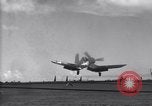
F4U Corsair airplane noses over during landing on deck of USS Bunker Hill during World War II
Slow motion footage of F4U Corsair airplane landing on USS Bunker Hill (CV-17) in the Pacific Theater during World War 2. The aircraft rounds out above first sets of restraining cables and then snags a later one and noses over.
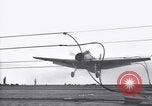
TBM Avenger aircraft noses over suffering prop and engine damage, during landing on deck of USS bunker Hill in World War II
Slow motion footage of TBM Avenger aircraft landing on USS Bunker Hill (CV-17) In the Pacific Theater during World War 2. The aircraft snags a restraining cable and noses over. As it settles back, the engine and cowling appear to separate partially from the airframe. Firefighters respond in protective gear.
Men in a piper cub direct artillery fire by providing information in the Pacific.
Artillery fire is directed from a piper cub in the Pacific Theater. Piper cubs in a field. A house in the background. Men stand nearby the planes. Trees in the background. The plane in flight. Men discuss a map. They fly the plane. A pilot watches through binoculars from the plane. Soldiers talk on the phone and get information with them. They fire according to the information. Smoke arises from firing. The plane lands. Other planes parked on the ground. (World War II period).
Crews of U.S. Air Force 80th Fighter Squadron and their P-38 aircraft, during World War II.
Crews of U.S. Air Force 80th Fighter Squadron "Headhunters", and their P-38 airplanes in Pacific theater during World War 2. A ground crewman playing with a model of a P-38 plane. Sign reading "Captain Jay T. Robbins, Commanding Officer" is updated by Robbins to say "Major..." Aircrews gather to study a map and discuss a mission. Large "W" on nose of one plane. Plane with 15 Japanese kill flags on it, labeled "Captain C. Homer," (who later succeeded Major Robbins as the Commanding Officer). U.S. pilots stand in front of their planes. Name "Adams" visible on one of them. Pilot inside the plane, gets ready for take off. (Among pilots seen are three 80th Squadron aces: Robbins, Homer, and Ken Ladd.)