


 Francais
 Deutsch
 Italiano
Refine Your Search
+"Pacific Theater" +1945 stock footage and images
- Showing 1 to 6 of 211 results more
more Hide
Hide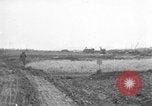
77th Infantry Division soldier looks at sign board at the commemorating spot in the Pacific Theater during Ryukyu Campaign.
U.S. Army 77th Infantry Division soldier looks at sign board in the Pacific Theater during Ryukyu Campaign of World War II. Soldier walks on field towards the commemorating spot. He looks at sign board which reads 'at this spot the 77th Infantry Division lost a buddy,Ernie Pyle,18 April 1945'.
Operation of United States Coast Guard in Okinawa and Iwo Jima, Pacific Theater during World War II
Overseas activities of United States Coast Guard in World War 2. February 19, 1945, U.S. Marines invade Iwo Jima in Pacific Theater. Naval guns and aircraft bombard Iwo Jima. Mountain in the background. Aircraft in flight. Marines and Coast Guardsmen aboard landing craft. Marines landing on Iwo Jima under heavy Japanese fire. Destroyed landing ships litter water's edge. Marines hunkered down and treating wounded, under fire. LSTs and other ships at established beachhead. Vehicles drive onto beach. April 1, 1945, Marines attack Okinawa. Navy warships bombard Okinawa with heavy guns and continuous rocket fire. Beachhead is established against light resistance. Japanese kamikaze aircraft attack American invasion ships. Several ships are hit and sunk. Surviving sailors are helped aboard rescue boats. Antiaircraft fire from American ships fills sky with smoke and flak. A kamikaze aircraft crashes in the sea. Sky filled with American bombers. Aerial view of Atomic bomb explosion over Nagasaki Japan on August 9, 1945. Raising American Flag on Japan homeland.
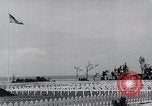
U.S. Army aircraft bombing raids on Japanese cities in 1945, and atomic bomb explosion in World War 2.
Air raids and battle in Japan in the Pacific Theater near the end of World War II. A cemetery of United States military soldiers in the Japanese island of Okinawa. Memorial at the tombstone of Ernie Pyle built by the 77th Infantry Division of the U.S. Army. General Doolittle, General Henry Arnold, General George Kenney, General Ennis Whitehead and other officers during a discussion standing before planes at the 48th Air Force base. B-29 aircraft advances towards Tokyo. Bomber aircraft dropping of a number of guided bombs towards their targets. Targets include Japanese airplane factories, shipping industry, military supply chains in the cities of Tokyo, Nagasaki, Nagoya, Okinawa and Yokohama of Japan. Explosion and smoke arises from bombed targets on ground. Aerial wide and close up views of a B-29 aircraft in flight. Narrator notes that on 05 August 1945, Enola Gay, a B-29, carries the atomic bomb and flies towards Hiroshima. Atomic explosion seen signifying the one in Hiroshima on August 6, 1945, but narrator indicates the image seen is that of the first atomic explosion (the Trinity test) during on July 16, 1945 in New Mexico. Immense cloud of smoke and light. This atomic explosion, the first of two, was pivotal in compelling Japan to surrender unconditionally. Film ending includes public service announcement image "Buy Bonds. Hold Them. Victory Loan."
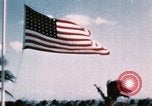
War Correspondents and photographers in PacificTheater during World War Two. Surrender of Japanese at Truk, Caroline Islands
American combat correspondents and photographers in Pacific Theater during Second World War. Close up of American flag flying over a U.S. military cemetery. A sailor kneels before a cross marking the burial site of a comrade. War correspondent types report on portable typewriter. Combat photographer loading film in his camera. Photographer developing film in dark room. Scene shifts to the event photographed, which is Japanese Lieutenant General Shunzaburo Mugikura, Commanding General, Japanese 31st Army, on board USS Portland (CA-33), signing document of surrender for the Japanese base at Truk, Caroline Islands, 2 September 1945.
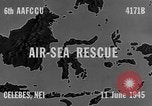
Air-Sea rescue and accident during World War II in the Pacific Theater of operations
Celebes, Netherlands East Indies (NEI). Air-Sea Rescue June 11, 1945. View from low flying aircraft of a 13th Air Force B-24 ditched in Japanese-controlled waters off the coast of Celebes, NEI. A Catalina PBY flying boat of the Jungle Air Force's 2nd Emergency Rescue Squadron, lands and picks up the B-24 crew. However, as it takes off on the water, it founders and crashes, killing three men. An accompanying PBY lands immediately and picks up all survivors who are aboard a rubber raft. Crew members on the wing of the PBY, help survivors aboard.
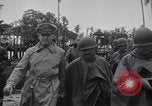
Under General Douglas MacArthur command, the Allied troops capture Philippines from the Japanese.
The life of General Douglas MacArthur. MacArthur on captured islands in the Pacific theater. Gen. Douglas confers and walks with other commanders. Animated map shows Allied advance from New Guinea Islands towards the Philippine Islands. General Douglas in conference with President Roosevelt, and Admiral Nimitz. MacArthur points at a map and explains his plan of action. In accordance to the plan the Allied convoy sails towards Leyte Islands. Fighting and combat at the Philippine Islands. Behind naval bombardment the allied troops land on the island. MacArthur's face is iluminated by intermittent light from Naval Gunfire at night as he watches the landing from a battleship. In daylight, MacArthur on deck with with a three-star general, as he smokes his corn cob pipe. Allied troops establish a beachead on Leyte. General MacArthur gets off an Landing ship and wades ashore. Allied troops move towards Manila. Block-by-block fighting on streets of Manila against Japanese forces. American paratroopers jump and land on Corregidor; scenes of parachutes descending and landing. MacArthur and his staff stroll down a street in Manila. He visits the prison camps and speaks with joyful, liberated, former prisoners of the Japanese. MacArthur salutes as the American Flag is raised in a ceremony over Corregidor. Image of atomic bomb explosion. MacArthur gets off a plane wearing 5 stars. Scenes of Japanese surrender ceremony aboard the Battleship Missouri at end of World War 2 in 1945. MacArthur gives an address to conclude the proceedings. (World War II period).