


 Francais
 Deutsch
 Italiano

Refine Your Search
+"Pacific ocean" +1944 stock footage and images
- Showing 175 to 180 of 212 results more
 Hide

U.S. crewmen of the submarine Flying Fish (SS-229) display their flag and symbols of their victories during World War Ii
Closeup views of several sailors on the U.S. submarine Flying Fish (SS 229) during World War 2. Several crew stand on her deck holding their logo and flags and pennants representing sunk and damaged Japanese ships. An officer points out and enumerates the pennants and flags. The Logo depicts a flying fish carrying a torpedo. Crew members hold their flag and symbols of victories wide for the camera, as their boat cruises on the surface of the Pacific.
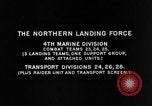
Information about the composition of northern task force for operations on Kwajalein Atoll in the Marshall Islands is given.
A training film on operations of U.S. forces on Kwajalein Atoll in the Marshall Islands during World War II. Northern task force is composed of several groups. These include the northern landing force which comprises of the 4th Marine Division. This in turn is made up of combat teams 23, 24 and 25. Each landing team is composed of three landing teams, one support group and attached units. The remaining group consists of Transport Divisions 24, 26 and 28. They also include a raider unit and a transport screen. The northern support group, the northern carrier group, the initial tractor group, the reserve tractor group and the mine sweeper and the salvage group are also included. Information about the shipping of the northern attack force is given. Aerial view of ships underway at sea. Interior of a ship. Joint operations room, combat information center room, intelligence office, communication room, photographic and reproductions rooms on the ship. Signal and communication equipment. The ship convoy underway, advancing towards the target area. Men aboard ships. An aircraft in flight overhead. An officer studies a map and instructs personnel.
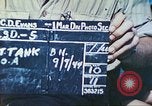
U.S. Marines of 1st Tank Battalion en route to Peleliu on the USS Gunston Hall (LSD-5) in World War II
U.S. Marines of the 1st Tank Battalion aboard the USS Gunston Hall (LSD-5) headed toward Peleliu in the Palau Islands during World War 2. Marines work on their M4A2 Sherman tanks aboard ship. They use tar and tape to seal places on the tanks as they prepare them for amphibious assault.They clean a hatch on one. A Marine points out water proofing points on tank. A slate reads "motor trouble" on September 12th. Another reads: "Passing Army Convoy." Then a long line of ships is seen on the horizon in the distance.
The USS Gunston Hall arriving in waters off Peleliu as part of an invasion task force during World War II
The USS Gunston Hall (LSD-5) in the waters off Peleliu, Palau Islands, during World War 2. Officers reading orders and briefing Marines on deck. Closeups of marines and officer reading the orders. Sailors shooting the sun with sextants. Other invasion task force ships seen from the Gunston Hall

World War Two in the Pacific. U.S. Navy air attacks on Philippines. Carrier-based U.S. aircraft, defending the fleet, attack Japa
U.S. carrier-based aircraft attack Japanese targets in Philippines. U.S. Navy F6F Hellcat taking off from the flight deck. Men remove chocks from aircraft. U.S. Navy SB2C Helldiver taking off from the carrier. Men on deck underneath an aircraft. Plane director on the deck. The U.S. Navy TBM Avenger taking off. Gun camera scenes from U.S. Navy fighter aircraft attacking formation of Japanese Mitsubishi G4M ("Betty") bombers. They shoot down a number of them, including one that loses its wing during the encounter.

Destruction of the SS John Burke from Kamikaze attack at sea during World War II
A convoy to resupply allied troops at Mindoro, Philippines, seen underway, as it comes under attack by Japanese Kamikaze planes, during World War 2. Opening scene shows a burning Japanese warplane trailing smoke as it falls and breaks up before crashing into the sea. Flak clouds seen in the sky from the antiaircraft fire of the U.S. battleship, USS South Dakota (BB-57) seen low on the horizon in the background. Several ships are seen in the convoy. Suddenly a huge explosion occurs as a Japanese kamikaze (unseen) strikes the 14 thousand ton Liberty ship, SS John Burke. She is carrying a cargo of ammunition that explodes, raising a wall of water around the ship and creating a mushroom cloud of smoke that billows high into the sky.