


 Francais
 Deutsch
 Italiano
Refine Your Search
+"Pakistan" +1959 stock footage and images
- Showing 1 to 6 of 7 results more
more Hide
Hide
U.S. President Eisenhower briefs press about his 2 1/2 week trip to nine countries during a press conference in Washington DC
U.S. President Dwight Eisenhower's 175th press conference in Washington DC, United States. Several correspondents from different nations arrive for the President's 175th press conference. Men prepare cameras mounted on tripod stands at the back of a hall. President Eisenhower with an official walks past the newsmen seated in the hall. The President makes an announcement of his two and a half weeks' trip starting from December 4, 1959. The newsmen taking notes. The President says that he would be visiting nine countries and would be making brief informal visits to Rome, Ankara, Karachi, Kabul and would be in New Delhi for the inauguration of the American Exhibit at the World Agricultural Fair on December 11. He says he will visit Tehran and Athens on his way to Paris for the Western Summit meeting. He gives details of the 3 main days. December 4 - when they would be developing legislative program for the coming year, December 11 - the beginning of the World Agricultural Fair, and December 19 - when he would be in Paris for a meeting. A newsman asks the President the purpose of this extensive visit. The President states the importance and need of being the first U.S. President to make an extensive visit to a strategic continent like Asia. He expresses his interest in visiting India and millions of people who are struggling to raise their standard of living. He says that he will visit Pakistan, Afghanistan, Iran and other nations on the way. The President further says that he hopes to build in that region of Asia and in many other parts, a better understanding of the United States. A correspondent asks the President whether Mrs. Eisenhower and his family members would be joining him for the visit. The President says that some of his family members would be joining him but may be not his wife.
Mao Zedong's stand on war, China's foreign policies and aggression towards neighboring nations.
Propaganda piece about living conditions in the People’s Republic of China under Mao Zedong, with images photographed by Indians visiting the country. Delegates from all over the world at an international conference. Representatives from Iraq, Canada, Romania, Australia, and Pakistan among others. Elderly Chinese communist revolutionaries pose. Mao Zedong's views (according to a narrator) are presented: He believes that war in inevitable between capitalist and socialist nations. View of a rally and military parade in China. Explosions during the Korean War in 1951 with Chinese troops in action. In Tibet, homeless, displaced Tibetan children and families after the Chinese take over in 1959 as part of Communist China expansion. Indian Army soldiers return after China's attack on India during the Sino-Indian War in 1962. View of Soviet Union Premier Nikita Khrushchev. Map of Asia depicts Chinese aggression towards its neighbors. Explosions during the Chinese aggression in Vietnam and Laos. Mao Zedong intent on risking a war with the West.

Pakistani President Ayub Khan visits a machine parts factory in Pakistan
A factory in Pakistan. Exteriors of a factory in Pakistan. Pakistani President Ayub Khan and other government officials arrive at the factory. They greet the owner and then view the factory in operation. Men work on machines inside the factory, stamping metal parts and assembling small parts. Officials inspect the factory. Men work on various machines.
President Muhammad Ayub Khan reviews troops at a ceremony in Pakistan.
Pakistani President Muhammad Ayub Khan in Pakistan. Pakistani soldiers lined up. General Ayub Khan reviews troops. Officials seated in stands. Pakistani flag flies from a pole. Troops march as President Ayub Khan reviews the parade.
U.S. President Dwight David Eisenhower visits Turkey and Pakistan and is greeted by the people.
U.S. President Dwight David "Ike" Eisenhower during a visit in Asia. U.S. President arrives in Ankara, Turkey. He gets off an aircraft and is greeted by Mahmut Celal Bayar, the President of Turkey. People on either side of the streets welcome Ike. Policemen ride bikes in a formation. Both the Presidents in a motorcade. People look from the windows of their houses. A poster of U.S. President on a building. A sign reads 'Turks trust Ike'. He is given a farewell. The President gets in a plane and leaves for Pakistan. The President arrives in Karachi. Flags of the United States and Pakistan. U.S. President is greeted by Pakistani President Muhammad Ayub Khan. Soldiers stand in a squad. U.S. Persistent climbs up a carriage drawn by six horses and is escorted by guards. People stand on either side of the streets to greet him. People look from the gallery of their houses. He gets off the carriage and visits the tomb of Muhammad Ali Jinnah, the founder of Pakistan. He witnesses a display of horsemanship. Ike stands with Ayub and waves.
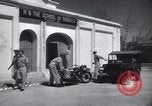
A U.S. officer instructs Pakistani soldiers about the use of American signal equipment and Pakistanis train in T-33A jets
Unites States soldiers in Pakistan. Soldiers outside a building with a sign that reads "Headquarters, School of Signals. Established 1947". An American officer teaches the use of American signal equipment to Pakistani soldiers. The flag of Pakistan flying in breeze on a flagpole. Line of T-33A jet aircraft lined up on runway. Pakistani pilot gets into the cockpit of a USAF T-33A jet trainer aircraft. Three T-33A training aircraft take off simultaneously from the airfield, in formation.