


 Francais
 Deutsch
 Italiano
Refine Your Search
+"Palawan Philippines" +1945 stock footage and images
- Showing 1 to 6 of 9 results
Men remove dead bodies of American prisoners massacred by the Japanese in Palawan, Philippines (WW2)
Bodies of dead American prisoners in Palawan, Philippines, victims of the Palawan Massacre of American POW by Japanese forces in December 1944 (World War II). A sign board reads: 'This area off limits to all personnel'. 'Remains of American prisoners of war'. Men exhume corpses in the area. They dig the graves. Exterior of a building. Recovered dead bodies of soldiers lying on the ground. Men sit nearby. A man searches the dead bodies.
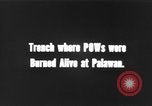
Men dig out a trench and take out the remains of American prisoners who were burned alive by Japanese in Palawan, Philippines.
Dead American prisoners recovered in Palawan, Philippines after the Palawan Massacre of American POW by their Japanese captors in December 1944. The remains of the prisoners who were burned alive. Remains of the prisoners in a trench. Men dig the trench and take out the remains. They hold a skull in hands and inspect it. (World War II period).
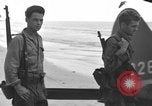
United States pilots board Stinson L-5 plane parked along shore in Palawan, Philippines, during World War II.
U.S. pilots board Stinson L-5 Sentinel airplane of the 25th Liaison Squadron "Guinea Short Lines" (serial 42-99261) parked on shore at Palawan, Philippines, during World War 2. The L-5 taxis along shoreline and takes off. L-5 in flight over sea.
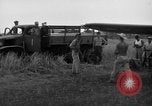
United States pilots around Stinson L-5 Sentinel aircraft parked at field, Palawan in Philippines.
American and Filipino soldiers around army truck and Stinson L-5 Sentinel aircraft, serial number 42-98472 parked at field in Palawan, Philippines. Pilots pose. Native tribesmen inspect the plane. Pilots under wing of plane. Men get on to trucks. Tribesmen pose in fields. L-5 in flight. (Note: This aircraft belonged to the 25th Liaison Squadron.) (World War II period).
American soldiers escaped and rescued from Japanese prison camp speak about their experiences at the camp in Philippines
A representative of Prisoners War Branch,an MIS-X officer interviews American soldiers who escaped from Japan's 10-A prison camp in Palawan,Philippines, and then were rescued by U.S. forces during World War II. Private first class Eugene Nielson tells how he was captured soon after the fall of Pearl Harbor. He also speaks about food, medical facilities and living conditions at Japanese camp in Palawan. Corporal William J.Balchus shares his experiences about the life at the prison camp.
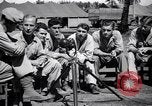
Escaped and rescued American war prisoners speak about life at Japanese prison camp in Philippines
A representative of Prisoners War Branch,an MIS-X officer interviews American soldiers who escaped from Japan 10-A prison camp in Palawan,Philippines, and were then rescued by American forces during World War 2. Private first class Ernest J. Koblos speaks about the work that he did at such camps. He says that he carried wood and worked at the airstrip in the Japanese prison camp. Marine Rufus W. Smith was captured during the attack on Corregidor also speaks about the life of soldiers at prison camp in Palawan.