


 Francais
 Deutsch
 Italiano
Refine Your Search
+"Panama" +1944 stock footage and images
- Showing 1 to 6 of 20 results
General Eisenhower as a World War II officer and as the U.S. President.
Scenes from life and career of Dwight D Eisenhower, 34th President of United States. U.S. Air Force plane lands and the President disembarks the plane in India, in 1959. He is greeted by the Indian President Dr Rajendra Prasad and other dignitaries. Emblem of 'Panama'. Sign of 'welcome Ike Crusader'. Large crowd welcomes Eisenhower. Motorcade goes through the city's street. Milestones in General Eisenhower's life and the international esteem with which he is held. Lt Col Eisenhower concerned about U.S. isolationism in 1940 as World War 2 is underway. Explosions in Europe due to bombing by German aircraft. Eisenhower and other officers in the General Staff study a map. Eisenhower plans the strategy as the commander of Operation Torch (he is shown talking to General George C. Marshall and Winston Churchill). President Eisenhower visits 4 continents and meets several leaders. Large crowds welcome him. General Eisenhower prepares for D-Day Invasion of France during World War 2. June 5, 1944: The Allied forces including troops, artillery, equipment, ammunition, aircraft and ships prepared. June 6, 1944: The Allies invade Normandy. Troops wade through the water during D-Day Normandy beach landings, while under enemy fire. German soldiers surrender. May 7, 1945: Nazi General Alfred Jodl signs the unconditional surrender of his government. General Eisenhower returns to the U.S. He receives a hero's welcome in New York during a parade. He visits his hometown in Kansas. Pictures of his family, childhood and college days. Eisenhower on his visits to various countries as President.
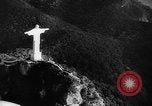
FBI agent William Sebold (posing as Harry Sawyer), and successful filming of members of Duquesne spy ring in the United States.
Aerial view of Christ Redeemer Statue on Mount Corcovado, Brazil. The director of the Federal Bureau of Investigation (FBI), John Edgar Hoover, narrates this 1944 clip and talks about enemy agents in the United States during World War II, before America's entrance into the war. German and Japanese suspects seen in South America. A German fleet carries German agents aboard merchant and cargo ships. German agents in formation on deck of ship, shown debarking the ship after receiving instructions. Japanese and Nazi German colonies being established in South America in large cities and in remote areas of Patagonia. Automobile industries, hotels, shops, and other industries established by Nazi German agents. German signs and Nazi Swastikas and Nazi flags shown on some buildings in South American countries including Brazil. A Nazi flag. A view of German factories in South America. Photographs of Adolf Hitler in a school building where young boys and girls are being instructed by their teacher. German pilot shown operating a passenger airliner; aerial view of from aircraft of Rio de Janeiro Brazil, including port and city areas. A dramatization depicts well planned accidents in the factories and sabotage attempts to slow production of goods bound for the United States. The Federal Bureau of Investigation (FBI) receives reports about planning of German attack on the Panama Canal. A woman watching a teletype machine as a report arrives. A man in a radio room of the Federal Bureau of Investigation receives information and turns to type out a report on his typewriter. Men and women convicted as spies are seen together in a room with U.S. federal agents. The spies are taken in a police van. Man serving as projectionist seen running a film projector. A film of Fritz Duquesne case in the FBI office shows FBI Agents' successful secret filming of members of the Duquesne spy ring. The film is shown being loaded onto a projector and then played. FBI agent William Sebold (posing as spy Harry Sawyer) is seen with Fritz Duquesne and other spy ring members: Pedestrians and vehicular traffic on a New York street corner as Sawyer and Duquesne prepare to meet. German spies sit together in a hotel room in New York City, recorded by hidden camera. Heinrich Clausing, a spy ring member and former cook on the cruise ship SS Argentine is seen. Also seen is Hartwig Richard Kleiss putting on his hat and smoking a cigar. He's shown giving money to Sawyer for purchase of a spy camera, according to narration. J Edgar Hoover notes that German agents communicated through a Long Island radio station that was secretly controlled by the FBI. Hartwig Kleiss is seen showing the blueprint plans of the steamship SS America, including plans for its secret gun emplacements. Fritz Duquesne is shown in the film, removing diagrams of various American arms that he had concealed in his sock Japanese agent Takeo Ezima, of the Imperial Japanese Navy, is also seen meeting in the hotel with Harry Sawyer.
American soldiers trained in jungle warfare in Panama
American soldiers trained in jungle warfare in simulated combat conditions in Panama. Soldiers move through dense forests as one soldier puts camouflage make up onto the face of the other soldier. Soldiers put on flotation bladders inside their uniform. They cross the stream by swimming and rowing in rubber boats. Gasoline flames are ignited in water as soldier swim across the river and reach on the bank. (World War II period).
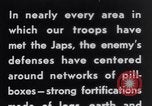
American soldiers trained in jungle warfare at Panama
American soldiers trained in jungle warfare in simulated combat conditions at Panama. Soldiers move through dense forests amidst heavy firing. Soldier crawls through the jungle. Fire spreads through the forest. Pillbox is fired upon, attacked and dynamited. (World War II period).
A technical group attends a meeting to carry out investigations for U.S. Army chemical warfare tests on San Jose Island, Panama.
U.S. chemical warfare tests on San Jose Island, Panama during World War II. Close-up view of U.S. 6th Air Force B-25 Mitchell bomber flying low over islands near San Jose Island. More distant shot of formation of B-25 bombers in flight. A field located near San Jose shows a bomb dump. U.S. airmen load bombs on a bomber aircraft. A technical group consisting of U.S. NDRC (National Defense Research Committee) scientists, trained officers of United Kingdom's Army and Navy and U.S. Army Air Force officers attend a meeting in front of a chart.
Test of persistent gas munitions during various U.S. chemical warfare tests on San Jose Island, Panama during World War II.
Tests of persistent gas munitions during U.S. chemical warfare tests on San Jose Island, Panama during World War II. A simulated chemical warfare shows U.S. troops firing mortars. A U.S. bomber aircraft in the sky. M7 100-lb bombs stacked at a munitions dump on the island. The bomber aircraft is loaded with bombs. The bombs are dropped by the aircraft from various heights. A technician examines an explosion area and makes use of an instrument to determine if there is any loss in contamination and vapor yield as a result of tree bursts. A bomber in flight and members of crew on board. The technician on the bomb drop site examines results on trees. Chemical samplings of bombed area are made in laboratories of the United States. A soldier wearing protective clothing. Mortars lay down a mustard gas barrage.