


 Francais
 Deutsch
 Italiano
Refine Your Search
+"Peleliu Palau Islands" +1944 stock footage and images
- Showing 61 to 66 of 198 results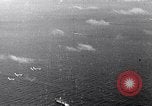
U.S. Navy Task Force Maneuvers prior to invasion of Peleliu, Palau Islands in World War II.
U.S. Navy Task Force Maneuvers prior to invasion of Peleliu in World War 2. Ships of invasion task force making simultaneous turns as Navy TBF airplanes fly overhead in formation. Escort Carrier USS Marcus Island (CVE-77) cruising in calm waters. Aerial views from above of Grumman TBF Avenger aircraft landing on the Marcus Island.
Public demonstration of "fire bomb" and its use supporting U.S. Marines in the Battle of Peleliu in World War II
A U.S. Navy F6F Hellcat airplane is seen parked on a ramp, with a bomb slung under its fuselage. The narrator identifies it as a "fire bomb," containing gel gasoline. Scene shifts to an F6F dropping one from several thousand feet, in a demonstration. The incendiary bomb creates a swath of fire along the ground, in the direction of flight. A flight of two F6Fs repeat the demonstration, dropping their bombs simultaneously, from a formation. Another drops a bomb on a pier at a waterfront. View to the rear from an airplane that just dropped a bomb in a wooded area. Views of actual U.S. 1st Marine Division operations on Peleliu, Palau Islands, during World War 2, showing F4U Corsair aircraft, flying low and slow, with gear down, dropping napalm incendiary bombs on Japanese troops dug in on a ridge. View of smoke rising from bomb strikes at targets near a river.
The USS Gunston Hall arriving in waters off Peleliu as part of an invasion task force during World War II
The USS Gunston Hall (LSD-5) in the waters off Peleliu, Palau Islands, during World War 2. Officers reading orders and briefing Marines on deck. Closeups of marines and officer reading the orders. Sailors shooting the sun with sextants. Other invasion task force ships seen from the Gunston Hall
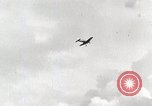
United States 1st Marine Division troops bomb Peleliu Island, Palau.
U.S. 1st Marine Division operations on Peleliu, during World War 2. U.S. F4U Corsair aircraft, flying low and slow, with gear down, drop napalm incendiary bombs on Japanese troops dug in on a ridge. Huge explosions seen. A C-47 transport airplane taxis on airfield. F4U Corsairs are seen parked and tents are pitched nearby.Several C-47s are parked on a ramp. Three F4Us taxi past them headed to the runway. F4Us take off and one is seen bombing Japanese positions on the ridge. Slate notes 1st Marine Division and D+24. Major General William Henry Rupertus,kneels on one knee, in sand, as another officer (shirtless) briefs him. They briefly discuss tactics and then walk away. Marine rifleman firing into burning wreckage of a Japanese position. Marine firing grenade from his rifle. Two Marines stand on beach with LVT (landing vehicle tracked) on the sand, nearby. They point at large ship offshore. Views of the Peleliu beachhead, with numerous ships and landing craft beached, including the second USS Seaward (LST 278) that collided with LST-129 and suffered considerable damage, On October 2, 1944. (LST-129 may be the LST seen next to LST-278.)
U.S. Navy and Marine Corps combat operations at Peleliu Island, Palau, during World War II.
U.S.LST-129 and the second USS Seaward (LST-278) next to each other, in rough surf at rock strewn Orange Beach III, Peleliu, in the Palau Island group, during World War 2. These two LSTs collided and suffered damage on October 2, 1944. View of airfield with U.S. F4U Corsair aircraft parked. An F4U landing on the runway. Another aircraft takes off. Construction equipment and tents seen on airfield. A PBY Catalina aircraft takes off. Change of sequence shows battlefield with bare trees. F4U aircraft flying low and slow, with landing gear extended, drop bombs, raising heavy smoke clouds, at Japanese positions just beyond a nearby ridge.
Major General Smith and other Marine officers aboard flagship USS Mount McKinley (AGC-7) at Peleliu, in World War II
Major General Oliver Prince Smith, Assistant Division Commander of the 1st Marine Division,along with other Marine officers aboard the USS Mount McKinley (AGC-7), watch bombardment of Peleliu during the U.S. 1st Marine Division amphibious assault on September 15, 1944. Landing craft are seen. The USS Louisville (CA-28) in camouflage, is seen firing her guns from close to shore. The island is covered in smoke from the exploding shells. General Smith is seen alone looking through binoculars. A group of Marine officers later look through binoculars. Marine officers line the deck to observe the action.