


 Francais
 Deutsch
 Italiano
Refine Your Search
+"Philippines" +1941 stock footage and images
- Showing 1 to 6 of 37 results more
more Hide
Hide
The Philippines gains independence from the United States on July 4, 1946; also scenes from 1941 Japanese invasion WW2
The Philippines are established as an independent nation. Crowds of Filipinos gathered at Rizal Park (Luneta Park) in Manila on the July 4, 1946. View of Independence Grandstand (a temporary structure built in front of the Rizal Monument) with American flag and Philippine flags on tall flag poles.. View looking down on General Douglas MacArthur at a podium, speaking into microphones. Camera pans over various segments of the audience. A map shows the Philippine Islands in context of its neighbors in the Pacific Ocean. Camera pans closeup across faces of many Filipinos gathered at the independence event. View of the Jones Bridge over the Pasig River in downtown Manila. Heacock’s Department Store on the Escolta. The Legislative Building. (later the National Museum of the Philippines). Ocean going ships in a harbor. Cargo being offloaded from a ship onto smaller boat. An industrial complex with eight tall smoke stacks emitting smoke. Steel and petroleum plants. Filipino workers in an assembly plant. The Legislative building with people coming and going. Air raid sirens sounding and people running in streets of Manila at onset of Japanese invasion of the Philippines in December, 1941, at start of World War 2, in the Pacific. People running across the Jones Bridge, seeking shelter. Others boarding a bus. Smoke rising from Japanese bombing. Glimpse of Japanese tanks entering Manila during attack and invasion. Japanese infantry climbing a hill. Bodies of persons killed during the Japanese invasion. Glimpse of Japanese troops occupying Corregidor. U.S. General Wainwright negotiating the surrender of Corregidor with Japanese General Homma. View of an American warship firing during the U.S. campaign to defeat the Japanese on islands in the Pacific. An American landing ship carrying U.S. troops who storm ashore. General Douglas MacArthur striding ashore with a retinue of officers, at Leyte, Philippines, on October 20, 1944. as he keeps his promise to return to the Philippines. Views, back again, to MacArthur speaking at the Independence Day ceremony in Manila on July 4, 1946. Also seen at the ceremony are: U.S. Senator Millard Tydings, (co-sponsor of the 1934 Tydings–McDuffie Act, which provided independence to the Philippines after a 10-year transition under a limited autonomy), and Paul V. McNutt, U.S. High Commissioner of the Philippines, who read President Truman's proclamation of Philippine Independence to the assembly. Camera pans over the gathering which includes many U.S. Service personnel in uniform. The oath of office is administered to the elected President of the Philippines, Manuel Roxas. At the conclusion, the American flag is lowered by Paul McNutt, as President Roxas raises that of the Republic of the Philippines. A celebratory parade in Manila includes a float with signs reading: "Let's Produce and Rebuild," among other things. Other floats represent "Mountain Province," and "The City of Manila," "The University of the Philippines," and "The Division of City Schools." One float, sponsored by the Chamber of Commerce, contains a huge replica machine gear, and models of an aircraft and a ship. It's message is about turning the gear that helps make the nation great. American and Filipino soldiers march, carrying their respective national flags. A white-helmeted military band plays for the marchers. Final scene shows large loose formation of military aircraft in flight very high above the Independence Grandstand, at Rizal Park.
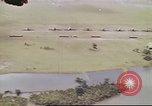
Airfield in Philippines prior to World War II in Pacific. Pilots with the Philippines Airlnes Twin Beech airplane
Aerial views from airplane flying over an airfield near the ocean in the Philippines, prior to World War 2 in the Pacific. (The airfield is probably Iba Field, on Luzon, which was destroyed by Japanese bombers on Dec. 8, 1941.) Army airplanes are parked on the field. Numerous buildings and facilities are seen. A bivouac area of tents near the water. Scene shifts to Philippine Airlines pilot Paul Irving Gunn and his assistant, aviator Emil Sylvan Scott, standing in the grass, by a Philippine Airlines model 18 Beechcraft. The airplane is bright red with the number 2 painted on its nose and the company logo on its fuselage.
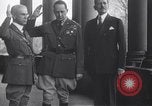
General Douglas MacArthur in 1930-1945; training of the Philippine Army; leading Allied troops against Japanese forces (WW2)
General Douglas MacArthur is appointed Chief of Staff, with rank of full General, in 1930. United States troops marching with the American flag. General MacArthur with two French military officers, during a tour of Europe. He is decorated by French Officials. MacArthur visits Germany and inspects German troops. U.S. President Roosevelt reappoints MacArthur as Chief of the Staff. MacArthur speaking to an audience in Washington DC. Scenes of MacArthur's headquarters in the Philippines. Filipinos walking outside MacArthur’s office. MacArthur at his office in the Philippines with Eisenhower at his side. MacArthur talks on the telephone. Flags of the United States and the Philippines. Filipino troops marching at Fort Santiago inside the walled city of Intramuros in Manila. MacArthur supervises the creation of a Philippine Army before World War 2. Philippine Army cadets perform outdoor calisthenics and attend a meeting. Philippine Army cadets train in knife fighting together with U.S. soldiers. View of Japanese attack of U.S. Navy ships and airfields at Pearl Harbor in December 1941. Japanese bombardment of the Philippines in December 1941 and into early 1942 as Japanese occupy Philippines during World War II. View of Corregidor Island. U.S. Army and Filipino soldiers on Corregidor load and fire artillery at the Japanese before the fall of Corregidor. U.S. soldiers in the Bataan peninsula. Face of MacArthur superimposed over a montage of American factory workers manufacturing ammunition and military vehicles. Start of the Bataan Death March. PT boat carrying MacArthur leaves Corregidor. War equipment prepared in factories. A battleship underway to Australia. MacArthur in Australia. U.S. convoy moves towards Japanese held islands in the Pacific. Allied soldiers land on the islands. A soldier lands on a beach and raises the American Flag. MacArthur points to the Philippines on a map and discuss war strategy. In accordance with the plan key positions in the Pacific are attacked. MacArthur looks on as United States soldiers land on the islands. MacArthur while smoking a pipe inspects the landing of Allied soldiers on islands behind heavy bombardment. Amphibious tractors land on the beach of Palo, Leyte. Allied paratroops make a landing. United States troops sail on rubber boats towards the beach of Palo, Leyte. Paratroopers on parachutes landing in Leyte. MacArthur confers with Allied Commanders. Allied troops walk past a destroyed Bahay Kubo nipa hut. Japanese soldiers are taken as prisoners in the Philippines.
Damaged houses and buildings as Japanese airplanes bomb Manila, Philippines during World War II.
An orientation film titled 'This is the Philippines' depicts the bombing of Manila, Philippines by Japanese aircraft during World War II. Buildings along the sides of a street. Traffic on a road. Japanese airplanes bomb Manila in 1941. Damaged houses and buildings in the area. Smoke rises due to the bombardment. Several buildings set on fire during the Japanese attack.
Japanese troops and military elements moves forward to attack Manila in Philippines.
Japan's Military moves up to attack Manila in Philippines in December 1941, during World War 2. Japanese troops cross a bridge. Trucks and artillery towed. Japanese occupation soldiers move forward. Smoke rises from houses. Troops march in field and smoke rises in the background. Tanks move forward from a village. People besides road wave Flag of Japan to greet Japanese troops in City. Damaged United States aircraft on airstrip. A plane takes off. Animated map shows movement of Japanese aircraft portraying aerial attack over Corregidor.
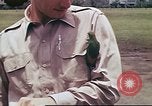
Members of the U.S. Army 17th Pursuit Squadron at Nichols Field in the Philippines, before World War II, in the Pacific.
Scenes of Nichols Field, the Philippines, in 1941, before World War 2, in the Pacific. An airman plays with a budgerigar parakeet that sits on the shoulder and walks on his hands and arms. Group of airmen conversing in front of Squadron building. A truck, with Nichols Field painted on its side, arrives. A Bolo bomber (B-18), is seen in background. An airman drinks a coke and dons a checkered white cap with 17th written on it. A seversky P-35 pursuit airplane, originally slated for delivery to Sweden (note fuselage insignia), lands on the airfield.