


 Francais
 Deutsch
 Italiano
Refine Your Search
+"Philippines" +1944 stock footage and images
- Showing 25 to 30 of 167 results more
more Hide
Hide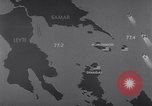
Battle for Leyte Gulf between the Allied naval-air forces and the Japanese naval-air forces.
Animation shows Allied naval-air attack over the Philippines islands during the Battle for Leyte Gulf against the Japanese naval-air forces in October 1944. The battle is fought around a chain of islands such as Luzon, Samar, Leyte and Mindanao. (World War II period).
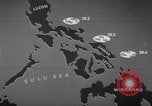
Battle for Leyte Gulf between the Allied Naval Air Forces and the Japanese Naval Air Forces.
Animation shows Allied Naval Air attack over the Philippines island of Leyte during the Battle for Leyte Gulf against the Japanese Naval Air Forces in October 1944. The battle is fought around a chain of islands such as Luzon, Samar, Leyte and Mindanao. Allied 3rd and 7th naval fleet launch a massive attack and cripple the Japanese naval-air support. Results show heavy damage inflicted to Japanese Naval Air Forces. (World War II period).
Animation outlines timeline of battle for the Surigao Strait starting with PT boat contacts with the enemy.
Animation shows Allied naval battle for the Surigao Strait in the Philippine islands during the Battle for Leyte Gulf. Segment begins with PT boats making radar contact and then physical contact with the Japanese naval-air forces during October 1944. (World War II period).
Animation show division 107 striking Japanese and then retreating in the Surigao Strait during the Battle for Leyte Gulf.
Animated map shows Allied naval battle for the Surigao Strait in the Philippine island during the Battle for Leyte Gulf against the Japanese naval-air forces during October 1944. Radar picks up enemy's presence. Division 107 strikes Japanese forces and then retreats quickly, making smoke. (World War II period).

U.S. film designed to boost national morale during World War II. Numerous scenes of American forces engaged in combat.
Several American school children, including one in a Boy Scouts of America uniform, recite the pledge of allegiance during World War 2. Scene broadens to encompass a school yard filled with elementary school students reciting the pledge in front of an American flag flying high on a pole. As scene fades images appear of battleships firing guns; an F4F airplane taking off from an aircraft carrier; landing craft approaching a beach; American soldiers fighting with small arms and a flame thrower, in jungles of New Guinea; a U.S. gun crew firing heavy artillery; and a U.S. P-38 aircraft on a rainy runway, spraying water as it takes off, in the Aleutian Islands. U.S. troops firing automatic weapons on a Pacific Island. A B-17 pilot wearing an oxygen mask in his cockpit, flying in a formation creating contrails at high altitude over Germany. Waist gunner firing at an attacking German fighter plane that explodes in air. U.S. troops in jeeps moving over jungle road. U.S. ski troops on snow in Iceland heading downhill toward their tents in the snow. American troops during amphibious landing in the Philippines. U.S. troops aboard army halftracks on desert in Iran. American paratroopers dropping from C-47 aircraft over France. U.S. soldiers marching through two large gates with cadre of Chinese soldiers in China. American troops fighting in Italy and firing a 155mm howitzer. U.S. infantry following a sherman tank over a war-torn landscape with shells bursting nearby. Crowded, busy street scenes of traffic and pedestrians in Manhattan, New York City, and Chicago, Illinois. Army tanks being manufactured by war production workers in a Detroit war production plant or factory. A Los Angeles shipyard filled with workers at shift change. Closeups of individual American soldiers in combat helmets. U.S. troops descending rope nets from transport ships to board landing craft, and approaching the beaches of Normandy, France, under fire, on D-day, June 6, 1944. Views of the Statue of Liberty, including closeups.
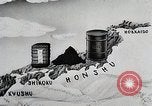
Japanese natural resources related to Second Sino-Japanese war and World War II
Animated map illustrating shortage of indigenous raw materials in Japan. As stockpiles vanish during Second Sino-Japanese war, Japan's domestic sources supply only 10% of the nation's needs for war. Animated sequence shows lack of steel, aluminum, copper, and power generation for the conduct of war. But one of the nation's greatest resources is the population of skilled Japanese workers, who are shown at various high tech jobs, as well as on the farms and in the fishing industry. Japanese workers are seen who work for the Zaibatsu (four ruling families of Japan). Banks of Japanese women typists and women in a factory. Young women painting faces on a "Kewpie doll." A Japanese family at dinner time. Women engaged in fabric spinning. Animated graphic illustrates Japan's war-related resources for World War 2, by showing a Japanese soldier standing astride map of Japan with lines extending to sources of needed raw materials from Japanese possessions in Korea, Manchuria,Formosa, China,Indochina,Malaya, and its network of Pacific Islands. Final scene displays copy of Los Angeles Times newspaper with headline reading: "Jap Supply Lines Blasted." It also features a story that appears to refer to the U.S. 6th Army invasion of Leyte in the Philippines, in October, 1944 (when General MacArthur waded ashore and stated,"I have returned"). (Note: Although produced during World War 2, this film shows prewar scenes of Japan. The animated illustrations and maps and, of course, the newspaper shown at the end, date from World War II.)