


 Francais
 Deutsch
 Italiano
Refine Your Search
+"Philippines" +1945 stock footage and images
- Showing 1 to 6 of 453 results more
more Hide
Hide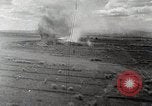
Views of Clark Field and environs,Luzon, Philippines, after liberation by U.S. in 1945
Aerial views from airplane flying very low over portions of Luzon, Philippines, after liberation by the U.S. in World War II. Smoke from farmers burning parts of their fields. View of Clark Field and environs. Barracks and other installations, including a hospital with red cross on the roof. Aerial view of the Holy Rosary Church in Angeles City, Pampangga, Philippines whose roof was damaged by an American Mitchell B-25 bomber on January 7, 1945. The bomber, dubbed the "SAG Harbor Express" of the 499th Bomb Squadron, had been hit by Japanese anti-aircraft artillery. 2nd Lt. Arthur Browngardt was manning the bomber, and perished with all crew as the plane crashed near Holy Angel Academy. Destroyed and damaged Japanese warplanes on Clark Field. Two Americans (one with a rifle) and a local mechanic examining an undamaged Japanese Mitsubishi G4M "Betty" bomber (tail number: 763-12). They open the fuselage door and go inside.
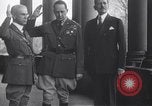
General Douglas MacArthur in 1930-1945; training of the Philippine Army; leading Allied troops against Japanese forces (WW2)
General Douglas MacArthur is appointed Chief of Staff, with rank of full General, in 1930. United States troops marching with the American flag. General MacArthur with two French military officers, during a tour of Europe. He is decorated by French Officials. MacArthur visits Germany and inspects German troops. U.S. President Roosevelt reappoints MacArthur as Chief of the Staff. MacArthur speaking to an audience in Washington DC. Scenes of MacArthur's headquarters in the Philippines. Filipinos walking outside MacArthur’s office. MacArthur at his office in the Philippines with Eisenhower at his side. MacArthur talks on the telephone. Flags of the United States and the Philippines. Filipino troops marching at Fort Santiago inside the walled city of Intramuros in Manila. MacArthur supervises the creation of a Philippine Army before World War 2. Philippine Army cadets perform outdoor calisthenics and attend a meeting. Philippine Army cadets train in knife fighting together with U.S. soldiers. View of Japanese attack of U.S. Navy ships and airfields at Pearl Harbor in December 1941. Japanese bombardment of the Philippines in December 1941 and into early 1942 as Japanese occupy Philippines during World War II. View of Corregidor Island. U.S. Army and Filipino soldiers on Corregidor load and fire artillery at the Japanese before the fall of Corregidor. U.S. soldiers in the Bataan peninsula. Face of MacArthur superimposed over a montage of American factory workers manufacturing ammunition and military vehicles. Start of the Bataan Death March. PT boat carrying MacArthur leaves Corregidor. War equipment prepared in factories. A battleship underway to Australia. MacArthur in Australia. U.S. convoy moves towards Japanese held islands in the Pacific. Allied soldiers land on the islands. A soldier lands on a beach and raises the American Flag. MacArthur points to the Philippines on a map and discuss war strategy. In accordance with the plan key positions in the Pacific are attacked. MacArthur looks on as United States soldiers land on the islands. MacArthur while smoking a pipe inspects the landing of Allied soldiers on islands behind heavy bombardment. Amphibious tractors land on the beach of Palo, Leyte. Allied paratroops make a landing. United States troops sail on rubber boats towards the beach of Palo, Leyte. Paratroopers on parachutes landing in Leyte. MacArthur confers with Allied Commanders. Allied troops walk past a destroyed Bahay Kubo nipa hut. Japanese soldiers are taken as prisoners in the Philippines.
Filipino Luzon Guerilla Forces (LGAF) in Cagayan Province, 1945
Enrile Elementary School in Cagayan Province, Philippines, being used as a headquarters for Filipino Luzon Guerilla Forces (LGAF). A sign on blackboard read: "Silence, Guardhouse." A guard at the entrance gate. A Filipino guerilla, with a package in hand, walks in through the gate and reports to an LGAF officer at a desk on the porch . He points out intelligence information on a map spread on the desk. The officer seated at the desk places the intelligence information in an envelope and gives it to another LGAF guerrilla, who leaves on horseback to deliver the information to friendly forces. A field in view. A wooded region. Smoke rises from areas in the wooded region. A water buffalo in the field.
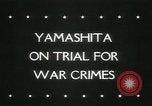
Runup to Yokohama War Crimes Trial of Kuroda and others; Clips of Trial of General Yamashita in Manila 1945 (WW2)
First part deals with World War II Allied war crimes trials of Japanese defendants in detained in Omori Prisoner of War Camp in Tokyo, Japan. Soldiers unload luggage from the back of a truck in Omori Prisoner of War Camp. Captured Japanese generals bring their luggage to prison camp. Sign reads “XI Corps Stockade #2 Omori P.O.W. Camp”. 8th Army Chief General Clovis E. Byers and Lieutenant Colonel Salvi, Commandant of Omori, talking to each other. Japanese military officials in Omori Prison Camp include Admiral Shigetaro Shimada, Commander Shigemori Kuroda, General Masaharu Homma and Colonel Kingoro Hashimoto. Second part is Japanese General Tomoyuki Yamashita on trial for war crimes in Manila, Philippines. Few Military soldiers talk to each other at a camp. Few views of Japanese Generals under trials for war crimes. General Yamashita brought for the trial. General Yamashita enters a court in Manila for the trial. An interior view of the trial court. General Russel Burton Reynolds presides the trial session. General Yamashita sits on a chair at his trial. A member of the trial court reads a document. Lawyers give their points during the session. General Yamashita is taken out after the trial session in court.
Units of United states 14th Corps capture Clark Field as they advance toward Manila, Philippines, during World War II
American troops in their drive toward Manila, in 1945, during World War 2, pass several knocked out and burning Japanese Type 89 Chi-Ro tanks. A dead Japanese soldier, shot dead while trying to commit suicide, lies on the ground with an undetonated hand grenade in his mouth. U.S. M4A2 sherman III tanks and infantry of the XIV Corps moving on the Lingayen Plains Philippines, leading to the capital, Manila. U.S. armor towing artillery ford a stream, as they pass beneath framework of an apparently unusable bridge. A battery of U.S. M101 105mm Howitzer artillery pieces is set up and bombards the Clark Field area. One striking shell produces an explosion, fire and column of black smoke. U.S. troops ride forward atop tanks. Glimpse of one soldier with flamethrower tanks on his back. American tanks firing their guns. Destroyed Japanese aircraft on the ground. A soldier using a mine detector to sweep the area. He signals to another soldier who comes to probe the area with a long knife. Next a soldier is seen standing in a hole dug around a bomb Placed nose up under the ground by the Japanese. Soldiers pull it from the hole, using a rope. U.S. soldiers walk in area full of similar holes and bombs pulled from them. General Douglas MacArthur is seen, on January 26, 1945, walking among remains of Japanese aircraft at Clark Field. He visits the Filipino cemetery at Camp O'Donnell, which was a prisoner of war camp, considered the terminating point of the Bataan Death March, where some 20 thousand Filipinos and almost 2 thousand Americans died during the Japanese occupation of the Philippines. MacArthur is seen standing by a large Christian Cross monument, and walks among untended graves marked with small wooden crosses. The Mount Pinatubo volcano is seen on the horizon in the background. MacArthur and those accompanying him walk around a large monument containing a placard written in tagolog. U.S. soldiers start a mortar barrage against Japanese forces dug in on "Hill 70." Infantrymen move through trees and brush to flush out the entrenched enemy. Glimpse of type of improvised device made of explosives and gasoline, that U.S. soldiers are using to drive Japanese troops out of their fortifications. As a soldier watches with binoculars, the camera records several of these devices exploding with great force. Glimpse of a dead Japanese soldier on the ground. U.S. troops ride atop an M18 Gun motor carriage of the 637th Tank Destroyer Battalion, as it crosses a river. American tanks and infantry moving cautiously across a bridge as shells explode ahead of them. Tanks firing at Japanese troops entrenched in hillside above a road. Large numbers of American infantry marching along a road accompanied by tanks. Areas around them burning from fires set by retreating Japanese forces.
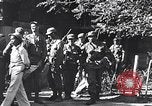
U.S. Rangers and Filipino guerrillas rescue Allied prisoners from Japanese prison camp in Philippines during World War II.
On January 30, 1945, 121 members of the 6th Ranger Battalion and 286 Filipino guerrillas are seen setting out on a 30 mile trek behind Japanese lines, to free Allied prisoners of war (POWs) and civilians from a Japanese camp near Cabanatuan City, in the Philippines, during World War 2. They stretch out in a long, informal column as they traverse low flat lands and ford a wide shallow river. The men carry weapons and supplies (some on their heads) as they move along, almost like a Safari. Scene shifts to rescued prisoner, Major Emil P. Reed, U.s. Army Medical Corps,26th Cavalry. He was the senior officer among prisoners at the Cabanatuan prison camp number 1. He recounts being told by the Japanese Commandant that commencing January 7th, they were free at their own risk, but also assured them they would not be molested by the Japanese if they stayed within their regular camp area. Sergeant Samuel E. Goldy, Signal Corps, also speaks a few words about that period when Japanese were departing. Next the camera records the Rangers and Filipino guerillas returning with the approximately 500 freed POWs. Some Filipino women and children watch them return. At one point, the cadre climb aboard army trucks and continue their journey in a convoy. The POWs climb down from their trucks at the 92nd Evacuation Hospital, in Guimba, Luzon. Some take pleasure is simply lying down on the grass at the site. Many gather around hospital staff handing out packages of treats, including cigarettes, candy and the like. A couple of them express pleasure as they smoke cigarettes. Two frail and injured are seen hobbling with canes. Some appear seriously malnourished. A group are seen trying on new clothes. A British prisoner, Sergeant Robert Bell, Manchester Regiment, British Army, speaks of his experience. He was taken prisoner in Singapore and sent to Thailand where he worked to build a railway for the Japanese. Many prisoners died there from disease and malnutrition. He was one of a small number who survived after being on a Japanese ship with other prisoners when it was sunk by American dive bombers. Sergeant Walter Ring, of San Roque, Luzon, is seated, relaxed on a chair, as he recounts his experiences. Two young Filipino boys sit on the grass at his feet. He reaches to one, whom he says is his son Louis and to the other, his son Sam. His captivity began on Bataan in 1942. Finally, after rest and rehabilitation, the former POWs are seen heading away from the battle fronts to be transported back to the U.S.A.