


 Francais
 Deutsch
 Italiano
Refine Your Search
+"Poland" +1939 stock footage and images
- Showing 85 to 90 of 129 results more
more Hide
Hide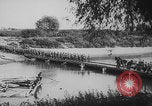
German troops cross temporary bridges in Poland during World War 2 occupation
During the German invasion of Poland during World War II, German army forces cross new temporarily built bridges. The troops are composed primarily of soldiers on foot, with horse-drawn supply wagons and some mounted cavalry. German troops crossing on a low and simply-made bridge with no guardrails. Debris in the water near the bridge. Horse-drawn wagons entering a different bridge. View of crooked rails on hastily-made bridges. A soldier on a bicycle rides up a muddy road beside a horse-drawn supply wagon. Another wagon ahead contains another bicycle. A third bridge is crossed. On the opposite bank, a wagon pulled by two horses speeds off the bridge, kicking up dust. A soldier runs behind. Horses run to pull wagons up a hill, and then slow at the top. The troops walk along a road.
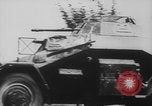
German tanks and infantry travel fast through Poland
Motorized German vehicles move quickly down a dirt road, continuing the invasion of Poland during World War II. The first vehicle shown is a light reconnaissance car, likely the Sd.Kfz 221 but potentially the 222. Another vehicle shown is the Sd.Kfz 263. Tanks and supply trucks drive on uneven roads, while soldiers on foot watch the progress. A vehicle drives through a small puddle or stream. A series of Panzer II tanks roll down a steep hill while soldiers in undershirts stand and sit to the side of the road. Many militarized vehicles are visible in a wide shot covering a bend in the road. A truck speeds past. Off the road, German soldiers look on and a cow is lead around. A massive line of German infantry marches in formation. A lone mounted cavalry soldier leads the line of troops, while military cars drive past. Close shots show the young soldiers' faces and their full uniforms. These proceedings are scored by triumphant music. The inside of a German airplane cockpit is briefly shown, looking past the heads of the pilots to the sky. German Luftwaffe crew look through documents on aircraft as they track positions of retreating Polish forces. A German soldier wearing headphones transmits a message using a radiotelegraphy machine.
German JU-87 Stuka dive bombers attack Westerplatte in Gdansk, Poland, during World War II
A formation of German JU-87 Stuka dive bomber aircraft en route to attack Polish forces at Westerplatte peninsula in Gdansk, Poland, during World War 2 invasion of Poland. Alternating scenes of the Stukas in flight and views of the ground as they approach Westerplatte. View from inside a Stuka as it commences dive over the target. Smoke rising from exploding bombs on the ground. Sequence shifts to several JU-87s landing at their home field. German soldiers stripped to the waist lift bombs and carry them to the aircraft. Several more Stukas landing. Then a Stuka is seen flying over the field, with no landing gear visible. (Some Stukas were fitted with explosive charges to jettison the gear in emergency.) The pilot makes a successful belly landing, although the aircraft sustains considerable damage. German fliers gather around the JU-87 and examine it and converse. (It appears that the aircraft may have suffered some battle damage, as well.) Fliers look over photographs of their next target, while armorers move a heavy bomb to an aircraft with the aid of a dolley lift. Groups of ground crew carry smaller bombs. Several men together lift a bomb under a wing. An aircraft is refueled, and hand cranked to start, and takes off. A Stuka in flight, and view from the rear seat, of the pilot and his cockpit bomb sight. Slow motion view from aircraft as it dives toward a rail marshaling yard and pulls out upon release of its bomb. It flies through smoke from exploding bombs. View as it begins to strafe a column of Polish military vehicles at low altitude.
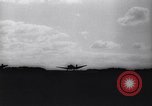
German Luftwaffe (Air Force) employs mix of aircraft during intensified bombing campaign over Poland in World War II
Numerous German Ju-87 Stuka dive bombers are seen taking off from an airfield, on bombing missions against targets in Warsaw, Poland, during invasion of Poland in World War 2. Ground crews load bombs aboard the aircraft. A Dornier D0-17 bomber is seen taking off. A Henkel He-111 is seen in flight. View of ground target from nose of the bomber. Smoke rising from burning targets on the ground. Narrator refers to Bzura River area (where Polish forces had launched a counterattack). The Confluence of the Rivers, Vistula and Narev, are seen and the Polish fortress of Modlin, as the bombers approach it. Fires and smoke are seen rising from the German bombing.
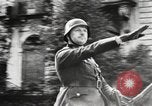
German leader Adolf Hitler reviews a victory parade in Warsaw, Poland.
Germany invades Poland. German troops march in a victory parade in Warsaw, Poland. German leader Adolf Hitler reviews the parade. German soldiers on bicycles and horses with rifles in hand. Soldiers in army trucks. Officers drive past in cars. A soldier on the tank gives a Nazi salute.
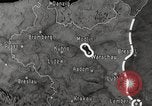
Bomb damaged buildings, bridges and fields in Warsaw, Poland.
Germany invades Poland. Animated map shows Warsaw and Modlin in Poland. An aerial view of the houses and coastal areas. Water flowing over the war damaged bridge. Polish civilians walk on streets. Bomb craters on German fields.