


 Francais
 Deutsch
 Italiano
Refine Your Search
+"Poland" +1939 stock footage and images
- Showing 121 to 126 of 129 results more
more Hide
Hide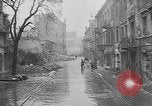
Destruction in Warsaw after German bombing
Aftermath of German bombing in Warsaw during invasion of Poland by Germany. Wrecked and damaged buildings in residential areas. Rubble lies in the street. Civilians walk in front of the ruined buildings. Balconies of the damaged buildings. Vehicular traffic on the street.
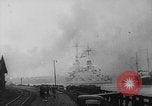
German battleship SMS Schleswig-Holstein bombards the Westerplatte fort in the port of the Polish town of Danzig (Gdansk)
Wide views of the German training ship SMS Schleswig-Holstein as it sails into the Polish port city of Danzig (Gdansk), beginning the German invasion of Poland in World War II. The Deutschland class battleship had been stationed close to the harbor since August 25th under the pretenses of a ceremonial visit, but 225 German soldiers were hiding belowdecks. In the morning of September 1st, the battleship fires on the fortified Polish munitions depot on the Westerplatte Peninsula, the first shots of World War II. Views onboard the Schleswig-Holstein of German sailors firing guns and Captain Gustav Kleikamp looking on through binoculars. After the bombardment, a white Polish surrender flag is visible flying from a building onshore. A "Westerplatte" peninsula sign and the ruined walls of the Westerplatte fort are shown from onboard a boat in the port of Danzig. German and Polish officers discuss surrender terms. German soldiers distribute cigarettes to battle-weary Polish Navy prisoners of war.
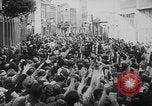
German soldiers march through civilian crowds in Konigshutte (Chorzow)
A scene from the beginning of the invasion of Poland during World War II. A single wide moving shot of a large formation of German army troops marching through the Polish city of Chorzow (German name Konigshutte), which bordered Germany. The street is packed with civilian men, women, and children who raise their hands and cheer, some with Nazi salutes, welcoming the German soldiers because many citizens of that area considered themselves half German or "Volksdeutsch." A few soldiers at the front of the column can be seen smiling as they press their way through the cheering crowd.
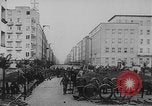
The city of Gdynia surrenders and German boats clear the Bay of Danzig
During the German invasion of Poland during World War II, the Polish city of Gdynia surrenders to the German occupation. A main street is shown with German soldiers walking around. A shot from a moving car shows young civilian men standing on the side of the road. A poster on a wall in Polish encourages Polish citizens to not give up the fight and says that Polish troops will come to defend Gdynia. The mayor of Gdynia discusses the surrender terms with the commander of the German forces. Armed German soldiers guard a large store of sacks. Male civilians walk through the streets of Gdynia. A shot from high up shows German troops marching through the streets while other soldiers stand to the side. Armed soldiers walk past a dirt embankment with steel beams sticking out of it. German tanks and troops move through the streets while concerned-looking civilians watch. In the bay of Danzig, German boats in the distance search the bay for mines.
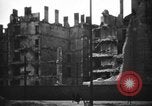
Polish citizens commemorate victims of Wawer Massacre, raise Adolf Hitler puppet in effigy during WW2
Destroyed city blocks and rubble in Warsaw ghetto during World War 2. A man writes “WAWER” on pavement as reference to the 1939 massacre of 107 Polish civilians by German forces in Wawer, near Warsaw. Women leave flowers on pavement to commemorate victims in Wawer. Pavement Polish graffiti with the symbol of the PW Polish Underground State. Polish men play with a cartoon Adolf Hitler paper marionette puppet hung on a wall. Polish men hoist cartoon Adolf Hitler puppet in effigy up a lamppost. Bottom of streetlamp with graffiti words written in German.
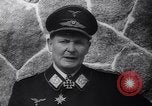
Hermann Goering, Chief of the German Air Force, gives a speech in tribute to the Luftwaffe (Air force)
Chief of the German Air Force (Luftwaffe), Hermann Goering, extols the capabilities and contributions of the Luftwaffe to German conquests, mentioning Poland, and France. As he speaks, a German Henschel Hs 126 observation plane is shown, followed by shots of a Messerschmitt Me-109 and formations of them flying amongst clouds, A German antiaircraft emplacement on a parapet high above a river. A lone German sentry patroling a beach and a flight of Me-109s flying low over his head. View from nose of a German bomber flying low over water. German Dornier Do-17 bombers penetrating a coastline. Pilots and gunner in bombers. Formation of Heinkel He-111 bombers in flight. Animation shows British mainland from perspective of a dive bomber heading toward the ground. Sequence finishes with explosion. Throughout the last half of the clip, a male chorus is heard singing the Luftwaffe's unofficial anthem, "Bomben auf Engelland," (Bombs on England) by Norbert Schultze (Norbert Arnold Wilhelm Richard Schultze).