


 Francais
 Deutsch
 Italiano
Refine Your Search
+"Poland" +1941 stock footage and images
- Showing 1 to 6 of 18 results more
more Hide
Hide
The invasion of Poland, Dunkirk evacuation, Second Armistice, and London Blitz during World War II.
'50 Years of Cinematography' depicts the role of military and news cameramen during World War II. Germany starts the War. Invasion of Poland in 1939: German Nazi Luftwaffe bombers in flight over Warsaw. Explosions due to the bombardment. Burning and damaged buildings in the war torn city. Civilians amidst rubble and ruins. Soldiers and civilians look at corpses on a sidewalk. A woman with her child cries. A man walks on a street. Dunkirk Evacuation in 1940: Allied troops evacuated from the Dunkirk coast. Allied troops on ships. Smoke rises from a ship under German attack. Soldiers wade through the water towards waiting ships. Burning ships. The Second Armistice at Compiegne after the German victory in the Battle of France, 1940: German troops stand at attention. German Fuhrer Adolf Hitler, President of the Reichstag Hermann Goering, German Field Marshal Wilhelm Keitel and other German officers arrive at the venue. The leaders and officers walk past the soldiers at attention. Hitler gives the Nazi salute. The Blitz, London in 1940-1941: Bomb damaged buildings. Cars and pedestrians amidst ruins and rubble on the streets. A train over a collapsed wall. Civilians in a horse cart. A wrecked bus in a damaged building. Rescue workers among the rubble. Clouds over the city.
German invasion of Poland triggers British mobilization for World War II
Prime Minister Neville Chamberlain of Britain sits pensively at his desk. Winston Churchill and his wife, Clementine, walking together in London. King George VI stepping from a car and entering 10 Downing Street. Mobilization of British forces for war. British civilians marching casually wearing steel army helmets. A man volunteering for the Army. New recruits being issued uniforms. Others, in civilian clothes, learning to drill with rifles and then marching away from a village. Recruits in bayonet practice. Winston Churchill speaking about the tragedy brought upon Europe by Hitler (this Churchill speech was at St. James's Place, London, June 12, 1941, in an address to Allied delegates). Aerial views of the destruction of Poland by Luftwaffe aircraft of Germany. Civilian Polish victims of German bombardment. A boy and women mourning over the dead. A child being held near a bonfire to warm her. Children rescuing a few possessions from a destroyed home. Parents carrying children. Women and girls crying and in mourning for the loss of loved ones and destruction from war.
Actions of Germany and Russia at the beginning of World War II
Events leading to start of World War 2. Contingents of German army troops and black uniformed SS (Schutzstaffel) troops parading past Hitler on reviewing stand in German city. Hitler youth at a rally in a stadium. Hitler addressing an open air assembly, shaking his fist, yelling about the might of Germany in an animated fashion. Women holding signs reading: "Down with War and Fascism," and "Aid the Allies." 1939 edition of the New York Times carries headline about Nazi pact with Soviets and of Estonia giving Moscow air and sea bases. Views of Soviet leaders, Joseph Stalin, Vyacheslav Molotov, and General Boris Mikhailovitch Shaposhnikov, preparing to meet with German foreign minister Joachim von Ribbentrop for signing of Molotov-Ribbentrop Pact agreeing to non-aggression between Germany and the Soviet Union. Von Ribbentrop descending from his airplane for the meeting. Scenes of German attack and invasion of Poland, September 1, 1939. Vehicles carrying German troops on the move. German Stuka, Ju87 dive bombers peeling off in dives and dropping bombs. German He-111 bomber in flight. Many explosions and collapsing buildings and destruction depicted. Soviet T-26 Twin-Turret Cavalry Tank seen moving through snow as it crosses Polish frontier, on September, 17, 1939. Soviet troops charging into Poland in the snow. The two forces meet in central Poland. Newspaper cartoon of the time shows Hitler and Stalin politely addressing each other in deprecating terms. Soviet icebreaker opening the way for German warships. German submarine making way on the surface, ostensibly from a base in Murmansk, and firing at a surface ship with its 88mm deck gun. A French fighter plane spinning towards earth and pilot parachuting. Narrator speaks of French Communists sabotaging electrical systems on the aircraft. The plane burning on the ground. German troops marching along the Champs Elysees, with the Arc de Triomphe in background. German troops firing artillery at Soviet forces after Germany turns on the Soviet Union and commences Operation Barbarossa in 1941. Wooden buildings burning. Russian soldier with hands up approaches German soldier to surrender. German soldier motions him behind battle line.
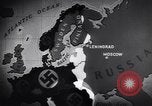
German Operation Barbarossa on the Eastern front in World War II
Animated map shows extent of German controlled areas in Europe following their conquest of the Balkans in World War 2. Norway is under their control and German forces threaten Leningrad and Moscow. A soviet defense line is shown on the map. The German attack is shown to come from 5 directions on June 22, 1941, with the launch of German Operation Barbarossa. A sky filled with German Heinkel He 111 bombers is shown. German Panzer III tanks with 75 mm guns. Army trucks carry German troops into battle. German soldiers on motor cycles and infantry advance under fire. Animated map shows principal German targets as Leningrad, Moscow, and Kiev. It then shows beginning a drive from the North to encircle Leningrad. Arrows show where German Marshal Fedor von Bock's forces drove 480 miles into Soviet territory. Slates identify cities being overrun by German invaders, including: Pskov, Novgorod, Brest-litovsk, Minsk,Mogilev, and Vitebsk. On July 17, 1941, a German tank is seen entering Smolensk, past the Dnieper River threatening Moscow, itself. To the south, German forces, under Marshal Gerd von Rundstedt, cut deep into the Ukraine. Newspapers world-wide consider the Soviet forces close to defeat. Slate shows communique from the German High Command stating: "The issue in the East is already settled. Smolensk is the last halt on the road to Moscow." German infantry marching. Scene shifts to heavy artillery being fired by Soviet forces in a snowy scene clearly later in the year. Animated map shows German forces very close to Moscow on October 15, 1941, forcing the Soviet Government and all foreign missions to move to Kuibyshev, 700 miles to the east. Adolf Hitler, in a speech on October 3, 1941, states that the enemy is broken and will never rise again. Animated map shows 500 thousand square miles of Soviet territory occupied by German forces. Views of fires burning in Russia. Damaged and abandoned Soviet industrial plants. A German guard atop a hill looks down on thousands of Soviet people in the occupied areas of Russia. Damaged and abandoned Soviet T-26 tanks. Glimpse of damaged Soviet aircraft and field artillery. Headline in New York World Telegram newspaper reads: "Berlin Admits Russ War May Last Winter." Another headline reads: "Red Army Holds Push On Moscow." Weary German soldiers traveling in horse-drawn wagons, pulling field artillery. Soviet and German war planners are seen at work. Slate quotes Adolf Hitler saying: "A single blow must destroy the enemy, without regard for losses... A gigantic all-destroying blow." German armor moving along a road. Animated map shows this technique in the German invasions of Poland, France, the Balkans, and Yugoslavia. In contrast, the Soviet planners are seen, as map illustrates how they intend to take advantage of the vast area of their land by holding lines of defense an falling back as necessary to keep engaging the invaders across interior of the Soviet Union. Soviet infantry are seen marching along a road. German troops riding atop their tanks. Soviet troops forcing German invaders into close combat in her cities. Soviet soldiers running in a city and firing heavy machine guns. Bomb damage and rubble inhibit German armor mobility in cities. Cities where this kind of Soviet resistance prevailed were: Rostov, Kharkov, Kiev, Kursk, Smolensk. German troops leaving a city with heavy black smoke rising in the background. More views of cities where Soviet troops are engaged German forces in House-to-house battles, including: Odessa, where the Old Opera Theater building is shown sandbagged and relatively undamaged. The Odessa NI tank, created from an STZ-3 agricultural tractor.
German Operation Barbarossa on the Eastern front in World War II.
View of the city, Pskov, on the Veilakaya river. A steel bridge is seen and city across it with smoke rising. German troops march in loose formation over a bridge in Novogorod. Views of German camouflaged tank (with shrubbery) and other armor and troops entering Soviet cities of Brest-litovsk, Minsk, Mogilev, and Vitebsk. View of German Panzer III tank heading toward the camera as it enters a narrow street in Smolensk. Animated map shows progress of these German advances and highlights German forces under German Field Marshal Gerd Von Runstedt cutting deep into the Ukraine. Headline on Chicago Daily News reads: "Nazis Claim Knock-out Victory" with subtitle line reading,"Moscow line cracks." Other newspapers reflect conviction that Soviet forces face imminent defeat by Germany. Slate shows communique issued by the German High Command, stating: "The issue in the East has already been settled. Smolensk is the last halt on the road to Moscow." More views of marching German troops. A battery of Soviet artillery firing from a snow-covered field. Animated map shows German forces moving close to Moscow. Foreign diplomats are moved from Moscow to the city of Kuibyshev. Hitler speaking on October 3, 1941, saying "This enemy is broken and will never rise again." Animated map depicts 500 thousand square miles of Soviet territory occupied by December, 1941, and compares it to the entire west central United States encompassing the states of : South Dakota, Iowa, Nebraska, Kansas, Missouri, and Oklahoma. Fires raging in agricultural area of the Soviet Union. Destroyed Soviet industrial plants, and huge numbers of Soviet citizens under German occupation. Views of destroyed Soviet armor, aircraft and artillery pieces. As season changes, German forces are seen in rain gear moving slowly through cold rainy weather. Some walk beside horses and other ride on horse-drawn caissons along with artillery pieces. Segments of film show contrast between the German military strategies. The German forces would plunge deep into enemy territory and create an area of conquest. This is illustrated by a slate bearing Adolf Hitler's statement that, "A single blow must destroy the enemy, without regard for losses, a gigantic destroying blow." An animated map illustrates the success of this approach by the Germans in Poland, France, and the Balkans. German Generals seen planning the same "Blitz" strategy against the Soviets. Film shifts to the Soviet strategy, showing their idea of building stronger defense, as they fall back, taking advantage of the great size of their territory. Views of Soviet troops on the move. View of Shells knocking out a German tanks. Panzer III tanks advancing. Panzer VI tanks completely covered by German troops catching rides. Soviet field artillery and machine guns firing in cities, forcing German soldiers to leave their vehicles. Soviet cities bombed out and burning, with debris and obstacles limiting the ability of armor to navigate in them. Montage of battle scenes cities of Rostov, Kharkov, Kiev, Kursk, Smolensk, all thwarting the Nazi blitz into the Soviet Union. Battles being waged in cities. (World War II; WW II; World War 2; World War Two)
German Operation Barbarossa invasion of the Soviet Union is successful at first but then fails to defeat the Soviets
German forces overrunning Soviet cities and towns during Operation Barbarossa of World War II. View of the city, Pskov, on the Veilakaya river. A steel bridge is seen and city across it with smoke rising. German troops marching in loose formation over a bridge in Novogorod. Views of German armor and troops entering Soviet cities of Brest-litovsk, Minsk, Mogilev, and Vitebsk. View of German Panzer III tank heading toward the camera as it enters a narrow street in Smolensk. Animated map shows progress of these German advances and highlights German forces under German Field Marshal Gerd Von Runstedt attacking deep into the Ukraine. Headline on Chicago Daily News reads: "Nazis Claim Knock-out Victory" with subtitle line reading,"Moscow line cracks." Other newspapers reflect conviction that Soviet forces face imminent defeat by Germany. Slate shows communique issued by the German High Command, stating: "The issue in the East has already been settled. Smolensk is the last halt on the road to Moscow." More views of marching German troops. A battery of Soviet artillery firing from a snow-covered field. Animated map shows German forces movement close to Moscow and Foreign diplomatic representatives being moved from Moscow to city of Kuibyshev. Hitler speaking on October 3, 1941, saying "This enemy is broken and will never rise again." Animated map depicts 500 thousand square miles of Soviet territory occupied by December, 1941, and compares it to the entire west central United States encompassing the states of : South Dakota, Iowa, Nebraska, Kansas, Missouri, and Oklahoma. Glimpse of fires raising much smoke in agricultural area of the Soviet Union, destroyed industrial plants, and huge numbers of Soviet citizens under German occupation. Destroyed Soviet armor, aircraft and artillery pieces. With winter coming on, views of German forces in rain gear moving slowly through cold rainy weather. Some walk beside horses and other ride on horse-drawn caissons along with artillery pieces. Segments of film show contrast between the German military strategies. The German forces would plunge deep into enemy territory and create an area of conquest. This is illustrated by a slate bearing Adolf Hitler's statement that, "A single blow must destroy the enemy, without regard for losses, a gigantic destroying blow." An animated map reminds the viewer of the success of this approach by the Germans in Poland, France, and the Balkans. German Generals seen planning the same "Blitz" approach against the Soviets. Film shifts to the Soviet strategy, showing their military planners idea of defense in depth, with multiple lines of successively stronger defense, taking advantage of the great size of their territory. Views of Soviet troops on the move. View of Shells knocking out a German tanks. Panzer III tanks advancing. Panzer VI tanks completely covered by German troops catching rides. Soviet field artillery and machine guns firing in cities, forcing German soldiers to leave their vehicles and seek them out. Soviet cities bombed out and burning, limiting the ability of armor to navigate in them. Montage of battle scenes cities of Rostov, Kharkov, Kiev, Kursk, Smolensk, standing in the way of the Nazi blitz into the Soviet Union. Battles being waged in cities. (World War II; WW II; World War 2; World War Two)