


 Francais
 Deutsch
 Italiano
Refine Your Search
+"Poland" +1946 stock footage and images
- Showing 1 to 6 of 9 results more
more Hide
Hide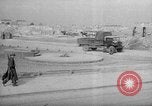
Ruined buildings outside Warsaw, and the first memorial to the Warsaw Ghetto uprising in Poland
Scenes shortly after the end of World War 2. View of the mostly cleared rubble and ruins in Warsaw, Poland, near the intersection of Anielewicza Street, Karmelicka Street, Lewartowskiego Street and Zamenhofa Street in the devastated Warsaw Ghetto district of Muranów, near where the first armed clash of the uprising occurred. Two soldiers walk by on a sidewalk beside the round memorial on the street corner. A truck is parked on an intersecting street. There are mostly open sight lines into the distance with all buildings having been destroyed. A horse cart moves along the road. A jeep with soldiers pass along the road. Closer views of the first memorial to the Warsaw Ghetto Uprising (also later called the Monument to the Ghetto Heroes), designed by Leon Suzin. Views of the inscription on the stone memorial, dated April 19,1946, and commemorating Polish Jews who fought against German military forces in World War 2. Translated, it reads, "To those who fell in an unprecedented and heroic struggle for the dignity and freedom of the Jewish people, for a free Poland, and for the liberation of mankind. Polish Jews." Some flowers laying at the memorial site. (The round 1946 memorial tablet, with its shape symbolizing the underground manholes used during the uprising, was later incorporated into the larger Monument to the Ghetto Heroes, sculpted by Nathan Rapoport and unveiled in 1948.)
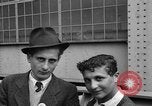
Refugees and displaced persons arriving in New York from aboard the SS Marine Flasher, arriving from Bremerhaven Germany
Arrival of displaced persons and refugees of World War 2 in New York, after the war. Men, women, and children arriving at New York City on May 20, 1946 after a voyage that departed Bremerhaven Germany on May 11, 1946. People greet relatives at the dock in New York. Two young men and a girl stand together and show the concentration camp tattoos on their arms. The tattoo numbers are A9496 on the young man with the hat, A13889 on the girl, and B3073 on the young man without a hat. The young man with tattoo B3073 is Berel Gola (later called Bernard Gola) a 20 year old Jewish man from Poland. He had been imprisoned by the Nazis at Treblinka and at the Auschwitz Concentration Camp, where he received the tattoo. A woman and a man holding a young girl stand. Women holding children stand by. A man holding a young child. People debarking from the ship. People crowd at the dock. They meet their relatives. People stand behind a fence. A woman greets her relative. An emotional woman cries when reunited with relatives.
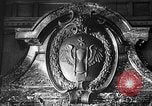
Nuremberg Trials reveal the Nazi enslavement of people in occupied countries and atrocities against Jewish people during World War II.
Opening scene, in 1946, is the courtroom where Nazi officials are being tried for war crimes at the Palace of Justice in Nuremberg, Germany, where the procecutor has completed charges 3 and 4, concluding the indictment against them. Sitting in first row of the dock are Hermann Göring (or Goering) (hidden behind soldier), Rudolf Hess, Joachim Von Ribbentrop, and William Keitel. The camera focuses on Fritz Sauckel, as he is identified as the Nazi slave labor chief. Supporting documents are shown. Film footage scenes of slave workers being rounded up and working on shipping docks, emptying rail cars, repairing railroads, and digging in open pit mines, under Nazi military guard. Next are shown views of Hermann Goering walking in an occupied village in 1942, overseeing the confiscation of all of the livestock. German soldiers releasing and rounding-up cattle, sheep, and pigs that had belonged to citizens of an occupied village. Dr. Wilhelm Frick is shown. He is charged with eliminating elderly, insane, or uncurable sick Germans, considered "Useless Eaters" and subject to Nazi euthanasia programs. Several frail and sick or mentally disabled persons are shown. Crosses are shown marking burial places of these persons outside the institutions in which they died. Next, several German Jewish men in civilian clothes are seen rushing to a work site where they are put to work as slave labor digging with shovels under direction of a Nazi military officer. Scene shifts to Nazi Storm Troopers (Sturmabteilung) harrassing German Jewish shopkeepers, writing anti Jewish messages on the windows, encouraging boycott, and preventing their businesses from operating. More views of Nazi Storm Troopers causing trouble in the streets. Next scene is Hermann Goering reading some dictates as Hitler and Hess, along with other Nazi officials, sit in attendance. The so called "blood purity" rules or blood purity laws of the Nuremberg Laws define German citizens narrowly and prohibit marriage between "German Citizens" and Jews. An unseen audience roars its approval. Jewish people are next seen being rounded up and beaten, mistreated, harassed, and evicted from home. Back at the trial, the prosecutor speaks of Nazi SS Brigadier General Jürgen Stroop cleaning out the Warsaw Ghetto, in Warsaw, Poland, in utter ruthlessness in 1943. Scenes of Polish Jews people being driven and dragged out by SS and Gestapo forces, many unclothed, and the entire place being dynamited afterward. View of a detonation system, and then a huge explosion and walls of the Warsaw ghetto in Poland area are seen crumbling to the ground. Buildings burning and people leaving with injured on a stretcher. Scenes of Nazi agents, Gestapo, and Wehrmacht Army chasing Jews from sewers using tear gas and driving them from buildings using light tanks and armored vehicles. Jews are rounded up, beaten with clubs, and dragged by Nazi German SS and Gestapo authorities who capture them. Back in the courtroom, Rudolf Hess is seen describing how Nazi doctors would screen arrested Jews as they entered concentration camps. Views of crowds of Jews entering a concentration camp near a railroad train depot. A large group of Jewish children at a camp. Children hold up their arms and the boys and girls reveal tattoo numbers on their arms. More views of women and children moving through outside paths of a concentration camp, surrounded in barbed wire and fencing. Views of so-called camp shower baths in which prisoners were killed by poison gas. Clothing of prisoners hanging outside the gas chambers, which the prisoners were told were delousing chambers. Views of the gas chamber shower heads and gas output vents. Views of naked prisoners, some seated and some laying down, inside a gas chamber. View of dead, naked prisoner bodies stacked up in a room. View of bags filled with gold from rings and teeth of the dead. Canvas bags and chests containing the teeth and gold jewelry, held in the Reichs Bank. Closeup of corpses. Bodies being loaded and unloaded from flatbed trucks and being dragged by camp inmates and German soldiers, and thrown into mass graves.
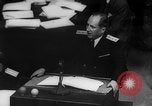
View of the Nazi Concentration Camps and its victims, and other atrocities committed by Nazi forces in World War 2.
Images and testimony related to the Nuremberg Trials held at the Palace of Justice in Nuremberg, Germany in October 1946. Flashbacks of a variety of Nazi crimes against humanity during the years of World War II. Reference to testimony of Kenaris and Hans Frank in describing Nazi policies and methods for exterminating Poles and others. Pictures recording the implementation and results of Nazi policies; atrocities and murder of victims in Ouradour Sur Glane in France, in Bande in Belgium, in the Catacombe of San Callisto in Italy and in Czechoslovakia. Nazi German soldiers seen leveling and destroying the town of Lidice in Czechoslovakia in 1942, after massacre of many residents, in retaliation for the assassination of SS Reich Protector Reinhard Heydrich. Corpses of the victims of the Nazi concentration camps, including Auschwitz, in 1945. Bones of humans in crematory ovens. Cramped starved women camp victims inside barracks. Stacks of luggage and suitcases of victims at a concentration camp, along with locks of hair, stacks of toothbrushes. Shaving cream brushes, shoes, clothing, and finally, piles of bones of camp victims. Testimony of Rudolf Franz Ferdinand Höss (sometimes spelled Höß or Hoess or Hess) describes concentration camps at Auschwitz in Poland. As scenes of victims in hospitals are shown, testimony of Rudolf Hoess is read, describing medical experiments include lowering the body temperature, injecting the body with poisons and infectious diseases and subjecting the body to high altitude pressure chambers. Shows pile of mutilated corpses.The "Arbeit Macht Frei" sign over the camp entrance of Auschwitz. Scenes of dead victims of Nazi brutality in the concentration camps.
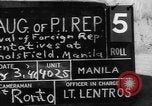
Representatives of Brazil, Argentina and Poland arrive for inauguration ceremony of Republic of the Philippines.
Inauguration of the Republic of the Philippines after the end of World War II. A man with a pet dog. Delegates at a field and pose for camera. Representatives of Brazil, Argentina, and Poland disembark from a U.S. plane. Unidentified U.S. Senators and delegates at Nichols Airfield in Manila. View of a civic parade.
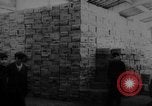
UNRRA personnel distribute food and clothes donated by the United States to people facing hunger in Poland after WW2
Polish men, women, and children receive new clothing and food from the United States through the UNRRA (United Nations Relief and Rehabilitation Administration) after World War 2. In Europe, men unload relief aid boxes from UNRRA. UNRRA personnel distributes clothing from America to Polish men. Polish women sort through a box of shoes donated by the United States. A Polish woman dresses her boy with new clothes received from UNRRA. Smiling children after receiving new set of clothes. Polish boys smiling. A female UNRRA personnel distributes food to hungry children. A Polish boy licks off sauce from a can of food. Boy consumes food straight from the carton. A young Polish boy eats a chocolate bar. Polish children walk by ruined buildings destroyed from bombings in World War 2. Children joyfully running down a wrecked city street.